



- Home
- /
- High Courts
- /
- High Court of J & K and Ladakh
- /
- Revenue Authorities Cannot Refuse...
Revenue Authorities Cannot Refuse To Issue Revenue Extracts Unless Barred By Court Order Or Competent Authority: J&K&L High Court
LIVELAW NEWS NETWORK
6 Oct 2026 8:10 PM IST
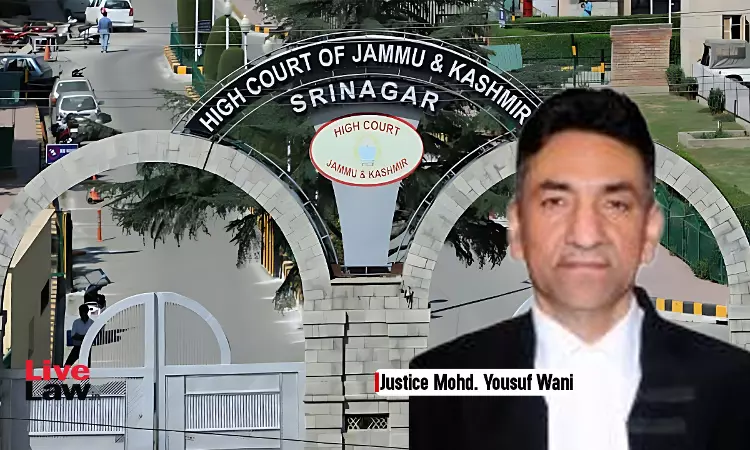
The Jammu & Kashmir and Ladakh High Court has held that revenue authorities cannot refuse to issue revenue extracts/Fards strictly in accordance with the available revenue records, unless their issuance is expressly barred by an order of a Revenue Court, Civil Court or other competent authority passed in litigation.The Court clarified that issuing a revenue extract does not authorise...
This is a premium content
Available exclusively to
Our subscribers
Subscribe Premium 
INR 1099+GST
Your support helps us to bring you more content at
an affordable subscription scheme !!!
All payment options available
The Jammu & Kashmir and Ladakh High Court has held that revenue authorities cannot refuse to issue revenue extracts/Fards strictly in accordance with the available revenue records, unless their issuance is expressly barred by an order of a Revenue Court, Civil Court or other competent authority passed in litigation.
The Court clarified that issuing a revenue extract does not authorise any alteration of the existing revenue entries. The authorities may, however, incorporate relevant court directions, orders or government instructions by way of a footnote in the extract.
The Court was hearing a writ petition filed by one Sheikh Rafiq Ahmad and Rifat Rafiq, who sought directions to the revenue authorities to issue Fards concerning land at Baghat Barzulla, Srinagar, after the Tehsildar South allegedly refused to issue the documents on the ground that the village map/Aksa Latha was unavailable.
Justice Mohd Yousuf Wani observed, “There should be no hesitation in issuance of a revenue extract/Fard strictly as per the available revenue record.”
The petitioners claimed ownership and possession of land situated at Baghat Barzulla, Srinagar, on the basis of a sale deed. They stated that, after obtaining the requisite building permission, they had constructed a commercial building on the property and rented out portions of it to tenants.
According to the petitioners, the tenants were insisting on the execution of formal rent or lease deeds, for which revenue extracts/Fards were required. The petitioners stated that they had applied online for the documents and repeatedly approached the revenue authorities, but the Tehsildar South, Srinagar, declined to issue them because the village map/Aksa Latha was unavailable in the Tehsil office.
The petitioners also relied on a communication issued by the Divisional Commissioner, Kashmir directing Deputy Commissioners to ensure the delivery of services in accordance with standing orders and to take measures for the recreation of missing or dilapidated Massavies as per the applicable norms.
Their counsel argued that the failure to issue the extracts within the stipulated period violated the Jammu and Kashmir Public Services Guarantee Act, 2011. It was also contended that the refusal prevented the petitioners from using and enjoying their property, thereby infringing their rights under Article 300-A of the Constitution.
Court's Observations:
The High Court observed that the Revenue Department, being the custodian of land records, could not refuse to issue revenue extracts except where their issuance was expressly and specifically barred by an order of a Revenue Court, Civil Court or other competent authority passed in litigation.
The Court held that the officials authorised to issue revenue extracts could incorporate any relevant factual or legal point considered necessary to be recorded in the document, but could not refuse its issuance altogether.
The Court observed, “The mere issuance of revenue extracts/Fards cannot be used to change the recorded entries except strictly in accordance with the law.”
It further clarified that the authorities entrusted with maintaining revenue records had no authority to refuse applicants extracts reflecting the available record. Where necessary, relevant court directions, orders or government instructions could be mentioned in a footnote so that the authorities before whom the documents were subsequently produced could take note of them.
The Court also observed that the need for a revenue extract was not confined to persons whose names appeared in the revenue records. It noted that even a person who was neither a recorded owner nor otherwise had an interest in the immovable property might need an extract to initiate legal proceedings for enforcement of rights allegedly acquired through a legal transaction.
The Court observed,
“The practice teaches that in day-to-day human transactions even a person who is not a recorded owner or otherwise having any interest in the immoveable property can even feel an urgent need to apply for issuance of revenue extract/Fard in respect of the property recorded in the name of others so as to enable him to take action under law for enforcement of his rights, alleged to have been accrued to him under any legal transaction(s).”
The Court also took note of the Divisional Commissioner's communication which required Deputy Commissioners of Kashmir Division to ensure compliance with government instructions and clarifications, including those relating to the Public Services Guarantee Act.
Examining the documents produced by the petitioners, the Court noted that the registered sale deed and Khasra Girdawari reflected their ownership and possession of the land. It held that the matter could be disposed of at the threshold stage by directing the authorities to discharge their statutory duty.
Accordingly, the Court disposed of the writ petition along with the connected application and directed the respondents, particularly the Tehsildar South, Srinagar, to issue the revenue extracts/Fards already applied for by the petitioners in accordance with the applicable rules.
The Court directed that the necessary extracts be issued within one week from the date a copy of the order was submitted to the Tehsildar's office.
Case Title: Sheikh Rafiq Ahmad and Another v. Union Territory of Jammu & Kashmir and Others
Citation: 2026 LiveLaw (JKL) 441
Appearances
Petitioners: Nissar Ahmad, Advocate.


