



School Discharge Certificate Prevails Over Medical Opinion In Determining Candidate's Age: J&K&L High Court
LIVELAW NEWS NETWORK
14 Oct 2026 8:15 PM IST
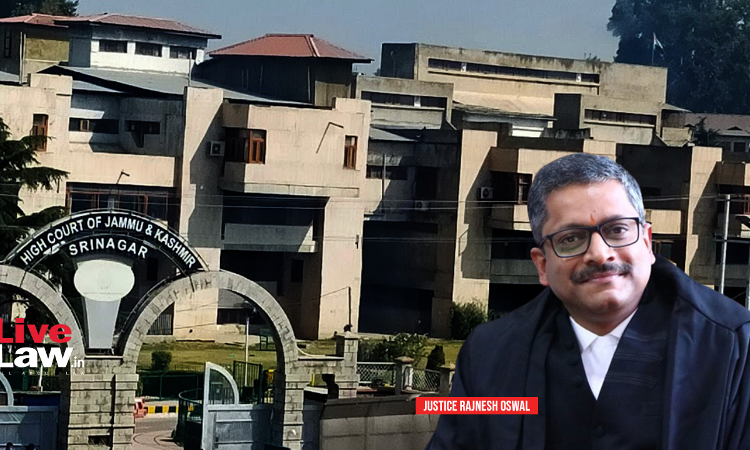
Where a school discharge certificate based on official academic records is available, a medical opinion cannot be relied upon to determine a candidate's age, the Jammu & Kashmir and Ladakh High Court has held while dismissing a plea challenging the cancellation of a woman's provisional selection as an Aaya/Helper in a government school.
Justice Rajnesh Oswal held that the authorities were justified in cancelling the petitioner's provisional selection after her school qualification certificate showed that she had not attained the minimum prescribed age of 18 years by the cut-off date. The Court observed that the medical certificate assessing her age at 23 years could not override the documentary evidence contained in her school records.
“The contention pales into insignificance when weighed against the documentary evidence on record,” the Court observed, referring to the provisional-cum-discharge certificate issued by the Headmaster of Government High School.
The Court was hearing a writ petition filed by Mst. Sakeena Banoo challenging a corrigendum dated February 17, 2023, through which the authorities cancelled her provisional selection for the post of Aaya/Helper at Primary School Jabda and provisionally selected another candidate in her place.


The petitioner had applied for the post pursuant to an advertisement notification dated January 18, 2023, and figured at serial number 12 in the tentative selection list. However, following the publication of the list and an invitation for public objections, an objection was raised alleging that she was underage.
Upon re-examination, the Scrutiny and Selection Committee found that although the petitioner had mentioned her date of birth as May 15, 2003, in her application form, her eighth-standard qualification certificate recorded her date of birth as March 4, 2005.
Under the applicable guidelines issued by the Director, Samagra Shiksha, on January 9, 2023, candidates were required to have attained 18 years of age as of January 1, 2023.
Calculating her age on the basis of the educational record, the committee found that the petitioner was 17 years, 9 months and 28 days old on the cut-off date and was, therefore, ineligible for selection.
Consequently, the authorities issued the corrigendum cancelling her provisional selection and provisionally selected respondent number four, who had the lowest annual income among the remaining eligible candidates.
Challenging the decision, the petitioner contended that the Chairman of the Medical Board had issued an age-determination certificate assessing her age at 23 years and that her selection ought to have been sustained on that basis.
She also submitted that her annual income did not exceed ₹50,400, whereas the selected candidate's annual income was ₹74,000, and claimed that she had a superior right to the post.
Court's Observations
Rejecting the petitioner's reliance on the medical certificate, the Court held that the documentary evidence furnished by the school was decisive in determining her age.
Justice Oswal noted that the provisional-cum-discharge certificate issued by the Headmaster of Government High School, Nagasari, Kalaroos, explicitly recorded the petitioner's date of birth as March 4, 2005.
The Court held,
“It is a settled position of law that where a school discharge certificate based on official academic records is available, a medical opinion cannot be relied upon to determine a candidate's age.”
The Court further observed that the petitioner's assertion in her application form that she was born on May 15, 2003, remained “wholly uncorroborated by any educational or requisite qualification certificate.”
In view of the documentary evidence, the Court held that the official respondents had acted within their authority in issuing the corrigendum and that the decision suffered from no legal or factual infirmity.
Finding no merit in the petition, the High Court dismissed it.


