



'Amounts To Forgery': J&K&L High Court Upholds Charges Against Man Accused Of Using Forged Records To Secure Bank Loan
LIVELAW NEWS NETWORK
6 Oct 2026 6:35 PM IST
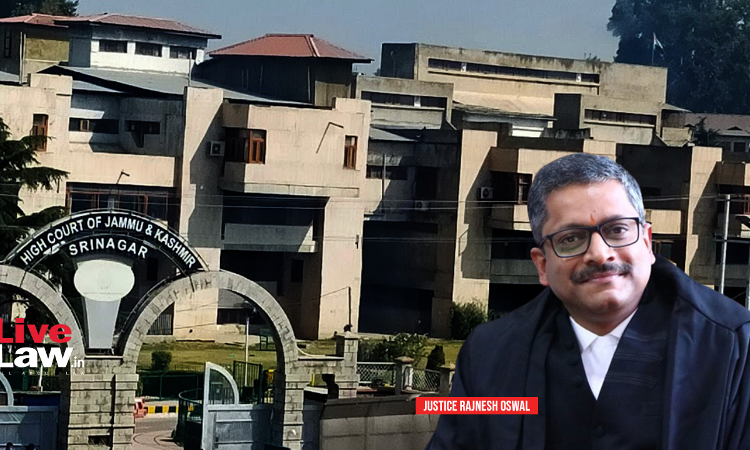
The Jammu & Kashmir and Ladakh High Court has held that a person need not forge another person's signature to attract the offence of forgery, observing that signing one's own name can amount to forgery in certain circumstances, including where a document is created with an intent to defraud.
The Court accordingly upheld the charges framed against one Ashok Singh Manhas in a case alleging that he, in connivance with a Patwari and others, used forged revenue documents to portray himself as the exclusive owner of land and thereby obtain bank loan facilities.
The Court was hearing a petition filed by Manhas seeking quashing of the CBI FIR, charge sheet and the order of the Special Judge, Anti-Corruption (CBI Cases), Jammu, whereby he was charged under Sections 120-B, 420, 467, 468 and 471 RPC and Section 5(1)(d) read with Section 5(2) of the J&K Prevention of Corruption Act.
Justice Rajnesh Oswal observed, “Thus, an accused need not forge another person's signature; signing one's own name can still amount to forgery under certain circumstances.”


The petitioner was one of the partners of M/s Shiva Overseas. The prosecution case was that he and his partner had applied for a credit-cash limit from UCO Bank by offering land as collateral security, although the land was allegedly not owned by the petitioner in the manner represented in the documents submitted to the bank.
The investigation revealed that revenue documents had been prepared showing the petitioner as the exclusive owner of four kanals and five marlas of land under Survey No. 90-min, whereas the revenue record showed him only as a minor co-sharer along with other members of the family.
The petitioner had challenged the proceedings primarily on the ground that the allegations did not constitute the offences alleged against him. He also questioned the constitution and jurisdiction of the CBI in the erstwhile State of Jammu and Kashmir and relied upon the pendency before the Supreme Court of a challenge concerning the validity of the CBI's constitution.
The petitioner further contended that a civil suit concerning the mortgage deed was already pending before the Sub Judge, Jammu, before registration of the FIR. He argued that the CBI could not routinely investigate matters falling within the domain of State agencies and that the allegations of forgery and cheating were not made out against him.
The CBI opposed the petition, submitting that the Government of Jammu and Kashmir had accorded consent under the Delhi Special Police Establishment Act and that the CBI had been registering and investigating cases in the erstwhile State since 1958. It was also submitted that the issue regarding the constitution of the CBI was already pending before the Supreme Court and that disputed questions of fact could not be examined at the stage of framing of charges.
Court's Observations:
The High Court first considered the challenge to the constitution and jurisdiction of the CBI. It noted that the judgment of the Gauhati High Court relied upon by the petitioner had been stayed by the Supreme Court and that the parties were at ad idem on this aspect.
The Court agreed that the challenge to the constitution of the CBI should be deferred until the Supreme Court decided the pending matter. It directed that further proceedings arising from the charge sheet would remain subject to the outcome of the proceedings pending before the Supreme Court.
The Court thereafter examined the allegations against the petitioner and the material collected during investigation.
According to the charge sheet, the petitioner and his partner had applied for a ₹50 lakh credit-cash limit by offering land measuring four kanals and five marlas under Survey No. 90-min as collateral security. The prosecution alleged that the land did not belong to the petitioner in the manner represented and that forged revenue documents had been prepared to support the claim.
The investigation revealed that the concerned revenue documents were forged and that Mohd. Maqbool, the then Halqa Patwari, Chak Changerwan, was allegedly the author of the forged documents. The investigation further alleged that ₹40,000 had been paid to him as bribe by the petitioner.
The revenue record showed that land under the relevant survey number was held by the petitioner's ancestors and that, after transfers, the remaining land continued to be held jointly by members of the family. The petitioner was only a co-sharer with a minor share.
The Court noted that the investigation had also found that the remaining land had been used as paths and roads by inhabitants of the area and that there was no vacant plot corresponding to the property shown in the forged revenue documents.
The investigation further revealed that two forged Fard Intekhab and Dasti Khakas had been prepared in November 2008 and that the forged revenue documents were signed by the concerned Patwari, attested by the then Naib Tehsildar and forwarded for countersignature to the Tehsildar.
The prosecution also alleged that the petitioner had shown a plot falling under Survey No. 14, actually owned by another person, as his own property under Survey No. 90-min to the approved valuer. During a pre-sanction inspection, the same property was allegedly shown to the bank officials as the petitioner's property.
The Court noted that a joint inspection conducted in July 2011, along with the original revenue records and other material, showed the actual position of Survey No. 90.
The Court then examined whether the issuance and use of the allegedly false revenue extracts could constitute the making of a false document for the purposes of the offence of forgery.
Referring to Section 464 RPC and the illustrations appended to it, the Court observed, “Furthermore, illustrations (e) and (h) make it clear that a person can commit forgery in respect of a document executed by himself.”
The Court relied upon the Bombay High Court's judgment in Bharat Hiralal Sheth and others v. Jaysin Amarsinh Sampat and another (1997), which had considered Illustrations (e) and (h) and Explanation 1 to Section 464 RPC.
The High Court noted that the Bombay High Court had held that the legislature intended to cover cases of forgery even where the person was the creator of a document made by himself and signed in his own name.
Applying that principle to the case before it, the Court observed that the allegations against the Patwari were that he had issued revenue extracts contrary to the official revenue record and that those documents were used by the petitioner and other accused for obtaining a loan.
The Court held, “By issuing these fraudulent revenue extracts in violation of official records, the accused Patwari committed the offence of making a false document within the meaning of Section 464 of the R.P.C.”
As against the petitioner, the Court noted that he had been arrayed as an accused by invoking Section 120-B RPC and found that, at that stage, there was nothing to establish that he had not committed the alleged offence of forgery in connivance with the Patwari.
The Court also considered the allegation that the petitioner had represented a plot situated under Survey No. 14 as his own property situated under Survey No. 90-min.
It held that, in view of the prosecution case and the material collected during investigation, the petitioner could not be held innocent at that stage. The Court observed that the alleged act prima facie established the offence of cheating.
The Court also found the authorities relied upon by the petitioner distinguishable and inapplicable to the facts and circumstances of the case.
Examining the order of the trial court, the High Court concluded that the trial court had rightly framed charges against the petitioner for the offences alleged.
Accordingly, the Court disposed of the petition while directing that the issue concerning the constitution of the CBI would remain subject to the decision of the Supreme Court in the pending matter.
The Court directed the trial court to proceed with the trial, noting that the proceedings had remained stayed for nearly 13 years. It further directed that no unnecessary adjournments be granted to the parties.
Case Title: Ashok Singh Manhas v. Union of India & Ors.
Citation: 2026 LiveLaw (JKL)
Appearances
Petitioner: Himanshu Beotra, Advocate.
Respondents: Monika Kohli, Senior AAG, with Sagira Jaffer, Advocate.


