



- Home
- /
- High Courts
- /
- High Court of J & K and Ladakh
- /
- State Must Pay Compensation For...
State Must Pay Compensation For Continued Use Of Private Land For Water Pipelines, Even If Laid Before Purchase: J&K&L High Court
LIVELAW NEWS NETWORK
6 Oct 2026 2:30 PM IST
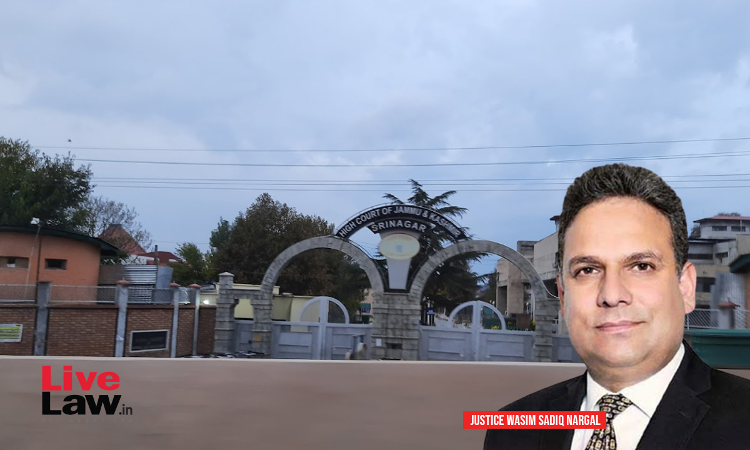
The High Court of Jammu & Kashmir and Ladakh has held that a landowner cannot be denied compensation merely because water pipelines were laid through the property before its purchase.It observed that the State's power to provide essential public services does not permit it to continue using private property indefinitely without addressing the owner's lawful claim to compensation...
This is a premium content
Available exclusively to
Our subscribers
Subscribe Premium 
INR 1099+GST
Your support helps us to bring you more content at
an affordable subscription scheme !!!
All payment options available
The High Court of Jammu & Kashmir and Ladakh has held that a landowner cannot be denied compensation merely because water pipelines were laid through the property before its purchase.
It observed that the State's power to provide essential public services does not permit it to continue using private property indefinitely without addressing the owner's lawful claim to compensation and use-and-occupation charges.
The Court was hearing a writ petition filed by Haleema and another seeking removal of underground and above-ground water pipelines and associated concrete structures from land in Tehsil Pattan. Alternatively, the petitioners sought compensation for the continued use of their land or initiation of lawful acquisition proceedings.
A Single Bench of Justice Wasim Sadiq Nargal observed that the continued use of private land for public infrastructure must be consistent with the constitutional protection of property under Article 300-A.
The Court held,
“The State may legitimately utilise private property for the purpose of providing essential public services, but such utilisation must have the authority of law and cannot result in the owner being compelled to bear, without lawful compensation, the entire burden of a facility intended to serve the public at large.”
The petitioners claimed ownership of the land on the strength of sale deeds and alleged that the Public Health Engineering Department had laid water pipelines of different dimensions across it, along with concrete structures used to control water distribution. They contended that the infrastructure had substantially restricted their use of the property.
According to the petitioners, the department had indicated that an alternative parcel of land would be identified and that they would be appropriately compensated. However, despite representations no effective action was taken.
The department opposed the claim, maintaining that the pipelines had been laid decades before the petitioners purchased the land in 2012, when the land was reportedly vacant. It also argued that the Jammu and Kashmir Water Resources (Regulation and Management) Act, 2010, did not provide compensation merely because a pipeline passed through the property.
Court's Observations:
The Court first examined Section 12 of the Jammu and Kashmir Water Resources (Regulation and Management) Act, 2010, which empowers the Government to lay or carry water pipelines through, across, under or over specified public and private premises. It noted, however, that this power is accompanied by statutory safeguards.
Section 12(2) provides for compensation where an owner or occupier suffers damage as a result of operations undertaken under the provision. Section 12(4), meanwhile, requires pipelines to be laid sufficiently underground to safeguard the owner's or occupier's use of the land. The Court read these provisions alongside Sections 88 and 89, which deal with compensation for damage and the procedure for assessing and awarding it.
The Court held that the statutory power to lay pipelines is not unqualified. The department's reliance on the fact that the pipelines predated the petitioners' purchase could not, by itself, defeat their claim.
Referring to Section 8 of the Transfer of Property Act, 1882, the Court explained that a transfer ordinarily passes to the transferee the interests and legal incidents attached to the property. It observed that the petitioners' subsequent acquisition of the land did not automatically extinguish any claim arising from the continuing impact of the pipelines on the property.
The Court clarified,
“The fact that the petitioners were not the owner of the land when the pipes were originally laid does not, by itself, disentitle him from claiming compensation in respect of the impact occasioned to the land.”
It further noted that the pipelines remained in place and continued to be used for water supply. The interference with the petitioners' property was, therefore, continuing rather than a one-time use. In the absence of compensation for such continued use, the department could not defeat the claim solely on the ground that the infrastructure had been installed before the land was purchased, the bench maintained.
The Court also considered the constitutional protection of property under Article 300-A. Relying on the Supreme Court's judgment in Vidya Devi v. State of Himachal Pradesh, (2020) 2 SCC 569, it reiterated that the State cannot deprive a person of property except by authority of law and that the obligation to pay compensation can be inferred from Article 300-A.
The Court referred to decisions of the High Court in Shabir Ahmed Yatoo v. UT of J&K, WP(C) No. 174/2021, and Chuni Lal Bhagat v. State of J&K, concerning the protection of private property and compensation where land is used by the State without following the prescribed legal procedure.
At the same time, the Court recognised that access to water is an essential public necessity, implicating the right to life and human dignity. It clarified that the right to provide water and the right to property must be read harmoniously, rather than treating one as automatically overriding the other.
The Court observed that “the constitutional protection of property under Article 300-A cannot be rendered illusory merely because the property is required for a public purpose.” The State may use private property for essential public services, but it cannot indefinitely place the entire burden of that infrastructure on the landowner without lawful compensation, it underscored.
The Court left the precise extent of damage, the area actually occupied by the pipelines and structures, and the amount of compensation to be determined by the competent authority under the statutory mechanism. It also held that if the department intended to continue using the land, the petitioners' claim for reasonable rent or use-and-occupation charges required consideration.
Accordingly, the Court directed the Chief Engineer, PHE, Kashmir, to constitute a committee under Section 89 of the 2010 Act within two weeks of receiving the judgment. The committee must conduct a spot inspection, examine the relevant revenue and departmental records, determine the area being used or occupied, and assess the nature and extent of any damage.
The Court further directed that, if the land is to be permanently retained, the authorities must examine the need to initiate acquisition proceedings under the applicable law. Any amount determined as payable must be paid within the period specified by the competent authority's order; failure to pay within that period would attract interest at 6% per annum, subject to the final determination of entitlement, from the date of purchase in 2012 until actual payment.
Clarifying that it had not determined the precise compensation, extent of damage or quantum of use-and-occupation charges, the Court disposed of the writ petition and connected applications in these terms.
Case Title: Haleema and Another v. State of Jammu and Kashmir and Others
Citation: 2026 LiveLaw (JKL) 438
Appearances
For the petitioners: Manzoor Ahmad Dar, Advocate.
For the respondents: Jahangir Ahmad Dar, Government Advocate.


