



- Home
- /
- High Courts
- /
- High Court of J & K and Ladakh
- /
- Sub-Registrar Cannot Examine...
Sub-Registrar Cannot Examine Legality Or Merits Of Document, Powers Confined U/S 34(3) Registration Act: J&K High Court
LIVELAW NEWS NETWORK
3 Sept 2026 3:20 PM IST
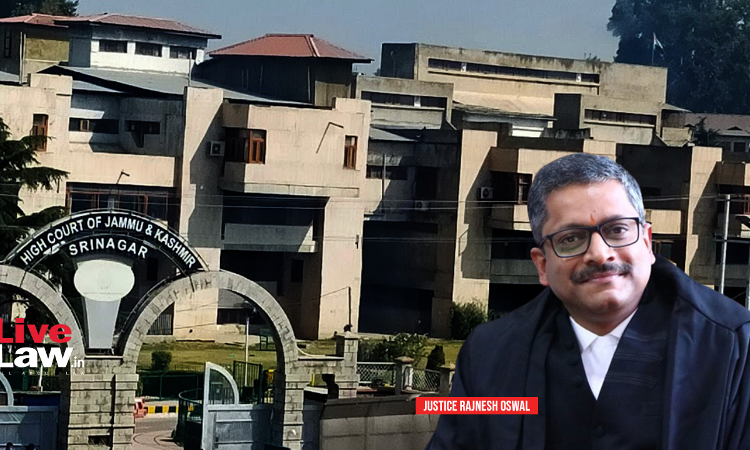
The High Court of Jammu & Kashmir and Ladakh has held that the powers and domain of the Sub-Registrar are strictly governed and bounded by Section 34(3) of the Registration Act, 1908, which is confined to satisfying himself as to the execution of the document by the person purporting to execute it and his/her identity.The Court further held,“…..While the Government has promulgated...
This is a premium content
Available exclusively to
Our subscribers
Subscribe Premium 
INR 1099+GST
Your support helps us to bring you more content at
an affordable subscription scheme !!!
All payment options available
The High Court of Jammu & Kashmir and Ladakh has held that the powers and domain of the Sub-Registrar are strictly governed and bounded by Section 34(3) of the Registration Act, 1908, which is confined to satisfying himself as to the execution of the document by the person purporting to execute it and his/her identity.
The Court further held,
“…..While the Government has promulgated the Jammu and Kashmir Registration (Identity Verification for Registration of Documents) Rules, 2023 to operationalize Section 34, these Rules do not empower the Sub-Registrar to inquire into or decide upon the legality, validity, or merits of the document submitted for registration”
Justice Rajnesh Oswal made the observations while allowing a petition filed by Muzaffar Hussain Rather, who had approached the Sub-Registrar for registration of a deed revoking a General Power of Attorney executed in 2009. The Sub-Registrar had neither registered the revocation deed nor passed a reasoned order refusing registration, while advising the petitioner to approach a civil court.
Examining Section 34(3) of the Registration Act, the Court noted that the Registering Officer is required to enquire whether the document was executed by the person by whom it purports to have been executed, satisfy himself regarding the identity of the person appearing before him and, where applicable, the authority of a representative, assign or agent.
Justice Oswal held that the statutory framework does not confer any adjudicatory jurisdiction upon the Sub-Registrar. The Court observed that the 2023 Rules merely operationalise the identity-verification requirements and do not enlarge the statutory powers of the registering authority.
Relying upon the Supreme Court's judgment in K. Gopi v. Sub-Registrar, the Court noted that “the registering officer is not concerned with the title held by the executant” and has no adjudicatory power to determine whether the executant possesses title. Once procedural requirements are fulfilled and execution is admitted, the document is required to be registered.
The Sub-Registrar had relied upon a Government order deleting the entry relating to “Cancellation of Instrument” from the registration checklist and contended that the NGDRS portal also had no separate category for registration of a revocation of power of attorney.
The High Court rejected this reasoning, observing that the Government order was intended to prevent Sub-Registrars from raising piecemeal objections and demanding additional documents, and to promote a citizen-centric registration system. The subsequent deletion of the checklist entry could not be construed as taking away the statutory jurisdiction to register a revocation of power of attorney, the bench opined.
The Court was particularly critical of the decision to keep the document pending instead of taking a decision in accordance with the Registration Act. Justice Oswal observed,
“Respondent No. 2 exercises purely ministerial duties under the provisions of the Registration Act, 1908, and possesses no adjudicatory or advisory power under the statutory framework.”
The Court further held that advising the petitioner to resort to civil remedies for cancellation of the power of attorney amounted to acting beyond the Sub-Registrar's statutory mandate. Keeping the revocation deed pending was described as “antithetical to public service” and reflective of an “unwarranted, citizen-frustrating approach.”
The Court also clarified that merely describing a power of attorney as “irrevocable” does not make it legally irrevocable. Relying upon the Supreme Court's decision in M.S. Ananthamurthy v. J. Manjula, the Court noted that an agency becomes irrevocable only where the attorney holder has an independent interest in the subject matter. “Mere use of the word 'irrevocable' in a POA would not make the POA irrevocable”, the court underscored.
The Court also rejected the contention that the petitioner must first institute a civil suit for cancellation of the instrument. The Court held that the substantive validity of the GPA and the ministerial act of registering its revocation are distinct matters. The absence of a specific revocation category on the NGDRS portal could not, by itself, justify delaying or denying registration.
Allowing the petition, Justice Oswal directed the Sub-Registrar to register the revocation document within seven days from receipt of the order, provided there was no other legal impediment.
Case Title: Muzaffar Hussain Rather v. Union Territory of J&K & Ors.
Citation: 2026 LiveLaw (JKL) 377


