



- Home
- /
- High Courts
- /
- High Court of J & K and Ladakh
- /
- Trap Laying Officers Must...
Trap Laying Officers Must Independently Corroborate Alleged Demand Before Proceeding: J&K&L High Court Acquits Accused In Corruption Case
LIVELAW NEWS NETWORK
26 Aug 2026 12:17 PM IST
The High Court of Jammu & Kashmir and Ladakh has set aside the conviction of a public servant in a corruption case, holding that the prosecution failed to prove initial demand of bribe beyond reasonable doubt.The Court observed that the Trap Laying Officer had not made any effort to verify the factum of initial demand before proceeding to lay trap, and the complainant's testimony...
This is a premium content
Available exclusively to
Our subscribers
Subscribe Premium 
INR 1099+GST
Your support helps us to bring you more content at
an affordable subscription scheme !!!
All payment options available
The High Court of Jammu & Kashmir and Ladakh has set aside the conviction of a public servant in a corruption case, holding that the prosecution failed to prove initial demand of bribe beyond reasonable doubt.
The Court observed that the Trap Laying Officer had not made any effort to verify the factum of initial demand before proceeding to lay trap, and the complainant's testimony was uncorroborated and unreliable given the previous discord between him and the accused.
The Court was hearing a criminal appeal filed against the judgment passed by the Special Judge Anticorruption, Kashmir, Anantnag, whereby the appellant was convicted of offences under Section 5(1)(d) read with Section 5(2) of the J&K Prevention of Corruption Act and sentenced to two years of simple imprisonment along with fine of Rs. 21,000.
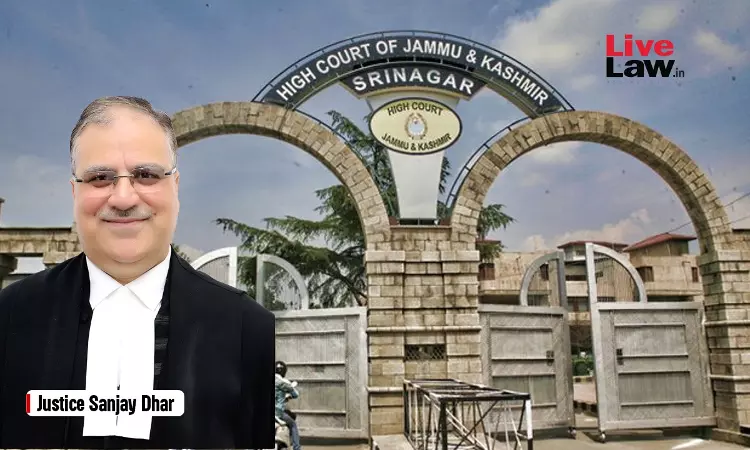
A Bench of Justice Sanjay Dhar, while acquitting the appellant referenced Mir Mustafa Ali Hashmi v. State of Andhra Pradesh, (2024) 10 SCC 489 and observed,
"...It is incumbent upon the Trap Laying Officer to get an independent verification done of the alleged demand and the said fact assumes prominence for ascertaining whether the complainant bore a grudge against the accused."
The Court further observed,
"In the present case, it seems that the Trap Laying Officer has not made any effort to verify the factum of initial demand of bribe by the appellant/accused from the complaint. None of the prosecution witnesses, who were part of the trap proceedings, have stated that any verification or questioning was conducted by the Trap Laying Officer or any other member of the trap team to elicit any information with regard to genuineness of the complaint from the complainant."
It was in 2009, the complainant lodged a written complaint before the Vigilance Organization, Kashmir, alleging that he along with five other Helpers were accorded in-situ promotion. The complainant approached the appellant, who was working as Incharge Establishment in the office of BDO, in connection with preparation of arrears bill. The appellant allegedly demanded Rs.300 per head for preparation of arrears bill, and the complainant collected Rs.1,800 from the Helpers.
A trap team was constituted, and the complainant produced 18 currency notes of Rs.100 denomination. After pre-trap demonstration, the trap team proceeded to the office. The complainant went inside, and after a brief conversation, the appellant allegedly demanded and accepted Rs.1,800 as illegal gratification, keeping it in his trouser pocket. The shadow witness watched from the window. Upon search, the tainted money was recovered from the appellant's pocket.
Charges were framed under Section 5(1)(d) read with Section 5(2) of the PC Act and Section 161 of RPC and the trial court convicted the appellant. Aggrieved, the appellant filed the present appeal.
Court's Observation:
The High Court examined the ingredients required to establish an offence under Section 5(1)(d) read with Section 5(2) of the PC Act ie initial demand of illegal gratification, demand and voluntary acceptance of tainted money during trap proceedings, and recovery of tainted money from the accused.
The Court noted that the complainant's associates, on whose behalf the bribe was allegedly settled, categorically stated that they did not contribute towards the bribe money and that the appellant never demanded any money from them. The Court observed,
"All the above named five officials, on whose behalf the complainant is stated to have settled the bribe money with the appellant/accused, have not supported the version of the complainant, inasmuch as they have categorically stated that neither any demand was made by the appellant/accused from them nor they had contributed their share of the alleged illegal gratification."
The Court noted that the complainant himself contradicted his own complaint, EXTP-1, regarding collection of Rs.300 from each associate. The Court observed,
"Even the complainant himself has contradicted his own narration made in his complaint, EXTP-1, to the extent it relates to collection of Rs.300 each from his other associates. This constitutes a major contradiction in the evidence on record so far it relates to initial demand of bribe by the appellant/accused."
The Court emphasized the importance of independent verification of the alleged demand before laying trap. The Court observed,
"In the present case, it seems that the Trap Laying Officer has not made any effort to verify the factum of initial demand of bribe by the appellant/accused from the complaint. None of the prosecution witnesses, who were part of the trap proceedings, have stated that any verification or questioning was conducted by the Trap Laying Officer or any other member of the trap team to elicit any information with regard to genuineness of the complaint from the complainant."
The Court noted that there was evidence of previous discord between the complainant and the appellant. The Court observed,
"It has come in evidence on record that there was some discord between the complainant and the appellant/accused relating to engagement of his brother as a daily wager and, in fact, one of the witnesses, PW Manzoor Ahmad Mir, has gone to the extent of stating that there was a land dispute between the complainant and the accused."
The Court found the shadow witness's testimony unreliable, as he did not see the exchange of money. The Court opined that from th statement of the shadow witness, it is clear that he has not watched what had actually transpired between the appellant/accused and the complainant. “He has not even heard the conversation exchanged by the two while the complainant was inside the office room of the appellant/accused.", the court remarked.
The Court identified several perversities in the trial court's judgment, including the observation that there was no evidence of initial demand but that did not weaken the prosecution case, and the erroneous recording that the shadow witness confirmed seeing the physical transaction. The Court observed,
"The findings recorded by the learned trial court being not only inconsistent and contrary to each other but the same suffer from perversity. The impugned judgment passed by the learned trial court is, therefore, not sustainable in law, inasmuch as despite noticing the infirmities in the case of the prosecution, it has proceeded to record the judgment of conviction."
The High Court thus set aside the impugned judgment, acquitted the appellant of all charges, and discharged his bail and surety bonds.
Case Title: Habibullah Kumar v. UT of J&K
Citation: 2026 LiveLaw (JKL) 361
Appearances
Appellant: Mr. Gowhar Majeed Dalal, Advocate
Respondent: Mr. Mohsin S. Qadiri, Sr. AAG; Mr. Faheem Nisar, GA


