



- Home
- /
- High Courts
- /
- High Court of J & K and Ladakh
- /
- Umadevi Judgment Not A Shield For...
Umadevi Judgment Not A Shield For Perpetual Temporary Employment: J&K HC
Namdev Singh
14 Dec 2025 3:29 PM IST
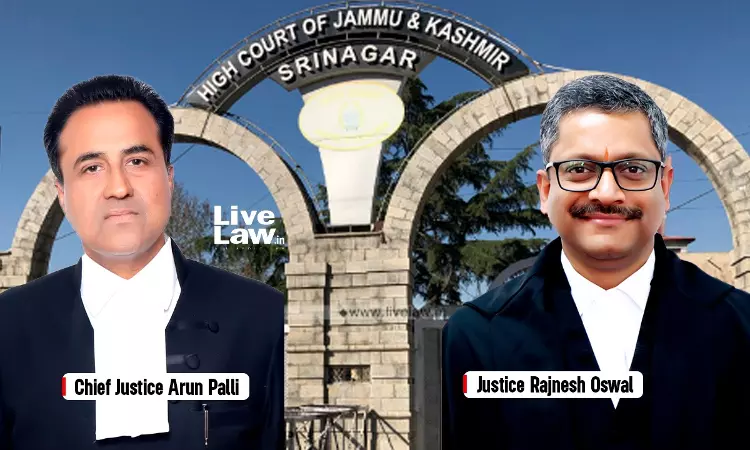
A Division Bench of the Jammu and Kashmir High Court comprising Chief Justice Arun Palli and Justice Rajnesh Oswal held that daily rated worker engaged prior to 31-03-1994 and continuously employed for decades cannot be denied regularization under SRO-64 on the pretext of being a casual labourer. Further, the Umadevi Judgment cannot be invoked to justify perpetual temporary employment...
This is a premium content
Available exclusively to
Our subscribers
Subscribe Premium 
INR 1099+GST
Your support helps us to bring you more content at
an affordable subscription scheme !!!
All payment options available
A Division Bench of the Jammu and Kashmir High Court comprising Chief Justice Arun Palli and Justice Rajnesh Oswal held that daily rated worker engaged prior to 31-03-1994 and continuously employed for decades cannot be denied regularization under SRO-64 on the pretext of being a casual labourer. Further, the Umadevi Judgment cannot be invoked to justify perpetual temporary employment for permanent work.
Background Facts
The respondent was engaged as a Daily Rated Worker in the Public Health Engineering Department. He served continuously for over three decades. After completing seven years of service, he sought regularization of his position under SRO-64 of 1994. The authorities did not act on his request. Subsequently, he filed a writ petition in 2012, which was disposed of with a direction to the department to consider his case. The department rejected his claim in 2022, stating he was engaged as a Casual Labourer and did not meet the criteria. Challenging this rejection, respondent approached the Central Administrative Tribunal, which allowed his application and directed the government to regularize his services with consequential benefits.
Aggrieved by the same, the Union Territory of Jammu & Kashmir and others then filed the writ petition before the High Court.
It was contended by the petitioners that the Tribunal failed to properly consider the department's detailed order of 2022. The order had validly rejected respondent's regularization claim because he did not fulfil the criteria mandated under SRO-64 of 1994. It was argued that merely working on a daily wage basis even for a long period does not automatically create a legal right to be absorbed into regular service. The regularization under SRO 64 is subject to fulfilment of specific criteria relating to age, qualification, availability of vacancies and issuance of formal approval by the competent authority.
On the other hand, it was contended by the respondent that he was unjustly denied regularization despite being eligible. He asserted that he was engaged as a Daily Rated Worker in July 1993, and had rendered uninterrupted service for over thirty years. It was also submitted that the department had recommended similarly situated co-workers for regularization while omitting his name.
Findings of the Court
It was observed by the court that the petitioners themselves had admitted that the respondent was engaged as a 'Daily Rated Worker' on 2 September 1993 and had worked continuously for over three decades. Therefore, it was contrary to the 2022 rejection order, which had classified him as a 'Casual Labourer'. It was further observed that a worker's status must be determined by the nature of their engagement i.e. consistent and uninterrupted work for a permanent need.
Relying on the coordinate bench judgment in State of J&K vs. Mushtaq Ahmed Sohail, it was reiterated by the court that individuals styled to have been engaged as casual labourers, in-effect were daily rated workers because they were not engaged occasionally.
Further the judgment of the Supreme Court in Jaggo v. Union of India was relied upon wherein it was held that engaging workers on a temporary basis for extended periods, especially when their roles are integral to the organization's functioning contravenes international labour standards and also exposes the organization to legal challenges and undermines employee morale.
The judgment of Dharam Singh v. State of U.P. which strongly cautions against the exploitative practice of keeping workers in dangerous, temporary engagements for decades when the work is permanent.
It was observed that the Umadevi judgment cannot be used as a shield to justify prolonged ad hoc, daily-wage, contractual, or outsourced employment where the work is permanent and the State has failed to undertake regular recruitment. The distinction between illegal and irregular appointments recognised in the Umadevi judgment must be applied, and irregular engagements cannot be continued indefinitely.
Further, long-term exploitation or denial of parity for identical work over extended periods is impermissible in law. Indian labour jurisprudence does not favours perpetual temporary employment for permanent work. Further, subsequent policy changes or organisational restructuring cannot extinguish accrued rights. Hence courts are duty-bound to examine arbitrariness in the State's refusal to sanction posts rather than reject claims on mere technicalities relating to rules or vacancies.
It was held that the petitioners were frequently changing their stand just to deny the legitimate claim of the respondent for regularization. It was found by the Division Bench that the Tribunal had correctly concluded that the respondent was employed in July 1993 as Daily Rated Worker i.e. before the deadline of March 31, 1994, therefore, he was eligible for regularization under SRO 64.
Hence, the Tribunal's order to regularize the respondent's services with all consequential benefits was upheld by the Division Bench. Consequently, the writ petition filed by the Union Territory of Jammu & Kashmir was dismissed by the Division Bench.
Case Name : U. T. of J&K and others vs. Kashmir Singh
Citation: 2025 LiveLaw (JKL) 317
Case No. : WP(C) No. 3303/2025
Counsel for the Appellants : Monika Kohli, Sr. AAG
Counsel for the Respondent : None


