



Victim's Disability Cannot Be Ground To Discard Her Testimony: J&K&L High Court Upholds Rape Conviction Of Two
LIVELAW NEWS NETWORK
3 Nov 2026 6:55 PM IST
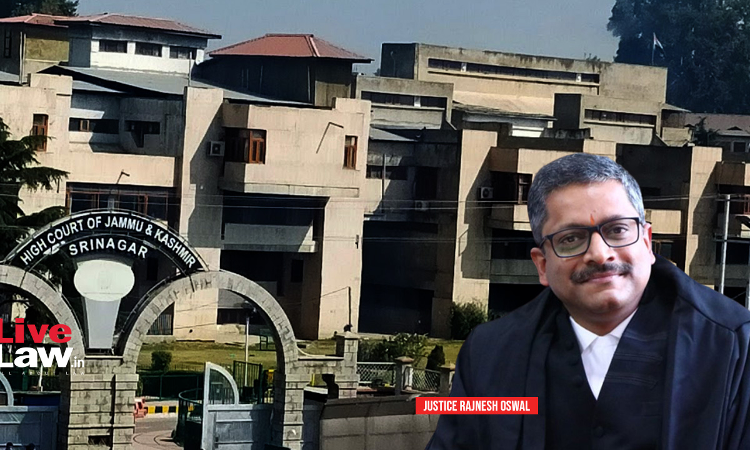
The High Court of Jammu & Kashmir and Ladakh at Srinagar has held that the disability of a victim of sexual assault cannot be treated as a disability of the Court to decipher the truth from her statement, and that rejecting her testimony merely on account of her disability would be unjustified, particularly when there is no material to suggest false implication or any history of enmity.
The Court thus dismissed the appeals of two accused challenging their conviction for rape and kidnapping, while allowing the appeal of the third accused, acquitting him of all charges.
The Court was hearing appeals directed against the judgment of conviction and order of sentence passed by the learned Principal Sessions Judge, Reasi, in a case arising out of FIR registered under Sections 363, 376 and 109 of the Ranbir Penal Code.
The appeal was heard by Justice Rajnesh Oswal, who observed,
“The fact remains that the victim suffers from a serious disability, but her disability cannot be a disability of the Court to decipher the truth from her statement. Rejecting her statement merely on account of her disability would be unjustified, particularly when there is no material to give even an inkling of false implication, nor any history of enmity between the appellants and the victim's father to suggest a false or frivolous case.”


Background
In 2014, the complainant, father of the victim, submitted a written application with the Station House Officer, Police Station Arnas, stating that his 11-year-old daughter had gone to the fields to gather leaves for goats but did not return. Upon searching, he found her lying unconscious in the bushes with blood-stained clothes.
The victim, who had partial visual impairment in one eye and speech impairment, narrated that three accused persons had taken her into the bushes, where two of them committed rape upon her. FIR was registered, and after investigation, a charge sheet was filed against the appellants.
The trial court convicted appellants Rakesh Singh and Sanjeev Sharma for offences under Sections 376 and 363 RPC, and appellant Rashpal Sharma for offences under Sections 363 and 109 RPC. The trial court sentenced them to rigorous imprisonment and fine. Aggrieved, the appellants approached the High Court.
The counsel for the appellants contended that the trial court failed to comply with the mandate of Section 119 of the Evidence Act, as the victim's statement was not video graphed and the interpreter was not allowed to be cross-examined. It was further argued that the medical evidence did not corroborate the commission of rape, and that there was no evidence against appellant Rashpal Sharma.
Per contra, the Government Advocate argued that the trial court rightly appreciated the evidence of the victim, and that the victim was a competent witness despite her speech impairment.
Court's Observation
The Court observed that the victim was initially examined by a Medical Officer, who noted that she exhibited stammering speech and referred her to an ENT Specialist. The Court noted that the trial court had recorded the victim's statement with the assistance of an interpreter, after satisfying itself regarding the interpreter's qualifications and competence.
The Court held that non-compliance with the proviso to Section 119 of the Evidence Act, which requires video graphing of the statement of a witness unable to communicate verbally, did not result in a miscarriage of justice, as the appellants failed to demonstrate any prejudice.
The Court relied on the judgment of the Supreme Court in State of Rajasthan v. Darshan Singh (2012), which held that a deaf and dumb person is a competent witness, and that the court must exercise due caution to ascertain that the witness possesses the requisite amount of intelligence.
The Court held,
“It is true that the victim's statement was not video graphed by the learned Trial Court; however, the appellants have failed to demonstrate, either before the Trial Court or before this Court, that non-compliance with the proviso to Section 119 of the Evidence Act has resulted in a miscarriage of justice.”
Regarding the contention that the medical evidence did not support the prosecution, the Court observed that the incident took place on 16.11.2014, whereas the victim was examined by the Medical Officer on 19.11.2014, and the absence of spermatozoa after 72 hours was natural.
The Court relied on Wahid Khan v. State of M.P. (2010) to hold that to constitute the offence of rape, complete penetration with emission of semen is not necessary. The Court further noted that the FSL report established the presence of spermatozoa and blood stains on the victim's trouser, which could not be explained away.
On the seizure of clothes, the Court observed that although the marginal witnesses were not examined by the prosecutor regarding the seizure memos, the testimony of the Investigating Officer, who proved the seizure memos, remained unchallenged during cross-examination. The Court relied on Mallikarjun v. State of Karnataka (2019) to hold that the evidence of the investigating officer can be relied upon to prove recovery even when panch witnesses turn hostile.
The Court further observed that the victim had clearly narrated the mode and manner in which she was kidnapped and assaulted, and her testimony directly implicated appellants Sanjeev Sharma and Rakesh Singh.
However, the Court noted that the victim had not made any incriminating statement against appellant Rashpal Sharma, though the other witnesses had deposed about his involvement. The Court held that appellant Rashpal was required to be given the benefit of doubt in view of the statement of the victim.
Accordingly, the Court dismissed the appeals preferred by appellants Rakesh Singh and Sanjeev Sharma, upholding their conviction and sentence. The appeal preferred by appellant Rashpal Sharma was allowed, and his conviction and sentence were set aside, acquitting him of all charges.


