



- Home
- /
- High Courts
- /
- High Court of J & K and Ladakh
- /
- 'Employees Cannot Be Expected To...
'Employees Cannot Be Expected To Obtain Vigilance Clearance Or Maintain Annual Performance Reports': J&K&L High Court
LIVELAW NEWS NETWORK
10 Sept 2026 10:00 AM IST
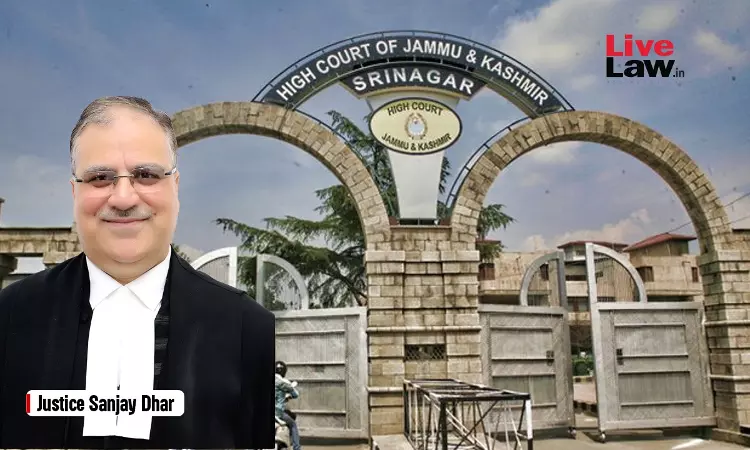
Underscoring the duty and obligation of the employer to obtain vigilance clearance and to maintain APRs in respect of its employees, the Jammu and Kashmir and Ladakh High Court has held that an employee cannot be expected to obtain his vigilance clearance and to maintain his APRs as these are matters entirely within the domain of the employer.Justice Sanjay Dhar made the observation...
This is a premium content
Available exclusively to
Our subscribers
Subscribe Premium 
INR 1099+GST
Your support helps us to bring you more content at
an affordable subscription scheme !!!
All payment options available
Underscoring the duty and obligation of the employer to obtain vigilance clearance and to maintain APRs in respect of its employees, the Jammu and Kashmir and Ladakh High Court has held that an employee cannot be expected to obtain his vigilance clearance and to maintain his APRs as these are matters entirely within the domain of the employer.
Justice Sanjay Dhar made the observation while allowing a petition filed by one Mohammad Yousuf Ahanger and another, challenging the decision of the Establishment-cum-Finance Committee which had rejected their claim for substantive promotion to the post of General Manager.
The Court held that the petitioners could not be blamed for the non-receipt of vigilance clearance or non-maintenance of their Annual Performance Reports (APRs), particularly when the Committee had neither examined the relevant records nor found any adverse material against them. It consequently quashed the impugned decision and directed fresh consideration of their promotion cases.
“….it is the duty and obligation of the employer to obtain vigilance clearance and to maintain APRs in respect of its employees. An employee cannot be expected to obtain his vigilance clearance and to maintain his APRs..Therefore, the petitioners cannot be blamed for nonreceipt of vigilance clearance and non-maintenance of APRs so as to deny promotion to them”, the court remarked.
Background:
The petitioners had been working as Incharge General Managers in the respondent Corporation. They had earlier approached the High Court complaining that despite being eligible for promotion, their cases had not been considered as no Departmental Promotion Committee (DPC) had been convened.
The High Court had in terms of an earlier order directed the Corporation to convene the DPC and place their cases before it for consideration of substantive promotion as General Manager from the date their right had accrued. When the direction was not complied with, the petitioners instituted contempt proceedings. During its pendency, the Establishment-cum-Finance Committee rejected their promotion claim.
Both petitioners had subsequently superannuated. The respondents argued that their retirement extinguished any right to promotion. The High Court rejected this contention, noting that the earlier judgment had attained finality and had already held that an accrued right to promotion could not be defeated merely because of superannuation.
One of the reasons recorded by the Establishment-cum-Finance Committee was that vigilance clearance sought in respect of the petitioners had not been received and that APRs of petitioner Mohammad Yousuf Ahanger were not available. Justice Dhar found this reasoning legally untenable. He remarked,
“An employee cannot be expected to obtain his vigilance clearance and to maintain his APRs. These are matters entirely within the domain of the employer.”
The Court therefore held that the petitioners could not be blamed for administrative lapses attributable to the employer and could not be denied consideration for promotion on that basis.
The Court also considered the Committee's reasoning that the post of General Manager was a selection post and that the Recruitment Rules did not confer an automatic right to promotion. Justice Dhar clarified that while an eligible officer is not automatically entitled to promotion merely on the basis of seniority, he is certainly entitled to consideration for promotion on the basis of merit. Such merit is to be assessed from the employee's service record and vigilance reports, he opined.
In the present case, there was no allegation of any deficiency or adverse entry in the vigilance reports or APRs of the petitioners. More importantly, the Committee had not even perused those records, since they were admittedly unavailable before it.
The Court consequently observed that the Committee had “only completed a formality” rather than actually considering the petitioners' cases for promotion in accordance with law.
The Court also rejected the Committee's finding that the petitioners had never held the post of General Manager, noting that the Corporation itself had admitted that they had been directed to hold the higher posts on a stop-gap basis in the exigency of service.
Holding the Establishment-cum-Finance Committee's decision unsustainable in law, the High Court quashed the decision and directed the respondents to reconsider the petitioners' cases for promotion to the post of General Manager on the basis of their service record.
Case Title: Mohammad Yousuf Ahanger & Anr. v. State of J&K & Ors.
Citation: 2026 LiveLaw (JKL) 391


