



- Home
- /
- High Courts
- /
- High Court of J & K and Ladakh
- /
- When Can “May” Be Read As “Shall”?...
When Can “May” Be Read As “Shall”? J&K&L High Court Applies Purposive Interpretation To Uphold Statutory Right Under Drugs & Cosmetics Act
LIVELAW NEWS NETWORK
25 Sept 2026 2:45 PM IST
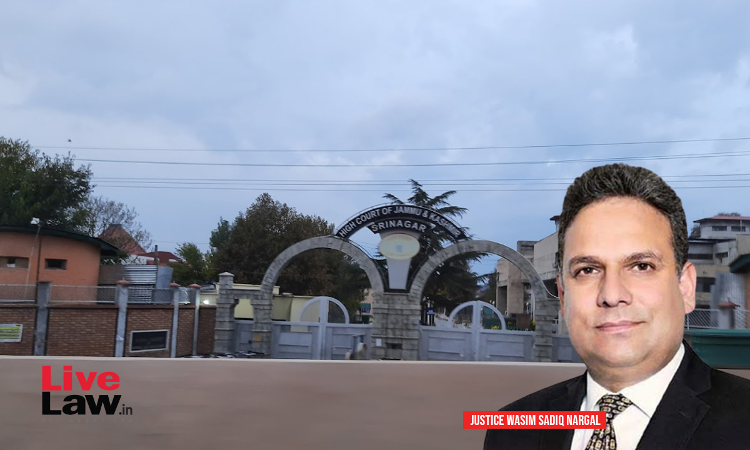
The Jammu & Kashmir and Ladakh High Court has held that the word “may” occurring in Section 25(4) of the Drugs and Cosmetics Act, 1940 cannot be construed as conferring an unfettered discretion on the Court where such interpretation would defeat the statutory right of a person to challenge a Government Analyst's report.Justice Wasim Sadiq Nargal observed that once a person, within...
This is a premium content
Available exclusively to
Our subscribers
Subscribe Premium 
INR 1099+GST
Your support helps us to bring you more content at
an affordable subscription scheme !!!
All payment options available
The Jammu & Kashmir and Ladakh High Court has held that the word “may” occurring in Section 25(4) of the Drugs and Cosmetics Act, 1940 cannot be construed as conferring an unfettered discretion on the Court where such interpretation would defeat the statutory right of a person to challenge a Government Analyst's report.
Justice Wasim Sadiq Nargal observed that once a person, within the prescribed 28-day period, notifies his intention under Section 25(3) to adduce evidence in controversion of the Government Analyst's report, the mechanism under Section 25(4) for obtaining a conclusive opinion from the Central Drugs Laboratory assumes a mandatory character where its exercise is necessary to preserve that statutory right.
The Court made the observations while allowing a petition filed by Maxmed Life Sciences Pvt. Ltd. and its Director under the erstwhile Section 561-A CrPC, corresponding to Section 528 of the Bharatiya Nagarik Suraksha Sanhita, and quashing the complaint and consequential proceedings arising out of prosecution under Sections 18(a)(i) and 27(d) of the Drugs and Cosmetics Act.
Background:
The prosecution arose from a sample of the drug “Amzone”, manufactured by Maxmed Life Sciences, which was lifted by the Drug Inspector from Chest and Disease Hospital, Bakshi Nagar, Jammu, on January 16, 2014.
The sample, was manufactured in December 2013 and had an expiry date of November 2015. The Government Analyst, Jammu, in a report dated February 11, 2014, declared the drug to be “Not of Standard Quality” after it failed the test for particulate matter.
The Drug Inspector thereafter issued a statutory notice under Section 25(2) of the Act informing the petitioner-company about the Government Analyst's report.
The company responded within the statutory period, disputed the report and expressed its intention to adduce evidence in controversion of the same. It also sought re-analysis of the sample. The company further informed the authorities that control samples tested in its in-house laboratory as well as a Government-approved laboratory had conformed to the prescribed standards.
The controversy arose because, while communicating its intention to seek re-analysis, the company referred to testing by an NABL-accredited laboratory, rather than specifically mentioning the Central Drugs Laboratory.
The respondents subsequently took the position that the petitioners had failed to exercise their statutory right in the manner contemplated by Section 25(3), since they had not specifically requested testing by the Central Drugs Laboratory.
The High Court rejected this approach.
Timely Intimation Of Intention To Challenge Analyst's Report Is The Crucial Requirement
Justice Nargal began by examining the scheme of Sections 25(3) and 25(4) of the Act. Section 25(3), he observed, ordinarily gives evidentiary conclusiveness to a Government Analyst's report. However, that conclusiveness is subject to an express statutory exception where the person concerned, within 28 days of receiving the report, notifies in writing the Inspector or the Court that he intends to adduce evidence in controversion of the report.
Section 25(4), in turn, provides the mechanism for testing the disputed sample before the Central Drugs Laboratory, whose report is treated as conclusive evidence of the facts stated therein.
Justice Nargal held that the two provisions have to be read together. The Court drew a distinction between the substantive right created by Section 25(3) and the procedural mechanism provided under Section 25(4) to make that right effective.
“Once their intention to controvert the report was duly communicated within the prescribed period,” the Court observed, “the statutory mechanism under Section 25(4) was available for obtaining the conclusive opinion of the Director, Central Drugs Laboratory.” It therefore held that the petitioners could not be treated as having forfeited the right merely because their communication referred to an NABL-accredited laboratory.
Request For NABL Laboratory Did Not Amount To Waiver Of Statutory Right
The Court found significance in the fact that the respondents themselves did not dispute that the petitioners had disagreed with the Government Analyst's report and sought re-analysis within the statutory period.
The mere reference to “any NABL accredited laboratory”, the Court held, could not by itself be construed as an abandonment or waiver of the statutory right.
The expression used by the petitioners might have rendered their request imperfect in form, but the substantive requirement under Section 25(3) was whether they had communicated, within the prescribed period, their intention to controvert the Government Analyst's report. On the admitted facts, that intention had been clearly communicated, the court maintained.
Why “May” In Section 25(4) Cannot Be Treated As Purely Discretionary
The principal question before the Court, however, went beyond the NABL issue. The Court specifically considered whether the use of the word “may” in Section 25(4) meant that the Magistrate retained an unfettered discretion to decide whether or not to send the disputed sample to the Central Drugs Laboratory.
Justice Nargal answered the question in the negative in the circumstances contemplated by the provision.
The Court referred to the Supreme Court's decision in Rakesh Ranjan Shrivastava v. State of Jharkhand, which explained that although “may” ordinarily denotes discretion, the word cannot invariably be construed in isolation from the nature of the power, legislative intent and consequences of its exercise.
Applying this principles to Section 25, the Court held that “may” should be read as “shall” in the circumstances of the case, noting that Section 25(3) creates a statutory right to controvert the Government Analyst's report, while Section 25(4) provides the mechanism to enforce that right.
The Court further emphasised that the Supreme Court has repeatedly recognised the importance of this safeguard, as failure to send the sample to the Central Drugs Laboratory while it remains testable may permanently deprive the accused of an independent analysis, rendering the protection under Section 25(3) illusory if Section 25(4) were treated as conferring an unrestricted discretion.
The Court accordingly held that the interpretation of “may” has to be informed by the purpose, object and legislative intention behind Section 25.
“May” Does Not Invariably Become “Shall”
The Court was careful, however, not to formulate an absolute rule that every statutory use of “may” must be read as “shall”.
It specifically clarified that the principle is not that the word “may” must invariably be substituted with “shall”. Rather, the particular statutory context, the nature of the right conferred and the consequences of non-exercise of the power justified such construction in the present case.
Justice Nargal observed that once the statutory conditions under Section 25(3) are fulfilled and the person concerned has duly exercised the right to controvert the Analyst's report, the Court's power under Section 25(4), though expressed as “may”, assumes a mandatory character where its exercise is necessary to preserve and give meaningful effect to that right.
Another important aspect of the judgment concerned the expiry of the drug's shelf life. The petitioners had exercised their right within the statutory period, but the sample was not sent to the Central Drugs Laboratory. The drug ultimately expired in November 2015, while the petitioners received summons only in November 2016. By that stage, meaningful re-analysis of the drug was no longer possible.
The Court held that the petitioners could not be made to suffer the consequences of the loss of an opportunity which they had sought to exercise within the statutory period.
The Government Analyst's report, having been timely controverted, could not regain its conclusive character merely because the sample subsequently lost its shelf life, the bench opined.
To allow the prosecution to continue solely on the basis of such a report, the Court held, would cause substantive prejudice to the petitioners and defeat the statutory safeguard contemplated by Sections 25(3) and 25(4).
In view of the statutory prejudice caused to the petitioners, the High Court concluded that continuation of the prosecution would amount to permitting the proceedings to continue without affording them the statutory safeguard available under the Act.
The Court therefore allowed the petition and quashed the complaint pending before the Chief Judicial Magistrate, Jammu, as against the petitioners, along with all consequential proceedings.
Case Title: Maxmed Life Sciences Pvt. Ltd. & Ors. v. State of J&K through Drug Inspector
Citation: 2026 LiveLaw (JKL) 420


