



Women's Reserved Seats In Public Transport Exist “More On Paper”: J&K&L High Court Seeks Compliance From Authorities
LIVELAW NEWS NETWORK
26 Nov 2026 12:00 PM IST
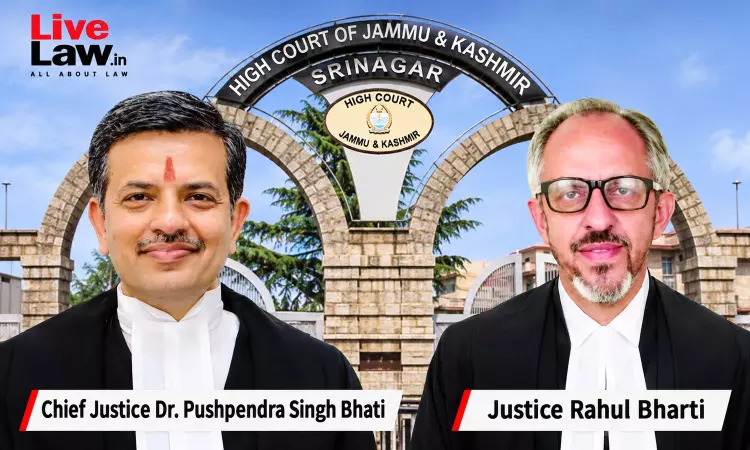
The Jammu & Kashmir and Ladakh High Court has expressed concern over the failure to effectively implement the reservation of seats for women and persons with disabilities in public transport vehicles, observing that the directions issued by the Transport Commissioner appear to be existing “more on paper rather than presence on the roads”.
A Division Bench comprising Chief Justice Dr. Pushpendra Singh Bhati and Justice Rahul Bharti noted that even the traffic police authorities appeared unclear about the legal provisions empowering them to enforce the safety and security of women commuters travelling in public and private transport vehicles.
The Court was considering a public interest litigation raising concerns over the difficulties faced by women, whether young or elderly, while commuting in buses, matadors and other public transport vehicles without any assurance that reserved seats would be available to them.
Taking note of the status report filed by the Transport Department and the response of the Srinagar Traffic Police, the Bench granted further time to the authorities to report compliance with its earlier directions. It also reserved liberty to issue additional directions to ensure that the purpose of the PIL translates into effective protection for women commuters.


The Court observed that the SSP Traffic, Srinagar, was “clueless as to the empowering legal provisions vide which the safety and security of commutation of women in public and private transport can be ensured and enforced.”
Background
The public interest litigation was initiated by Advocate Monisa Manzoor Mir, who approached the High Court raising concerns about the safety and security of women travelling in public transport and service vehicles. The Court had taken cognizance of the PIL through an order dated February 16, 2026.
The petitioner drew the Court's attention to a circular issued by the Transport Commissioner, Jammu and Kashmir, concerning reservation of seats for women and persons with disabilities.
Her grievance was that the circular was being implemented more in form than in substance, as women commuters continued to face uncertainty about the availability of reserved seats in buses, matadors and other public transport vehicles.
During the proceedings, the Senior Superintendent of Police, Traffic, Srinagar, submitted a reply dated August 6, 2026. The Secretary to Government, Transport Department, also filed a status report pursuant to the Court's earlier directions.
The Transport Department's report referred to the facility of free ridership for women commuters in Government-owned public transport, including SRTC and Smart City electric buses, under a Government Order issued on April 1, 2025.
It further referred to the Circular dated January 7, 2025, and another Circular issued by the Transport Commissioner, directing Regional Transport Officers (RTOs) and Assistant Regional Transport Officers (ARTOs) to ensure strict implementation of seat reservation for women and persons with disabilities.
The directions extended to public service vehicles, including buses, mini-buses, Sumos, e-rickshaws and other contract and stage carriage vehicles. The RTOs and ARTOs were also required to submit weekly compliance and enforcement reports to the Transport Commissioner.
Court's Observation
The Division Bench examined the reply filed by the SSP Traffic, Srinagar, and expressed concern over what it described as a clear sense of helplessness on the part of the traffic police authority.
The Court noted that the SSP Traffic had taken the position that enforcement of the directions could be undertaken only when supported by an executive decision, statutory notification or departmental directives issued by the competent authority.
Recording this position, the Bench observed,
“...This Court is finding a clear helplessness registered by said respondent No. 3 – Sr. Superintendent of Police (SSP) Traffic, Srinagar who comes forward sounding that he is only an authority who can enforce the directives provided they are borne from some executive decision/statutory notifications or departmental directives from the competent authority/ies”
The Court further noted that the response indicated that even the traffic police authority was unclear about the legal provisions under which the safety and security of women travelling in public and private transport could be ensured and enforced.
The Bench also considered the status report filed by the Transport Department, particularly its reference to the circulars directing the RTOs and ARTOs to ensure reservation of seats for women and persons with disabilities in different categories of public service vehicles.
However, the Court recorded that compliance reports pursuant to its three directions issued on August 10, 2026, were still awaited from the Transport Commissioner, the J&K Legal Services Authority, the Transport Department and the Traffic Police.
In view of the pending compliance, Deputy Advocate General Bikramdeep Singh and Government Advocate Waseem Gull sought further time to obtain instructions and report the steps taken by the concerned authorities. The Court granted the extension.
The Bench also made it clear that it would not confine itself to the existing directions if further intervention became necessary to achieve the object of the public interest litigation. In this regard, the Court observed,
“This Court reserves the discretion to come up with more directions to make the purpose of this writ petition more effective and result oriented purposeful and to be in actual service of women commuters so as to lend them due sense of safety and security in connection with their travel, be it for work places or for domestic purposes.”
The High Court granted further time to the respondents to place the requisite compliance material on record and directed that the matter be listed on December 23, 2026.


