



- Home
- /
- High Courts
- /
- Jharkhand High Court
- /
- In Jharkhand, Civil Judge (Sr....
In Jharkhand, Civil Judge (Sr. Division) Has Jurisdiction To Try Trademark Infringement Suits Valued Between ₹3 Lakh & ₹1 Crore: High Court
Sparsh Upadhyay
16 Aug 2025 11:38 AM IST
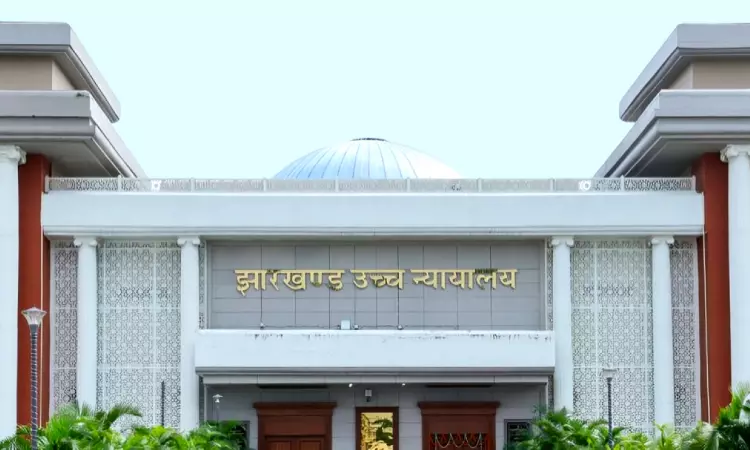
The Jharkhand High Court has held that in the State of Jharkhand, where the pecuniary value of a commercial dispute is between ₹3 lakh and ₹1 crore, a Civil Judge (Senior Division) designated as a Commercial Court has the jurisdiction to try a trademark infringement suit. A Bench of Chief Justice Tarlok Singh Chauhan and Justice Sujit Narayan Prasad held so while allowing...
This is a premium content
Available exclusively to
Our subscribers
Subscribe Premium 
INR 1099+GST
Your support helps us to bring you more content at
an affordable subscription scheme !!!
All payment options available
The Jharkhand High Court has held that in the State of Jharkhand, where the pecuniary value of a commercial dispute is between ₹3 lakh and ₹1 crore, a Civil Judge (Senior Division) designated as a Commercial Court has the jurisdiction to try a trademark infringement suit.
A Bench of Chief Justice Tarlok Singh Chauhan and Justice Sujit Narayan Prasad held so while allowing a commercial appeal filed by M/s Khemka Food Products Pvt. Ltd. against a 2024 order of the Civil Judge (Sr. Division)-I, Jamshedpur, directing the return of the plaint for presentation before a court having jurisdiction.
Case in brief
Briefly, the appellant company's business began in 1970, it was incorporated in 1999, and it began producing wheat flour in 2001. Though it adopted the trademark 'Grihasti Bhog' and filed registration applications in 2005, 2012 and 2014, the same were later abandoned.
Now, in February 2023, the appellant discovered that the respondents (ISDS Private Limited) were selling wheat flour under the identical mark 'Grihasti Bhog'. A cease-and-desist notice was sent to them on 10 March 2023.
In April 2023, the appellant filed an application under section 12A of the Commercial Courts Act, 2015, before the DLSA, Jamshedpur. However, the respondents refused to mediate, and accordingly, the Secretary, DLSA, Jamshedpur, issued the non-starter report.
Consequently, the suit for infringement and passing off under Section 134 of the Trade Marks Act, 1999 was filed on 14 August 2023 before the Civil Judge (Sr. Division)-I-cum-Commercial Court at Jamshedpur.
The respondents filed a written statement claiming use of the name since 2022 and later moved an application under Order VII Rule 10 CPC, contending that the court lacked jurisdiction.
They asserted that only the Additional District & Sessions Judge/Judicial Commissioner could try such suits. On 29 July 2024, the trial court accepted the objection and ordered the return of the plaint.
Challenging this very order, the appellant moved the HC, arguing that the dispute qualified as a 'commercial dispute' under Section 2(1)(c)(xvii) of the CC Act.
It was its primary contention that Notification No. 206/J dated 8 February 2021, issued by the State of Jharkhand in consultation with the High Court, conferred original jurisdiction on the Civil Judge (Sr. Division) to try commercial disputes valued between ₹3 lakh and ₹1 crore.
The State, on the other hand, maintained that the trial court's order was correct as for the present dispute, jurisdiction lay only with the District Judge-level court.
High Court's order
At the outset, the court examined the CC Act as well as its 2018 amendment to note that suits which are of specified value between ₹1 crore to ₹3 lakh have now come under its ambit and the state is well authorised to designate Commercial Courts at or below the District Judge level.
"The intent of the Parliament was clearly to expand the powers and to bring in more Courts under the rubric of 'Commercial Courts'. Considering that the specified value was being lowered, it was but natural to allow Courts below the rank of District Judge to be designated as Commercial Courts", the Court observed.
It further noted that in Jharkhand, the High Court had approved a notification designating Civil Judges (Sr. Division) as Commercial Courts for disputes valued between ₹3 lakh and ₹1 crore.
It added that since Commercial Appellate Courts can also be established at the District Judge level, the original authority entertaining the commercial dispute has to be subordinate to the District Judge, which essentially would be the Civil Judge-Sr. division.
Thus, the Court observed that the trial court had 'gravely erred' in construing the term 'District Court' in Section 134 of the Trade Marks Act as referring exclusively to a 'District Judge.
"The learned court below has gravely erred in construing the expression 'District Court' as 'District Judge' without caring to go through the provisions of the section 134 of the Trademarks Act which clearly provides that dispute of infringement can be instituted in a 'District Court' having jurisdiction to try the suit as against the expression 'District Judge' having jurisdiction to try the suit. The court would have been well advised and should have shown due deference to the notifications issued by this Court notifying the Civil judge-Sr. Division to be a Commercial Court and the District Judge to be a Commercial Appellate Court apart from being a Commercial Court depending upon the pecuniary jurisdiction", the bench observed.
Thus, holding that the Civil Judge (Sr. Division) in Jharkhand had jurisdiction to try the suit, the High Court allowed the appeal and quashed the 29 July 2024 order while restoring the suit to its original number. The trial court was also directed to proceed in accordance with the law.
Case title - M/s Khemka Food Products Pvt. Ltd., vs I.S.D.S. Private Limited and others
Case citation : 2025 LiveLaw (Jha) 64
Tags

Sparsh Upadhyay
Sparsh Upadhyay is an Associate Editor with LiveLaw.

