



- Home
- /
- High Courts
- /
- Jharkhand High Court
- /
- Industries Cannot Use Public Roads...
Industries Cannot Use Public Roads Disproportionately For Gain: Jharkhand HC Orders Parking Compliance, Trauma Care Near Steel Plant
Rushil Batra
19 April 2026 1:45 PM IST
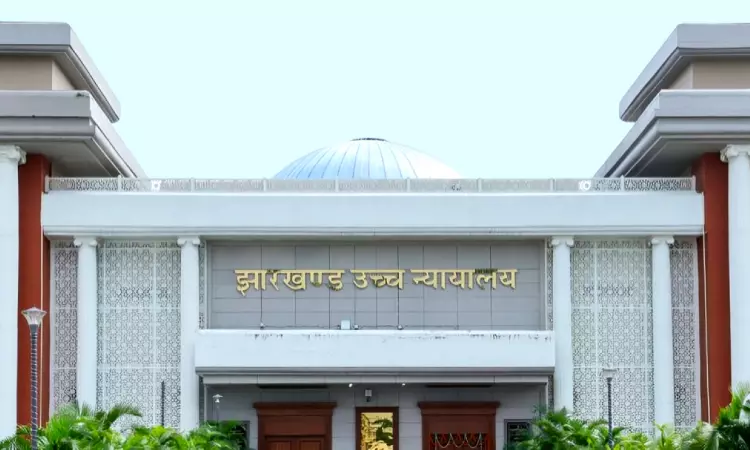
The Jharkhand High Court has held that industries cannot disproportionately use public roads for their commercial operations at the cost of ordinary commuters, directing strict enforcement of statutory parking norms and development of adequate trauma care facilities near a steel plant.A Division Bench comprising Chief Justice M.S. Sonak and Justice Rajesh Shankar was hearing a public...
This is a premium content
Available exclusively to
Our subscribers
Subscribe Premium 
INR 1099+GST
Your support helps us to bring you more content at
an affordable subscription scheme !!!
All payment options available
The Jharkhand High Court has held that industries cannot disproportionately use public roads for their commercial operations at the cost of ordinary commuters, directing strict enforcement of statutory parking norms and development of adequate trauma care facilities near a steel plant.
A Division Bench comprising Chief Justice M.S. Sonak and Justice Rajesh Shankar was hearing a public interest litigation concerning lack of parking facilities and road safety issues around the Chaliyama Steel Plant (CSP) at Rajnagar in Saraikela-Kharsawan district.
The petition was filed seeking directions to ensure proper parking facilities for heavy vehicles plying to and from the steel plant, alleging that in the absence of designated parking areas, trucks were using public roads and highways, leading to frequent accidents and posing risks to workers and commuters.
The petitioners alleged systemic negligence and non-compliance with statutory requirements, particularly Rule 41 of the Jharkhand Building Bye-laws, 2016, which mandates provision of internal parking facilities for industrial units. The respondents, in their affidavits, highlighted certain existing facilities and suggested measures to address the issues.
The Court, however, noted that in the absence of designated parking bays within the plant premises, heavy vehicles were using public roads as makeshift parking areas, thereby obstructing traffic and reducing road space available to other commuters. The Court observed:
“In the absence of a designated parking bay on the CSP premises, it appears that heavy vehicles and trucks carrying goods to and fro from the CSP disproportionately use public roads as a makeshift parking area. Such parking naturally obstructs the free flow of traffic and leaves all other commuters with much less road space. Thus, to further the commercial interests of CSPs, and prima facie on account of CSPs not complying with the statutory requirements to provide adequate parking facilities for their own vehicles or the vehicles of those with dealings and transactions with CSPs, the traveling public and commuters are forced to suffer”
Emphasising equitable use of public infrastructure, the Court held that while industrial vehicles are entitled to use public roads, such use must be reasonable and not disproportionate. It observed:
Ultimately, CSP is using such roads for its commercial ventures. There may be nothing wrong with such a reasonable user. But a disproportionate or inequitable user puts great stress on ordinary commuters of such public roads. Ultimately, such public roads are built and maintained through the taxpayers' funds. Therefore, all that we say is that there must be an equitable user of such roads, particularly by industries established for commercial gain
The Court also reiterated that the right to health is an integral facet of Article 21 of the Constitution, and noted deficiencies in medical infrastructure in the region, particularly in handling accident trauma cases. It held that executive inaction cannot defeat this right and that the State must ensure adequate healthcare facilities, especially in areas impacted by industrial activity.
Taking note of the inadequate medical infrastructure, the Court directed the State to consider establishment of emergency trauma care facilities in the vicinity, and to explore participation of the steel plant under Corporate Social Responsibility (CSR) obligations. Accordingly, the Court issued comprehensive directions, including:
“(i) The Respondent No. 2 – Principal Secretary, Department of Industries, Government of Jharkhand, shall ensure strict enforcement of Rule 41 of the Jharkhand Building Bye-laws, 2016, and shall take all necessary measures to ensure that adequate internal parking facilities are effectively utilized within the premises of the Chaliyama Steel Plant (CSP), so that public roads are not used for unauthorized parking of heavy vehicles;
(ii) The Respondent No. 2 – Principal Secretary, Department of Industries, Government of Jharkhand, shall consider and take a reasoned decision on the report submitted by the General Manager, District Industries Centre, Chaibasa, within a period of three (03) months from today and, if any measures are approved pursuant thereto, the same shall be implemented in accordance with law within a period of 12 months from today.
(iii) The Respondent-State authorities, in coordination with the concerned district administration and police authorities, shall ensure that no heavy vehicles connected with CSP are permitted to occupy public roads in a manner that obstructs the free and equitable flow of traffic.
(iv) The Respondent-State authorities shall also coordinate with the competent authorities, including the National Highways Authority, to ensure the upgradation and regulation of the concerned highway stretches, including the installation of street lighting, speed-monitoring mechanisms, and traffic control systems.
(v) The Respondent-State authorities shall identify and develop designated heavy vehicle parking and holding zones in the vicinity of the CSP and along the affected highway corridor, within a period not exceeding eighteen (18) months from today.
(vi) The Respondent No. 3 – Principal Secretary, Department of Health, Medical Education & Family Welfare, shall, upon consideration of the report submitted by the General Manager, District Industries Centre, Chaibasa, take a policy decision within a period of three (03) months from today regarding the establishment and operationalisation of adequate emergency medical and trauma care facilities in the vicinity of the CSP and the affected highway corridor;
(vii) While taking such a decision, the State shall also explore the possibility of participation of CSP under its Corporate Social Responsibility (CSR) obligations for strengthening such medical infrastructure.
(viii) If a decision is taken, the approved medical facilities shall be established and made functional within a period not exceeding eighteen (18) months from today.
(ix) The Superintendent of Police, Chaibasa, along with other competent authorities, shall ensure strict enforcement of traffic regulations, including prevention of unauthorised roadside parking by heavy vehicles and installation of appropriate monitoring mechanisms.
(x) Continuous vigilance shall be maintained to ensure that public roads are not subjected to disproportionate or hazardous use by industrial traffic.
(xi) The Principal Secretary, Department of Industries, Government of Jharkhand, in coordination with other officials referred to above, shall file a comprehensive compliance affidavit before this Court within a period of six (06) months, indicating the steps taken in furtherance of the above directions, after furnishing a copy to the learned counsel for the petitioners.
The Court emphasised continuous vigilance to prevent disproportionate and hazardous use of public roads by industrial traffic.
Case Title: Nageshwar Acharya and Anr v. State of Jharkhand and Ors.
Case No.: W.P. (PIL) No. 682 of 2025.
Appearance: Mr. Anupam Anand and Mr. Pranav Kumar appeared for the Petitioners. Mr. Piyush Chitresh appeared for the Respondent.
Tags


