



'Absence Of Application Doesn't Prevent Court From Granting Interim Maintenance Suo Motu Under Hindu Marriage Act': Jharkhand High Court
LIVELAW NEWS NETWORK
26 Oct 2026 1:25 PM IST
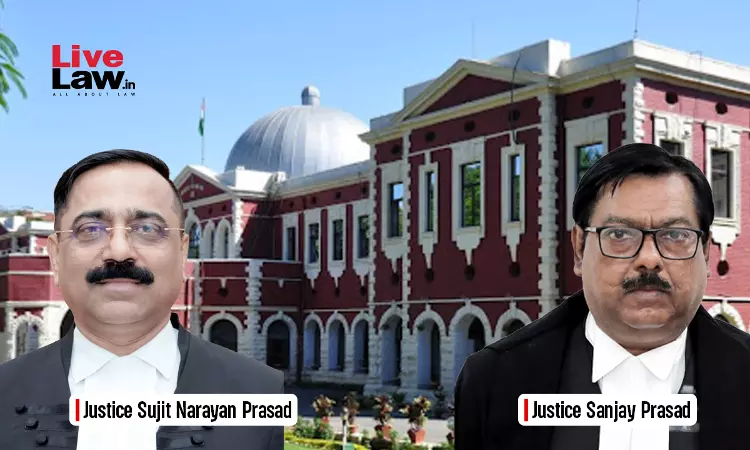
The Jharkhand HC has held that a court can grant interim maintenance suo motu under Section 24 of the Hindu Marriage Act, 1955, even where the financially dependent spouse has not filed a formal application seeking such relief. The Court observed that procedural technicalities cannot defeat the statutory right to maintenance, particularly where a spouse lacks the means to contest matrimonial proceedings.
A Division Bench of Justice Sujit Narayan Prasad and Justice Sanjay Prasad directed a husband to pay Rs.15,000 per month to his wife during the pendency of his divorce appeal, despite the wife having filed no application under Section 24 of the Hindu Marriage Act.
The Court was hearing an appeal filed by the husband against the judgment dated November 3, 2025, passed by the Family Court, Hazaribagh, dismissing his petition for divorce on the grounds of cruelty and desertion. The husband submitted that although the wife had been served notice in the divorce proceedings, she did not appear before the Family Court. Consequently, the proceedings continued ex parte, but the Family Court ultimately dismissed his divorce petition.


During the hearing of the appeal, the wife pointed out that she had separately instituted maintenance proceedings under Section 125 CrPC. By an order dated June 16, 2026, the Family Court had directed the husband to pay her Rs.15,000 per month from July 16, 2024, the date of filing of her maintenance application. The wife submitted that the accumulated maintenance had reached approximately Rs.3.75 lakh, but the husband had not paid any amount, leaving her in a financially distressed condition.
The High Court noted that the maintenance order had not been challenged before a higher forum and that, according to the wife, no payment had been made in compliance with it. Examining the purpose of Section 125 CrPC, the Bench observed that the provision seeks to prevent deserted wives, children and parents from being reduced to destitution, poverty or vagrancy by converting the moral obligation to maintain dependent family members into a legal obligation.
However, the Court clarified that while exercising appellate jurisdiction in the divorce proceedings, it could not act as an executing court to enforce the maintenance order passed under Section 125 CrPC. It therefore examined whether interim maintenance could independently be granted under Section 24 of the Hindu Marriage Act.
The Bench noted that Section 24 empowers courts to direct payment of maintenance and litigation expenses to a spouse who lacks sufficient independent income to support themselves or effectively participate in matrimonial proceedings. The Court emphasised that the provision is remedial in nature and seeks to ensure that financially weaker spouses are not disadvantaged in pursuing or defending matrimonial litigation.
It observed that maintenance pendente lite is not a matter of charity but a statutory right, intended to prevent a spouse from being deprived of the opportunity to defend their legal rights due to financial hardship. The Court further clarified that entitlement to relief under Section 24 does not depend upon the merits of the matrimonial dispute or the ultimate success or failure of the proceedings.
On whether a formal application under Section 24 was necessary, the Bench noted that the wife had not filed any such application. However, it held that the absence of an application could not prevent the Court from exercising its jurisdiction where the circumstances clearly demonstrated financial hardship. The Court observed:
“In view of the above discussion, it is absolute view of this Court that the absence of a formal application cannot fetter the jurisdiction of this Court to grant maintenance pendente lite suo motu, if the facts disclose that the respondent-wife is without means to survive or contest the case. Matrimonial litigation often places the economically weaker spouse at a disadvantage. The Court must intervene to prevent vagrancy and hardship, thereby ensuring that the respondent-wife is not rendered incapable of defending her rights.”
The Bench reasoned that the Family Courts Act is beneficial legislation and that courts exercising jurisdiction under it must act to protect litigants from financial hardship. The non-filing of an application could therefore not prevent the grant of interim maintenance where the need for financial assistance was apparent.
The High Court also considered whether Section 24 could be invoked by an appellate court rather than only by the court hearing the original matrimonial proceedings. It held that an appeal is a continuation of the original civil proceedings and that the expression “Court” under Section 24 includes the appellate court so long as the matrimonial litigation remains pending.
Accordingly, the Bench held that the High Court, while hearing a matrimonial appeal, could exercise its powers under Section 24 to grant interim maintenance. Applying these principles, the Court found that the wife was experiencing financial difficulties and lacked sufficient means to maintain herself or effectively contest the appeal. It observed that declining maintenance in these circumstances would effectively prevent the wife from defending the proceedings and result in a miscarriage of justice.
The High Court therefore directed the husband to pay Rs.15,000 per month to the wife during the pendency of the appeal, notwithstanding the absence of a formal application under Section 24.
The matter was directed to be listed after two weeks for compliance with the maintenance direction and further hearing.
Appearance:
For the Appellant: Mr. Prabhat Kr. Sinha, Advocate; Mr. Mayank Mridul, Advocate; Mr. Aditya Mazamdar, Advocate
For the Respondent: Mr. Ritesh Kumar, Advocate


