



'Stringent Bail Conditions Under PMLA Cannot Override Constitutional Right To Personal Liberty': Jharkhand High Court
LIVELAW NEWS NETWORK
21 Nov 2026 10:30 AM IST
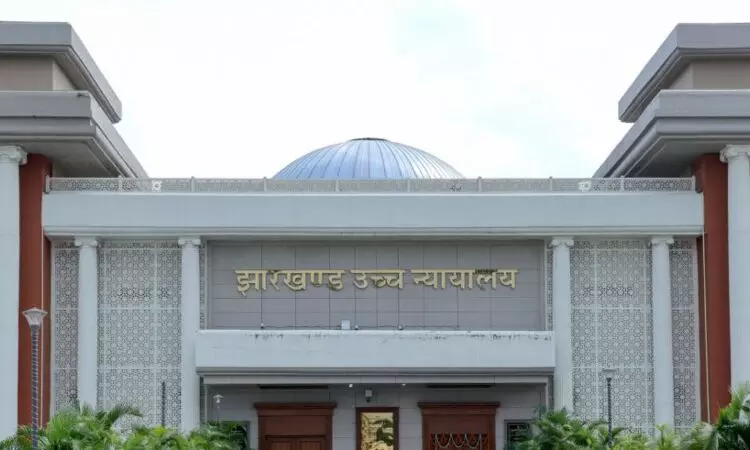
The Jharkhand HC has held that the stringent bail conditions prescribed under Section 45 of the Prevention of Money Laundering Act, 2002 (PMLA), cannot override the constitutional guarantee of personal liberty under Article 21 of the Constitution. The Court observed that prolonged pre-trial incarceration, particularly where the trial is unlikely to conclude within a reasonable period, constitutes a substantial ground for granting bail notwithstanding the restrictions under the PMLA.
A Single Judge Bench of Justice Sujit Narayan Prasad granted bail to two accused in a money laundering case involving the Prayag Group, considering their prolonged incarceration, the absence of chargesheets in the predicate offences, and the fact that the Supreme Court had already granted them bail in a connected money laundering case arising from the same underlying transactions.
The case arose from three FIRs registered by the CBI on June 30, 2015, against 33 companies, their directors, promoters and others for alleged cheating, criminal conspiracy and offences under the Prevention of Corruption Act.


According to the prosecution, M/s Prayag Infotech Hi-Rise Ltd. and M/s Prayag Infotech Network Pvt. Ltd. had collected approximately ₹2,862.84 crore from around 38.71 lakh investors through investment schemes promising lucrative returns. The Enforcement Directorate (ED) alleged that approximately ₹1,906.22 crore remained outstanding as of March 31, 2016. Based on these FIRs, the ED registered an ECIR on September 14, 2016, and subsequently filed a prosecution complaint on May 22, 2019, alleging offences under Sections 3 and 70 of the PMLA, punishable under Section 4.
The accused had earlier approached the Special PMLA Court, Ranchi, seeking bail, but their application was rejected on August 28, 2026. They thereafter approached the High Court. Examining the circumstances, the High Court noted that the Supreme Court had already granted the accused bail on July 24, 2026, in another ECIR registered by the ED at Kolkata, involving identical allegations arising from the same underlying transactions.
The Bench observed that the Supreme Court had considered the substantial period of pre-trial incarceration, the age of the alleged transactions and the remote likelihood of early conclusion of the trial. The Court also noted that the accused had been granted bail in other proceedings involving similar allegations and that there was no allegation of non-compliance with their bail conditions. Further, the properties and assets forming the subject matter of the proceedings had already been attached by the ED, and such attachment had been confirmed by the Adjudicating Authority.
Addressing the relationship between Section 45 PMLA and Article 21, the High Court observed:
“From the conspectus of the aforesaid decisions, it emerges that although the rigours of Section 45 of the Prevention of Money Laundering Act, 2002 are undoubtedly stringent and are intended to address the grave societal and economic consequences flowing from large-scale financial crimes, the said statutory restrictions cannot be interpreted in a manner that eclipses the constitutional guarantee of personal liberty under Article 21 of the Constitution of India. The Hon'ble Supreme Court has consistently held that the twin conditions contained in Section 45, however stringent, do not override constitutional protections and that constitutional courts are duty-bound to safeguard individual liberty whenever continued detention loses its legitimate purpose.”
The Bench further held that prolonged pre-trial incarceration assumes particular significance in cases involving voluminous documentary evidence, numerous witnesses and little prospect of an early trial. It observed:
“The unifying principle emerging from the aforesaid decisions is that the criminal process cannot be permitted to assume the character of punishment prior to conviction. While economic offences are serious and warrant a cautious approach in matters of bail, indefinite or unduly prolonged incarceration pending trial would be antithetical to the mandate of Article 21.”
Applying these principles, the Court noted that although the prosecution complaint had been filed in May 2019, charges had not yet been framed. The prosecution proposed to examine 19 witnesses and relied upon approximately 1,000 pages of documentary evidence, indicating that the trial was unlikely to conclude soon. The Bench also expressed concern that no chargesheet had been filed in the predicate offences despite nearly ten years having elapsed since registration of the FIRs. It further noted that the ED had not arrested the accused during its investigation between September 2016 and May 2019. Although proclamation proceedings had subsequently been initiated, the accused had themselves approached the Special Court in March 2026, disclosing their custody in connected proceedings and seeking issuance of a production warrant.
The Court held that they could not be treated as absconders for the purpose of denying them protection under Article 21 in these circumstances. The Bench concluded that continued incarceration would serve no legitimate purpose, particularly since the evidence was primarily documentary and already in the prosecution's possession. It observed:
“The continued incarceration of the petitioners, therefore, would not advance the cause of justice and, instead, would run contrary to the constitutional mandate of personal liberty and the right to a speedy trial guaranteed under Article 21 of the Constitution of India.”
Accordingly, the High Court allowed the bail application.
Appearance:
For the Petitioners: Ms. Misha Rohtagi Mohta, Advocate; Mr. Amulya Upadhyay, Advocate; Mr. Akhouri Awinash Kumar, Advocate; Mrs. Akhouri Ayushi Singh, Advocate
For the Opposite Party: Mr. Amit Kumar Das, Senior Advocate; Mr. Saurav Kumar, Advocate; Ms. Megha Singh, Advocate


