



'Questions Under Section 313 CrPC Must Be Explained To Accused In Language He Understands': Jharkhand High Court
LIVELAW NEWS NETWORK
27 Oct 2026 5:55 PM IST
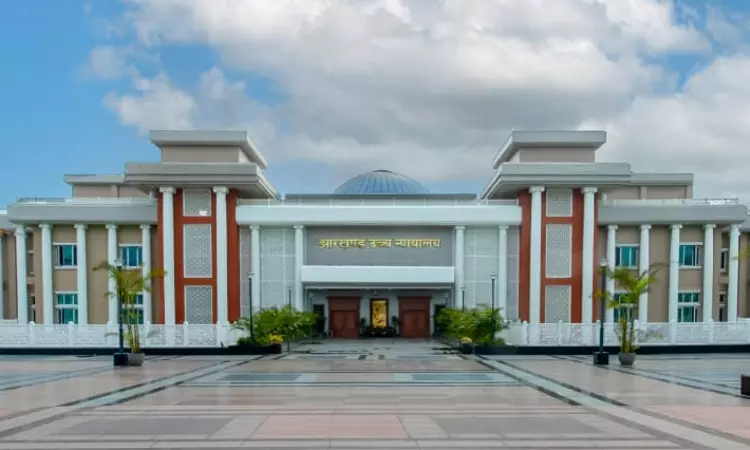
The Jharkhand HC has held that an accused must be questioned under Section 313 CrPC in a language he understands, and that improper recording of his statement, causing prejudice to his right to explain incriminating circumstances, can itself be a ground for acquittal. The Court set aside the murder conviction and life sentence of an illiterate man whose statement had been recorded entirely in English without any indication that the questions and answers were explained to him in his mother tongue.
A Division Bench of Justice Ananda Sen and Justice Pradeep Kumar Srivastava observed that Section 313 CrPC embodies the principle of audi alteram partem, ensuring that no person is condemned without an opportunity to explain the circumstances appearing against him.
The Court was hearing an appeal against the judgment dated April 25, 2018, passed by the Additional Judicial Commissioner-XII-cum-Fast Track Court, Ranchi, convicting Chamra Oraon under Section 302 IPC and sentencing him to life imprisonment with a fine of Rs.20,000.


The prosecution case was that on February 26, 2009, the accused allegedly jumped into a well while holding the informant's wife, Parmeshwari Devi, and forcibly pushed her underwater, causing her death. The informant also jumped into the well in an attempt to rescue her, but she could not be saved. It was alleged that the accused, who was the informant's uncle, committed the murder due to an existing land dispute between the parties.
Examining the trial proceedings, the High Court emphasised that Section 313(1)(b) CrPC imposes a mandatory duty on courts to provide the accused an opportunity to explain each incriminating circumstance emerging from the prosecution evidence. The Bench observed that compliance with Section 313 CrPC is not merely procedural but an essential component of the right to a fair trial under Articles 14 and 21 of the Constitution. It further explained that while Section 313(1)(a) permits the court to question the accused at any stage of the proceedings, Section 313(1)(b), which requires examination after the prosecution evidence and before the defence, is mandatory.
Turning to the present case, the Court noted that the accused was an illiterate villager who had affixed his left thumb impression (LTI) to the document containing his Section 313 statement. However, the entire statement, including the questions and answers, had been recorded in English. There was no indication that the questions had been translated into the accused's mother tongue or that the recorded answers had been read over and explained to him.
The Court held that where a statement is translated and transcribed in a language different from that spoken by the accused, the person recording it must endorse that its contents were read over and explained to the accused in the language in which he had deposed. It observed:
“…This is a serious lapse in the trial, and it goes to the root of the matter and shakes the edifice of a fair trial in this case. A person who doesn't even know how to read, write, or understand English should not be asked any questions in that language. If there is a communication gap and a lack of understanding of the language, the accused should be provided an interpreter…”
The Bench found that the absence of any certification regarding translation or explanation meant that there was no assurance that the accused had understood the incriminating circumstances put to him. The Court further noted another irregularity in the recording of the statement. Although the accused's examination was conducted on July 22, 2016, his thumb impression was obtained only the following day.
The trial judge had recorded that a printout could not be taken on the date of examination because of a power failure and that the statement was printed and signed on July 23, 2016. The High Court expressed shock at this procedure, particularly because the document also carried the trial judge's signature with the earlier date of July 22, 2016. It observed that the accused had been examined and allowed to leave, only to have his thumb impression taken the following day, without any indication that the contents of the document had been explained to him.
The Bench concluded that the examination under Section 313 CrPC had been reduced to a mere formality and had caused serious prejudice to the accused. It held:
“Thus, we are of the opinion that gross injustice has been caused in this case. Accordingly, we hold that compliance with Section 313 Cr.P.C. in this case is not in accordance with the law and has caused gross prejudice to the appellant.”
Significantly, the Bench observed:
“The improper recording of the statement under Section 313 Cr.P.C. itself is a ground for acquittal, as the natural consequence is that the circumstances against the accused, derived from the witnesses' depositions, were not put to the accused to explain but were used against him.”
The High Court also independently examined the prosecution evidence and found material weaknesses in the murder allegation. The circumstances, coupled with the serious procedural lapse under Section 313 CrPC, led the Court to conclude that the prosecution had failed to prove its case beyond reasonable doubt.
Accordingly, the High Court allowed the appeal, set aside the conviction under Section 302 IPC and the sentence of life imprisonment, and acquitted the appellant by extending him the benefit of doubt.
Appearance:
For the Appellant(s): Mr. Jai P. Agrawal, Advocate
For the Respondent(s): Mr. Shailendra Kr. Tiwari, Spl. PP


