



- Home
- /
- High Courts
- /
- Jharkhand High Court
- /
- Restitution Of Conjugal Rights |...
Restitution Of Conjugal Rights | Wife Living Separately For Job Is 'Reasonable Excuse' U/S 9 HMA: Jharkhand High Court Rejects Husband's Appeal
Rushil Batra
31 Jan 2026 3:04 PM IST
The Jharkhand High Court has held that the orthodox concept of a wife and the expectation that she must subordinate her life and career to the wishes of her husband has undergone a "revolutionary change", and that a married woman has a right to stand financially on her own feet and oblige society as a professional woman.A Division Bench comprising Justice Sujit Narayan Prasad and Justice...
This is a premium content
Available exclusively to
Our subscribers
Subscribe Premium 
INR 1099+GST
Your support helps us to bring you more content at
an affordable subscription scheme !!!
All payment options available
The Jharkhand High Court has held that the orthodox concept of a wife and the expectation that she must subordinate her life and career to the wishes of her husband has undergone a "revolutionary change", and that a married woman has a right to stand financially on her own feet and oblige society as a professional woman.
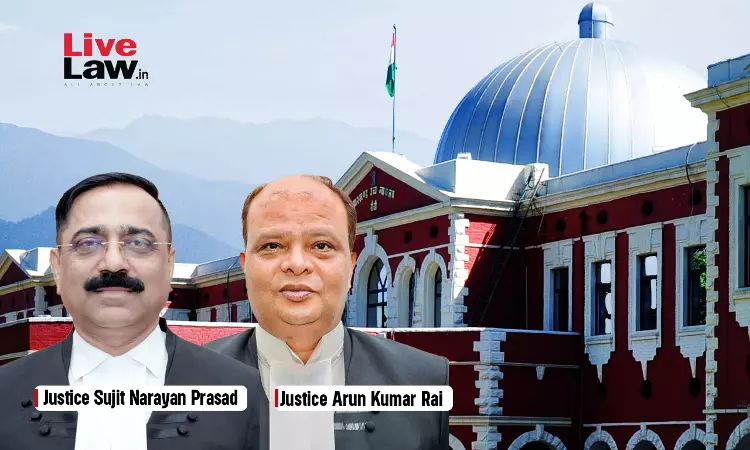
A Division Bench comprising Justice Sujit Narayan Prasad and Justice Arun Kumar Rai made these observations while dismissing a first appeal under Section 19 of the Family Courts Act filed by the husband against the dismissal of his petition for restitution of conjugal rights under Section 9 of the Hindu Marriage Act, 1955.
Background:
The marriage between the appellant-husband and the respondent-wife was solemnised on 12 March 2018. At the time of marriage, the wife was employed as a teacher at a private school, while the husband was employed as a daily-wage medical staff member at a hospital.
The parties lived together only for two to three days after the marriage and thereafter stayed separately since their places of work were in different cities.
Subsequently, differences arose between the parties. The husband alleged that the wife left the matrimonial home without informing him, took her ornaments and belongings, insisted that he should live as a “ghar jamai”, and asked him to prepare divorce papers.
On these allegations, the husband filed a petition under Section 9 of the Hindu Marriage Act seeking restitution of conjugal rights.
On the other hand, the wife submitted that while she was willing to continue the matrimonial life, she was unwilling to leave her employment. She alleged that her husband and his family demanded Rs. 10 Lakhs to purchase a Scorpio vehicle for a side business, and upon her refusal, disputes arose.
It was also highlighted during the proceedings that the husband was earning Rs. 10,000 per month on a contractual basis, whereas the wife was earning approximately Rs. 60,000 per month as a government teacher.
While examining the scope of Section 9 of the Hindu Marriage Act, the High Court reiterated that a decree for restitution of conjugal rights can be granted only when the following conditions are satisfied: (i) the respondent has withdrawn from the society of the petitioner; (ii) such withdrawal is without any reasonable cause or lawful excuse; (iii) there is no other legal ground for refusing the relief; and (iv) the Court is satisfied about the truth of the statements made in the petition.
Applying the above tests to the facts of the case, the Court noted that the primary reason for non-cohabitation between the parties was that they were working in different cities.
The Court held that the respondent-wife, being a woman, has the right to stand financially on her own feet, to pursue her professional goals and to contribute to society as a working professional. The High Court also held that the orthodox concept of a Hindu wife has undergone a “revolutionary change”, and observed:
"It is true that the orthodox concept of the Hindu wife is that she is expected to be Dharmpatni, Ardhangini, Bharya or Anugamini. The literal meaning is that she has to follow the husband and be in his company always as a part of his own body. This orthodox concept of wife and expectations from her to subject herself to husband's wishes has undergone a revolutionary change with education and high literacy in women and with recognition of equal rights to women in the constitution and abolition of sex distinction in all walks of life. She is a partner in marriage with equal status and equal rights with the husband".
The High Court further held that, as marriage partners, neither spouse can claim a superior or better right over the other. While married life involves joint living for mutual conjugal happiness, the Court observed that where both spouses are employed or engaged in professions of their choice, the nature of their married life must necessarily be shaped by the requirements of their respective employments.
The Court posed the question: "Whether a husband has an absolute right to insist that the wife should leave her service and live with him as his dependent only to discharge her marital obligations towards him...?" Answering in the negative, the Court noted:
“Such problems between the modern couples are on increase naturally because there are large number of married partners who are educated and have a career of their own in service or profession and they want to continue with them during the whole period of their married life.”
The Court held that, in cases concerning restitution of conjugal rights, the applicable test is one of “reasonableness”, namely, to determine which of the parties has adopted an unreasonable approach towards joint living.
It observed that, in the present case, both the husband and the wife were employed in different cities and neither was in a position to leave his or her service or place of work.
Applying this test, the Court held that the respondent-wife's insistence on continuing in her service while at the same time seeking to adjust her marital life could not be termed wholly unreasonable.
Furthermore, taking into consideration the evidence regarding the demand for a vehicle and money, the Court found that the wife had not voluntarily withdrawn from the husband's society but had done so under compulsion of circumstances.
The Court emphasised that restitution of conjugal rights does not imply that it is only the wife who must silently follow the husband, but that it is a joint responsibility of both spouses to find a suitable and workable path to sustain their relationship.
The Court therefore held that the respondent-wife had valid and sufficient reasons to live separately.
Accordingly, the High Court agreed with the findings of the Family Court and declined to grant the relief of restitution of conjugal rights.
Title: Jitendra Azad v. Meena Gupta
Case Number: F.A. No. 274 of 2023.
Appearances: Mr. Pankaj Srivastava appeared for the Appellant. Mr. Manoj Kumar Choubey appeared for the Respondent.
Tags


