



POCSO Act Requires Only Greater Punishment Where Same Offence Attracts POCSO & IPC Charges: Jharkhand High Court
LIVELAW NEWS NETWORK
13 Oct 2026 5:25 PM IST
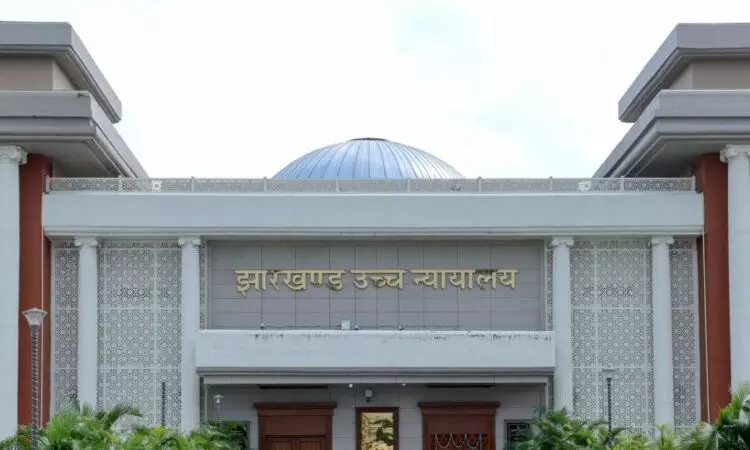
The Jharkhand HC has held that where an accused is convicted under both Section 4 of the POCSO Act and Section 376(2)(f) of the IPC for the same offence, Section 42 of the POCSO Act requires the Court to impose the greater punishment and does not permit separate sentences for both offences to run consecutively.
A Division Bench of Justice Ananda Sen and Justice Pradeep Kumar Srivastava was hearing an appeal against the judgment of conviction dated 02.07.2015 and order of sentence dated 07.07.2015 passed by the Additional Sessions Judge-cum-Special Judge (POCSO), Simdega in Special (POCSO) Case No. 01/2014.
The appellant had been convicted under Sections 376(2)(f), 323 and 506 of the IPC and Section 4 of the POCSO Act. He was sentenced to 10 years' rigorous imprisonment under Section 376(2)(f) IPC and another 10 years' rigorous imprisonment under Section 4 of the POCSO Act, with both sentences directed to run consecutively. He was also sentenced for the offences under Sections 323 and 506 IPC.
Before the High Court, the appellant did not challenge his conviction and confined his submissions to the sentence. It was argued that Section 42 of the POCSO Act provides for an alternate punishment where the accused is found guilty of an offence punishable under both the POCSO Act and another law. The State fairly conceded that the sentences under Section 4 of the POCSO Act and Section 376(2)(f) IPC could not be directed to run consecutively.


The Court referred to Section 42 of the POCSO Act and held that the Trial Court was required to award the greater of the punishments prescribed under the two provisions. At the relevant time, Section 4 of the POCSO Act prescribed imprisonment of not less than seven years extending to imprisonment for life, whereas Section 376(2)(f) IPC prescribed rigorous imprisonment of not less than ten years, which could extend to imprisonment for life. The Court therefore held:
“Therefore, as per provisions of Section 42 of the POCSO Act, the greater sentence is prescribed under Section 376 (2)(f) of I.P.C., which ought to be awarded by the learned trial court. There is no question of awarding the sentence for both offence i.e. under Section 4 of the POCSO Act and Section 376(2)(f) of the I.P.C. with direction to run consecutive.”
Accordingly, the Bench maintained the appellant's conviction under Sections 376(2)(f), 323 and 506 IPC and Section 4 of the POCSO Act, but set aside the sentence imposed under Section 4 of the POCSO Act.
The Court noted that the appellant had already undergone 13 years of imprisonment during the pendency of the appeal and was still in custody. Since he had therefore served the maximum sentence imposed upon him, the Court directed that he be released forthwith, if not required in any other case.
Appearance:
For the Appellant: Mr. Pramod Kumar, Advocate
For the Respondent: Mr. Vineet Kr. Vashistha, Spl. P.P.


