



'Spouses Must Endure Hardships Together': Jharkhand High Court Dismisses Husband's Plea Seeking Divorce Over Wife's Alleged Mental Illness
LIVELAW NEWS NETWORK
3 Nov 2026 8:13 PM IST
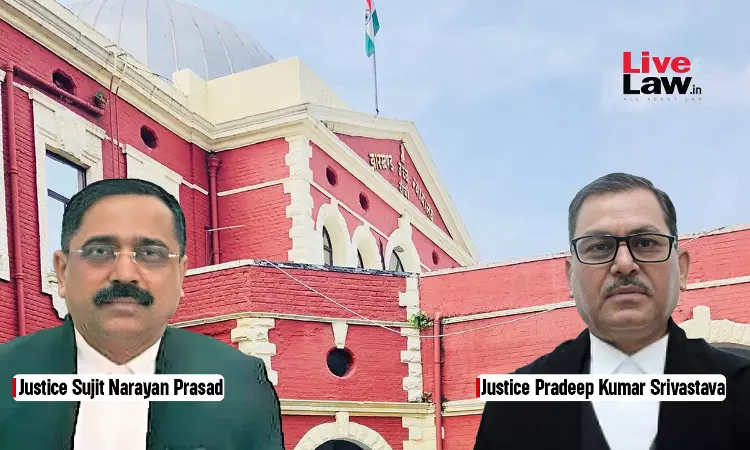
The Jharkhand HC has upheld the dismissal of a husband's divorce petition alleging cruelty and mental illness on the part of his wife, observing that marriage is highly revered in India and spouses must face illness and hardship together. The Court found that the husband had failed to establish either cruelty or mental disorder warranting dissolution of marriage under the Hindu Marriage Act, 1955.
A Division Bench comprising Justice Sujit Narayan Prasad and Justice Pradeep Kumar Srivastava was hearing an appeal against the September 7, 2024 judgment of the Family Court, Chatra, dismissing the husband's divorce petition under Sections 13(1)(ia) and 13(1)(iii) of the Act.
The parties were married on January 31, 2016, and had a son. The husband, who was posted with the CISF in Kota, Rajasthan, alleged that his wife exhibited abnormal, aggressive and erratic behaviour from the beginning of their marriage. He claimed that she would laugh without reason, talk to herself, appear before relatives without proper clothing and behave aggressively. He further alleged that her mental condition had been concealed before their marriage. The wife denied suffering from any such mental illness and alleged that she had been subjected to cruelty over a dowry demand of Rs.5 lakh.


Examining the allegations of cruelty, the High Court noted that neither the husband nor his witnesses had identified specific instances of physical assault, abuse or other conduct supported by sufficient particulars. It observed that the allegations were general and vague, with no cogent evidence establishing cruelty.
The Court further noted that the husband's family had known the wife before the marriage, making the allegation that her purported illness had been concealed unconvincing. On the question of mental disorder, the Bench examined Section 13(1)(iii) of the Hindu Marriage Act, observing that it covers incurable unsoundness of mind and mental disorders of such kind and extent that the petitioner cannot reasonably be expected to live with the respondent.
The Court stated that the alleged mental condition must be established through expert evidence. It also observed that a divorce petition on this ground could not rest merely on one or two instances of alleged mental disorder. Referring to a Supreme Court judgment, the Bench reproduced the following observation:
“Marriage is highly revered in India and we are a nation that prides itself on the strong foundation of our marriages, come hell or high water, rain or sunshine. Life is made up of good times and bad, and the bad times can bring with it terrible illnesses and extreme hardships. The partners in a marriage must weather these storms and embrace the sunshine with equanimity.”
The husband had relied upon a psychological testing report prepared by Dr. M. Jalil, who testified that the wife had a schizophrenic type of mental disorder. However, the Court noted that the report did not clearly establish schizophrenia or certify that her condition was incurable. The report itself recorded only mild perceptual abnormality and no fundamental disturbance in attention and concentration.
Significantly, a Medical Board constituted at RINPAS, Ranchi, had examined the wife in the presence of both parties and concluded that she did not appear to have any psychiatric illness. The Bench noted that the husband had belatedly questioned the Medical Board's findings but had not sought to cross-examine any member of the Board. The Court also considered that the wife had answered questions naturally and appropriately during cross-examination, was caring for the couple's son and had expressed willingness to resume matrimonial life. Meanwhile, the husband admitted that he had not provided maintenance to his wife or child.
Finding insufficient evidence to establish either cruelty or a mental disorder of the nature contemplated under Section 13(1)(iii), the High Court upheld the Family Court's decision and declined to interfere with the dismissal of the divorce petition.
Appearance:
For the Appellant: Mrs. Jyoti Nayan, Advocate
For the Respondent: None


