



- Home
- /
- High Courts
- /
- Karnataka High Court
- /
- Karnataka High Court Sets Aside...
Karnataka High Court Sets Aside Rape Conviction After 10 Yrs, Says Absence Of Expected Injuries Creates Doubt
Sebin James
29 Oct 2026 12:50 PM IST
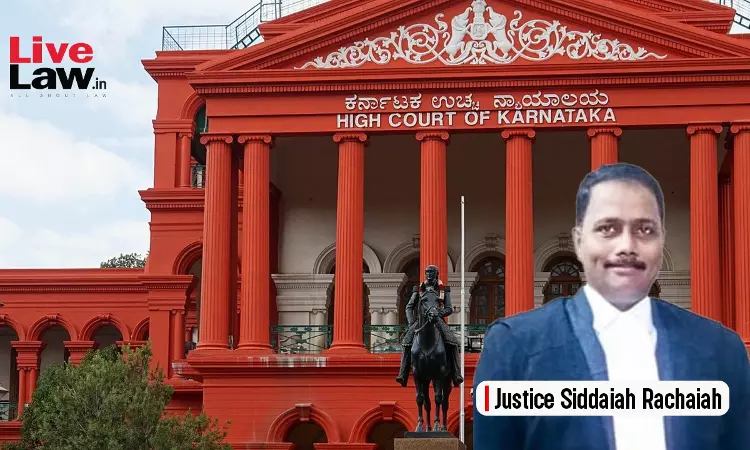
The Karnataka High Court has set aside a man's conviction for rape and criminal intimidation, observing that the absence of expected injuries on the survivor's body raised doubts about the alleged incident. The Court also noted that the possibility of false implication arising from political rivalry between the families could not be ruled out.A single-judge bench of Justice S...
This is a premium content
Available exclusively to
Our subscribers
Subscribe Premium 
INR 1099+GST
Your support helps us to bring you more content at
an affordable subscription scheme !!!
All payment options available
The Karnataka High Court has set aside a man's conviction for rape and criminal intimidation, observing that the absence of expected injuries on the survivor's body raised doubts about the alleged incident. The Court also noted that the possibility of false implication arising from political rivalry between the families could not be ruled out.
A single-judge bench of Justice S Rachaiah reappreciated the evidence and found that the trial court had failed to adequately consider material aspects of the prosecution's case.
The survivor had testified that she was subjected to penetrative sexual assault for nearly half an hour on the rough surface of a toor dal plantation. However, the medical evidence revealed that no external injuries had been found on her body, including her back.
“The presence of injuries on the back of the victim assumes greater significance, because, if such an incident had really occurred on a rough surface without clothes, she must have sustained injuries on her body. The absence of any injuries certainly creates doubt regarding the alleged incident,” the Court observed.
It noted that although the trial court had held that the absence of external injuries was not necessarily fatal to the prosecution's case, it had failed to adequately consider the specific circumstances of the alleged assault, including its duration and the rough surface on which it was said to have occurred.
The Court also considered the possibility of false implication arising from political rivalry between the families. It noted that PW-4, a relative of the survivor who was also an advocate, had helped the family approach the hospital after the alleged incident. During cross-examination, he admitted that he had contested the Panchayat elections but secured only six votes, while the accused's father had won the election.
“On considering the evidence of PW-4 and his admissions, it is clear that the family members of the victim approached him immediately after the incident... PW-4 is not only an Advocate but also a defeated candidate in the Panchayat election, and he has been defeated by the father of the accused,” the Court noted.
The Court further observed that the survivor's mother and nephew were hearsay witnesses regarding the alleged assault, while an independent witness to the spot mahazar had turned hostile and failed to support the prosecution's case.
The appellant had been convicted by the II Additional District and Sessions Judge, Chikkaballapur, of offences punishable under Sections 376 (rape) and 506 (criminal intimidation) of the Indian Penal Code (IPC).
According to the prosecution, the incident occurred in November 2007, when the survivor, who was allegedly a minor at the time, was cleaning utensils outside her house. The accused allegedly dragged her to a toor dal plantation, removed her clothes and sexually assaulted her for nearly half an hour. Her mother and grandmother subsequently found her at the spot.
Advocate S Shankarappa, appearing for the appellant, argued that the trial court's judgment was contrary to the evidence on record and that the survivor's testimony contained several contradictions, omissions and improvements. He also relied on the medical evidence, which recorded the absence of external injuries. The doctor had further stated that no spermatozoa were detected in the vaginal secretions.
Opposing the appeal, the High Court Government Pleader for the State argued that the trial court had properly appreciated the evidence and that the absence of seminal stains or spermatozoa did not, by itself, undermine the prosecution's case.
Upon reappreciating the evidence, the High Court held that the possibility of false implication could not be ruled out and that the trial court ought to have extended the benefit of doubt to the appellant.
Accordingly, the Court allowed the appeal, set aside the conviction and sentence, and acquitted the appellant of the offences under Sections 376 and 506 IPC.
Tags

Sebin James
Sebin James is a Correspondent with LiveLaw, covering the Karnataka High Court

