



- Home
- /
- High Courts
- /
- Karnataka High Court
- /
- Independent Witness Need Not...
Independent Witness Need Not Personally Believe Complainant's Reputation Was Lowered For Defamation Case To Proceed: Karnataka High Court
LIVELAW NEWS NETWORK
16 Nov 2026 6:00 PM IST
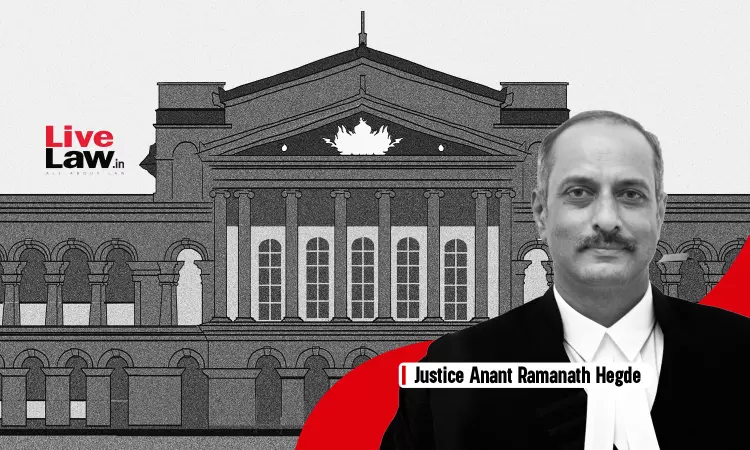
The Karnataka High Court on Thursday (November 12) held that an independent witness need not necessarily state that a complainant's reputation has been lowered in the witness's own estimation for a court to take cognizance of a criminal defamation complaint under Section 356 of the Bharatiya Nyaya Sanhita (BNS), 2023.A single judge bench of Justice Anant Ramanath Hegde clarified that whether...
This is a premium content
Available exclusively to
Our subscribers
Subscribe Premium 
INR 1099+GST
Your support helps us to bring you more content at
an affordable subscription scheme !!!
All payment options available
The Karnataka High Court on Thursday (November 12) held that an independent witness need not necessarily state that a complainant's reputation has been lowered in the witness's own estimation for a court to take cognizance of a criminal defamation complaint under Section 356 of the Bharatiya Nyaya Sanhita (BNS), 2023.
A single judge bench of Justice Anant Ramanath Hegde clarified that whether such testimony is required depends on the nature of the allegedly defamatory statements, the material available and the surrounding circumstances.
The Court explained that where the allegedly defamatory statements are inherently capable of lowering a person's reputation, the Magistrate may take cognizance and issue process without insisting that an independent witness personally believes the complainant's reputation has been lowered.
“If the imputation is of such a nature that the Court prima facie finds that it is inherently capable of lowering the moral or intellectual character of the complainant, or projects him as a person of bad character or as having engaged in conduct generally considered disgraceful, then the Court may without insisting on a statement from a witness that, in his own estimation, the complainant's reputation is lowered, may take cognizance and issue the process based on the statements of the complainant and the witness who state that the complainant's reputation is lowered in the estimation of others,” the Court held.
However, the Court clarified that where the allegedly defamatory statement is not prima facie capable of lowering the complainant's reputation, a mere assertion that the reputation has been lowered may not be sufficient.
In such circumstances, the Magistrate may require additional material or testimony from an independent witness stating that the complainant's reputation has been lowered in the witness's own estimation.
The Court made these observations while dismissing a petition filed by expelled BJP legislator Basanagouda Ramanagouda Patil Yatnal, seeking to quash criminal defamation proceedings initiated on a complaint filed by Congress leader Shivananda S. Patil.
The complaint, filed on July 18, 2025, alleged that Yatnal had made defamatory statements against Patil on April 30, 2025, which were broadcast on a YouTube channel named 'Gadinada Kranti'.
Yatnal challenged the Magistrate's order taking cognizance of the alleged offence and issuing summons, as well as the Sessions Court's order affirming it.
His primary contention was that the trial court could not have taken cognizance merely on the basis of the complainant's statement and the statements of two witnesses, as the requirements of Explanation 4 to Section 499 of the Indian Penal Code (IPC), corresponding to Section 356(1) of the BNS, had not been satisfied.
Yatnal argued that unless a person whose estimation of the complainant had actually been lowered appeared before the Court and testified to that effect, the essential ingredients of criminal defamation would not be established.
On the other hand, counsel for the complainant submitted that the statements attributed to Yatnal were defamatory on their face and had been widely circulated on social media. It was argued that the Magistrate was not required to insist on testimony from a person who personally believed that the complainant's reputation had been lowered.
Explanation 4 to Section 356(1) of the BNS provides that an imputation harms a person's reputation only if it directly or indirectly lowers that person's moral or intellectual character, standing in relation to caste or calling, or credit in the estimation of others, or causes the person to be regarded as being in a disgraceful bodily condition.
Examining the provision, the High Court observed that the expression “in the estimation of others” does not necessarily mean that the particular person whose opinion of the complainant was allegedly affected must invariably be examined as a witness at the stage of taking cognizance.
The Court said that possible reputational harm could, depending on the nature of the allegations and the available material, be prima facie inferred from the contents of the allegedly defamatory statement and the circumstances surrounding its publication.
In the present case, the Court noted that the two witnesses examined on behalf of the complainant had stated that they continued to hold a good opinion of him and considered the allegations false. However, they also stated that the allegations had lowered the complainant's reputation in the estimation of others.
The Court observed that while the witnesses had not identified the particular persons whose opinion of the complainant had allegedly changed, this did not automatically invalidate the Magistrate's decision to take cognizance.
It further noted that the complainant and two witnesses had been examined before the Magistrate and that there was no procedural violation.
Referring to the statements attributed to Yatnal, the Court observed:
“On perusal of the statement, there is no difficulty in taking a prima facie view that the statements cast serious aspersions on the complainant's integrity and character and are inherently capable of lowering the reputation of the complainant.”
The Court clarified that at the stage of taking cognizance, the Magistrate was not required to determine whether the evidence would ultimately be sufficient to convict the accused.
“Whether the public or any person believed the imputation to be true or whether the complainant's reputation was in fact lowered in the estimation of others, are the questions to be considered at the time of trial,” it observed.
Appearance: Advocate DALWAI VENKATESH for Petitioner.
Senior Advocate RAVI B NAIK for Respondent.
Tags


