



- Home
- /
- High Courts
- /
- Karnataka High Court
- /
- 'Lawmaker Must Be Circumspect In...
'Lawmaker Must Be Circumspect In Speech': Karnataka High Court Refuses To Quash FIR Against Congress Leader For Abusing Woman Official
Malavika Prasad
23 Jan 2026 11:44 AM IST
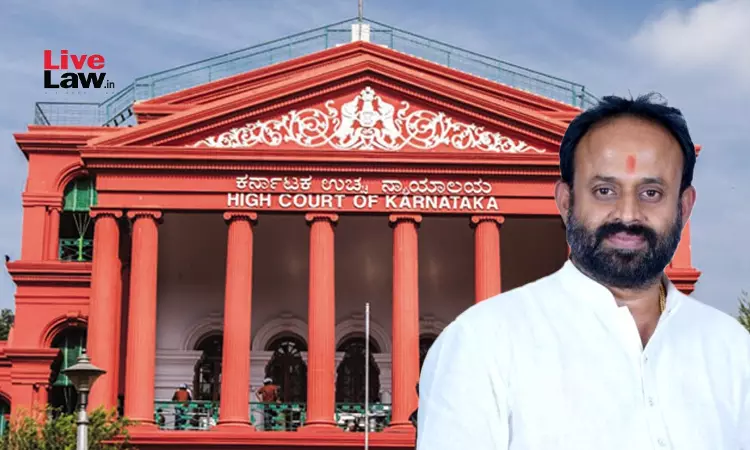
Refusing to quash an FIR against Congress leader Rajeev Gowda BV accused of abusing a woman municipal commissioner over removal of "unauthorized" banners, observing that lawmakers while making speeches are expected to be circumspect specially while addressing a woman, that too a public servant. For context, a film promotion programme for 'Cult' movie was to be conducted on 13-01-2026 at...
This is a premium content
Available exclusively to
Our subscribers
Subscribe Premium 
INR 1099+GST
Your support helps us to bring you more content at
an affordable subscription scheme !!!
All payment options available
Refusing to quash an FIR against Congress leader Rajeev Gowda BV accused of abusing a woman municipal commissioner over removal of "unauthorized" banners, observing that lawmakers while making speeches are expected to be circumspect specially while addressing a woman, that too a public servant.
For context, a film promotion programme for 'Cult' movie was to be conducted on 13-01-2026 at Nehru Stadium, Shidlaghatta Town which is stated to be under the leadership of the petitioner. Banners with petitioner's portrait were installed all over the city Fort area, wherein certain banners fell down and had hit certain vehicles. Against this a complaint was made to Municipal Commissioner who had cleared the banners as it was disturbing the public.
It is alleged that on 12-01-2026 the petitioner called the complainant and "hurls abuses which were not in good taste". The FIR was registered under Sections 132(Assault or criminal force to deter public servant from discharge of his duty), 224(Threat of injury to public servant), 352(Intentional insult with intent to provoke breach of peace), 351(3)(Criminal intimidation) and 56(Abetment of offence punishable with imprisonment) of the BNS. Against this petitioner moved the high court seeking quashing.
Justice M Nagaprasanna also remarked that BNS Section 79, a cognizable offence, was not invoked by the prosecution in the present case noting that the provision states that whoever by words, sound, gesture or act intends to insult the modesty of a woman would be punishable with imprisonment which may extend upto 3 years besides fine.
Lawmaker must be circumspect in speech specially when addressing a woman public servant
"It is difficult to comprehend as to how the prosecution has not invoked this offence, notwithstanding the nature of the conversation attributed to the petitioner, as it was against a woman who is a public servant. A person who once held the status of a lawmaker is expected to be circumspect and restrained in his speech, particularly when addressing a woman, a public servant who is only discharging her statutory duty.
It is in public domain or a matter of public knowledge that banners and flexes, whether for film 20 promotion or otherwise, erected indiscriminately across cities create menace to the public, impede movement, and erode civic aesthetics.The State appears to have remained blissfully indifferent to the rampant proliferation of such banners and flexes across public spaces. Such acts would squarely fall within the ambit of Karnataka Open Places (Prevention of Disfigurement) Act, 1981, yet action is seldom taken against such disfigurement. It is high time that the State wakes up and enforces the law in earnest against unauthorised banners, placards, and flexes"
Municipal Commissioner performed her duty, cannot be abused
The court further said that the municipal commissioner diligently performed her duty and when a public servant performs lawful duties, "no individual can claim license to intimidate or abuse such public servant for mere discharge of public functions".
"Therefore, abuse directed at a public servant, with a view to deter or obstruct them from performing official duties, would undoubtedly attract penal consequences. In the present matter, the complainant is not merely a public servant, but also a woman and no man can be permitted to speak in the language so offensive, so as to be beyond the pale of civility and lawful tolerance. At the very least, the language employed deserves investigation, as it is settled principle of law that an FIR is not an encyclopedia of offences," the court said.
The court also noted that the FIR crime was registered on 14-01-2026 and the petitioner's plea was preferred on 19-01-2026 within 5 days. It said that the petitioner, seeks interference at this stage when investigation is yet to meaningfully unfold.
The court observed that if the FIR discloses commission of cognizable offence, the Court should not ordinarily stifle investigation and interference is permissible only in the narrowest exceptional circumstances.
It thus dismissed the petition.
Case title: SRI RAJEEV GOWDA B. V., v/s STATE OF KARNATAKA
Click Here To Read/Download Order
Citation: 2026 LiveLaw (Kar) 17
Malavika Prasad
Malavika Prasad is a Desk Editor with LiveLaw

