



- Home
- /
- High Courts
- /
- Karnataka High Court
- /
- S.23 Senior Citizens Act | Express...
S.23 Senior Citizens Act | Express Recital In Gift Deed For Maintenance By Transferee Not Mandatory: Karnataka High Court
LIVELAW NEWS NETWORK
10 Feb 2026 2:23 PM IST
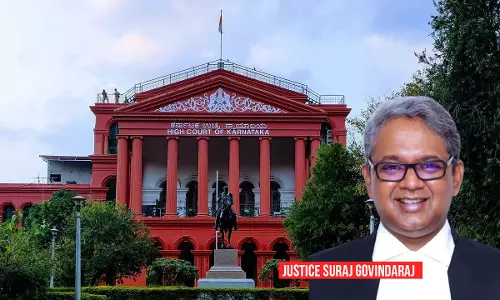
The Karnataka High Court has held that a gift deed through which a senior citizen transfers his property to the transferee need not contain an "express recital" of maintenance of the senior citizen, to claim that such transfer is void under Section 23 Maintenance and Welfare of Parents and Senior Citizens Act.In doing so the court held that maintenance of senior citizen under Section 23...
This is a premium content
Available exclusively to
Our subscribers
Subscribe Premium 
INR 1099+GST
Your support helps us to bring you more content at
an affordable subscription scheme !!!
All payment options available
The Karnataka High Court has held that a gift deed through which a senior citizen transfers his property to the transferee need not contain an "express recital" of maintenance of the senior citizen, to claim that such transfer is void under Section 23 Maintenance and Welfare of Parents and Senior Citizens Act.
In doing so the court held that maintenance of senior citizen under Section 23 is implicit wherein the provision seeks to protect the trusting nature of senior citizens, who may be financially dependent on children and rely on trust and moral expectations.
Section 23 (transfer of property to be void in certain circumstances) states that any senior citizen who has transferred by way of gift or otherwise, his property subject to the condition that the transferee shall provide the basic amenities, physical needs and who refuses or fails to provide it, the transfer of property shall be deemed to have been made by fraud, coercion or under undue influence.
Justice Suraj Govindraj in his order said:
"I am therefore of the considered opinion that the condition of maintenance under Section 23 is implicit when a senior citizen or parent transfers his self-acquired property particularly by way of gift or relinquishment, without consideration in favour of his son or daughter. The law must account for the social reality that senior citizens act on trust, familial assurances, and moral expectations rather than on legal formalities. In our society, aged parents rarely insist upon written stipulations while transferring property to their children. Such transfers are ordinarily founded on social norms and moral obligations, which the Act of 2007 seeks to protect and enforce through statutory intervention.
The trusting nature of senior citizens, especially in rural Karnataka, coupled with emotional and financial dependence on their children, is a social reality expressly recognised by the Act. To insist upon an express recital of maintenance in every such gift deed would defeat the protective object of the statute and render Section 23 nugatory. I am therefore of the considered view that the obligation to maintain a senior citizen can validly be inferred from the surrounding circumstances, the relationship between the parties, and their subsequent conduct, and that an express recital in the deed of transfer is not mandatory for invoking Section 23(1) of the Act of 2007"
"Where a gift deed is drafted by the donees and executed by an illiterate senior citizen on trust and familial assurances, an allegation of an oral understanding to provide care is sufficient compliance with Section 23(1), and insistence on an express contractual clause would defeat the protective object of the Act...an express recital in the gift deed obligating the donees to maintain the senior citizen is not mandatory for invoking Section 23(1) of the Act of 2007, and that such obligation can be inferred from the surrounding circumstances and conduct of the parties," the court held.
Background
The petitioner father, a senior citizen, has four children He contended that his daughters Shivamma and Puttamma assured him that they would take care of his maintenance, wellbeing, and daily needs during his old age. On the basis of such assurance, they had fraudulently procured a gift deed transferring the father's land in their favour and registered before the jurisdictional Sub-Registrar.
The names of the two daughters were mutated in the revenue records. Soon thereafter, the daughters neglected the Petitioner and failed to provide him with food, shelter, and other basic necessities. The Petitioner filed an application under Section 23(1) Maintenance and Welfare of Parents and Senior Citizens Act, seeking annulment of the gift deed before the authorities.
During the pendency of the proceedings before the Assistant Commissioner, one of the daughters, Shivamma, expired; she was survived by her son, Respondent No.6, who was brought on record as her legal representative. The other daughter, Respondent No.5 – Puttamma, entered appearance before the Assistant Commissioner and categorically stated that she had no objection to the application being allowed.
However, Respondent No.6 filed objections contending that the Petitioner possessed several ancestral properties and that the application under Section 23(1) of the Act of 2007 was motivated by ill will and malafides.
The Assistant Commissioner rejected the petitioner's application primarily on the ground that the gift deed did not contain an express clause obligating the donees to maintain the Petitioner. His appeal before the Deputy Commissioner was also dismissed, against which the petitioner moved the high court.
Findings
The court held that the Deputy and Assistant Commissioner had failed to examine as to who controlled the drafting process and whether the donor (petitioner) had any real agency or understanding of the contents of the gift deed.
"This omission is particularly grave in proceedings under a welfare statute, where vulnerability of the applicant is a central consideration. The authorities under the Act must not adopt a hyper-technical approach that reduces the statute to a dead letter. Failure to consider surrounding circumstances and conduct of the parties would result in and amounts to a failure to exercise jurisdiction under Section 23," the court held.
It said that by rejecting the petitioner's application solely on a technical omission in a document admittedly drafted by the donees, the authorities have, in effect, rewarded misuse of trust and penalised vulnerability of the senior citizen/parent, which is impermissible in law
The court also ruled that property in question is not ancestral property in which any respondent could assert a birthright. It is the self-acquired property of the Petitioner; thus the respondents cannot assert any independent entitlement to such property divorced from the Petitioner's welfare and subsistence.
While allowing the petition, as well as the petitioner's application before the authorities under Section 23 the court annulled the gift deed.
Before concluding the court remarked:
"The statute recognises that old age often brings physical frailty, emotional dependence, and diminished bargaining power. Transfers of property by senior citizens to their children or close relatives are rarely commercial or calculated acts; they are, more often than not, gestures of trust, affection, and hope for care. When such trust is breached, and the senior citizen is rendered neglected or vulnerable, the law cannot remain a silent spectator. Section 23 is a legislative affirmation that age, trust, and vulnerability cannot be converted into instruments of exploitation. Courts and authorities are therefore duty-bound to ensure that the autonomy of senior citizens is protected, not merely in form, but in substance, by undoing transactions that operate unjustly against them".
Case title: SRI. VENKATAIAH v/s THE STATE OF KARNATAKA and OTHERS
WRIT PETITION NO.13313 OF 2025
Click Here To Read/Download Order
Citation: 2026 LiveLaw (Kar) 42
Tags


