



- Home
- /
- High Courts
- /
- Karnataka High Court
- /
- Karnataka HC Suggests State To...
Karnataka HC Suggests State To Issue Guidelines On Background Check For Migrant Workers, Calls For Balanced Approach Without Stigmatization
LIVELAW NEWS NETWORK
5 March 2026 6:41 PM IST
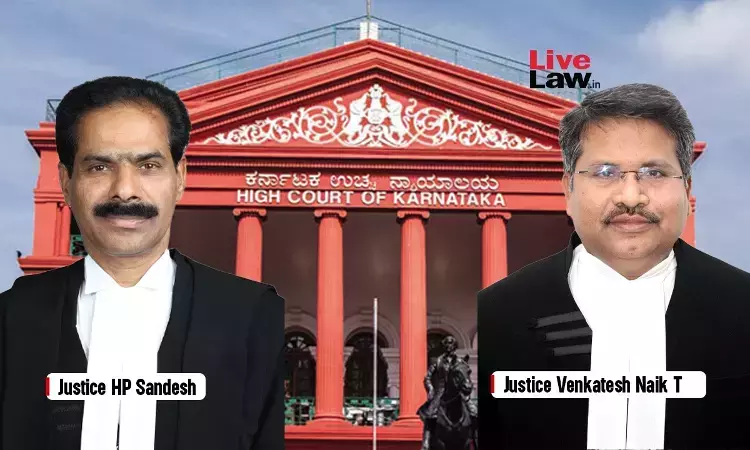
The Karnataka High Court has suggested to the State government to issue guidelines concerning background verification, identity confirmation or registration of inter-state migrant workers, while hearing a case wherein five persons stated to be migrant workers were accused of a triple murder. In doing so the court also emphasized need for preventive safeguards through strict enforcement...
This is a premium content
Available exclusively to
Our subscribers
Subscribe Premium 
INR 1099+GST
Your support helps us to bring you more content at
an affordable subscription scheme !!!
All payment options available
The Karnataka High Court has suggested to the State government to issue guidelines concerning background verification, identity confirmation or registration of inter-state migrant workers, while hearing a case wherein five persons stated to be migrant workers were accused of a triple murder.
In doing so the court also emphasized need for preventive safeguards through strict enforcement of existing labour and criminal regulatory mechanisms as well as a introduction of mandatory police verification mechanism before engaging workers who reside within private premises. The court however also emphasized while strengthening the mechanism migrant workers must not be stigmatized calling for a balanced approach.
The court was hearing the State's appeal challenging sessions court order acquitting four persons for the murder of a family of three.
A division bench of Justice HP Sandesh and Justice Venkatesh Naik in its order said:
"It is seen in recent times, incidents have been reported where Inter-State migrant, who were engaged for domestic or construction work, have allegedly been involved in serious offences such as murder and robbery in the very premises where they were employed. In many such cases, the house owners or employers had engaged the workers without conducting any background verification, identity confirmation, or registration with the concerned authorities. Some of such migrant workers frequently committing crimes and fleeing away and as such, the same have to be streamlined by issuance of certain guidelines by the State Government.
This situation highlights the urgent need for preventive safeguards through strict enforcement of existing labour and criminal regulatory mechanisms. Further, a structured and mandatory police verification mechanism should be introduced before engaging workers who reside within private premises, similar to tenant verification systems, with simplified online registration portals accessible to the public. At the same time, widespread public awareness campaigns through print, electronic, and social media platforms should be undertaken to educate citizens about safe hiring practices".
The bench however said that while strengthening preventive mechanisms, it is equally important to ensure that migrant workers are "not stigmatized as a class" since criminal liability is individual in nature and the constitutional guarantees under Articles 14 and 21 of the Constitution of India protect the dignity and equality of all persons.
The court thus emphasized on "balanced judicial directions aimed at regulation, awareness, and accountability without discrimination which would serve the larger interest of public safety and social justice".
"In this case, the migrant labours who were from West Bengal came to Bengaluru in search of job, entered the house of deceased persons as maid, they made criminal conspiracy, committed murder of deceased persons (three deaths) and robbed gold, silver and other valuable properties in their house and fled away. They were arrested after twenty months of the incident. Inspite of it, the prosecution was able to secure accused Nos.1 and 2 from the State of West Bengal and as per their voluntary statement, accused Nos.3 and 4 were secured in Bengaluru. Thus, there was difficulty in tracing and securing the accused persons. In this regard, streamlining of the aforesaid guidelines is very much required," the bench added.
The prosecution alleged that accused No.2, Suchitra Haldar, was working as a maid in the house of the deceased persons–Purushotham Lal Sachidev, Deepak Sachidev and Rita Sachidev.
It was alleged that accused No.1 Deepak Haldar the husband of accused no. 2, accused No.3 Mohammed Sarbal @ Raj, accused No.4 Bidan Shikari and accused No.5 Pradeep Naskar @ Mucche(absconding accused), were the friends of Deepak Haldar.
It was alleged that they all conspired together to rob cash, gold ornaments and valuable articles from the house of the deceased family and also hatched a plan to commit murder.
On 15.02.2009, accused persons went to the deceased house and allegedly murdered the deceased persons. They thereafter robbed gold Mangalya chain, two gold bangles, one gold ring, cash of Rs.30,000 kept in the almirah, seven silk sarees, a wall clock and two silver lamps and attempted to conceal the deadbodies.
The bench referred to the evidence of the witnesses and said,
"In order to prove the 'homicidal death' of the deceased, the prosecution examined PW1, who saw the dead body of the deceased persons for the first time in the house of the deceased situated at R.T. Nagar, Bengaluru. He has stated that soon after the incident, he came to the house, opened the door of the house and saw the dead body of deceased Purushotham Lal Sachidev, Deepak Sachidev and Rita Sachidev, in the house. PW2-Dr. Rajkumar, relative of the deceased also, stated that he saw the dead body of the deceased persons in the house of the deceased. PW3- Raghuveer Rajkumar, relative of the deceased, and PW32- Anurag Sachidev, adopted son of the deceased Purushotham Lal Sachidev and Rita Sachidev, have stated that they saw the dead body of the deceased persons in the house of the deceased. In order to support the oral testimonies of these witnesses, the prosecution examined PW4-Anand, in whose presence, the inquest mahazar was conducted on the dead body of deceased Purushotham Lal Sachidev. PW7-Vasanth Kumar has stated that the Police conducted inquest mahazar as per Ex.P6 on the dead body of Deepak Sachidev and PW9- Chanchal Pahava has stated that the Police have conducted inquest mahazar as per Ex.P7 in his presence on the dead body of Rita Sachidev."
The court noted that the doctor who conducted the postmortem examination stated that there was external injury on the dead body of Deepak Sachidev, and opined that death was due to respiratory failure consequent to the ligature strangulation and the material said to be used is NOKIA mobile charger wire. He said that the death of the Rita Sachidev was also due to respiratory failure consequent to the ligature strangulation wherein the material said to be used is a two pin plug wire. He gave the same evidence with respect to the son's death.
The doctor also stated in his evidence that he examined the material objects, i.e., the two pin plug wire, Duppatta and Nokia Mobile Charger wire and opined that death could be caused by strangulation with the help of the plastic wires and Duppatta which were found on the dead body of accused persons.
"The overall evidence of PW21-Dr.Nagaraj and the contents of Exs.P41 to P43 post-mortem examination reports revealed that the cause of death of deceased was due to asphyxia as a result of strangulation. Hence, as per the oral evidence of Doctor, who conducted the autopsy and the evidence of inquest mahazar witnesses and PW1 to PW3 and PW32, who are relatives of the deceased, who saw the dead body of the deceased persons goes to show that deceased Purushotham Lal Sachidev, Deepak Sachidev and Rita Sachidev died due to strangulation. Thus, the oral evidence is corroborated by medical evidence as to the cause of death of deceased. Hence, the homicidal death of stands proved," the court said.
The court further referred to the evidence of the witnesses and said that the same established that the accused had a clear opportunity to execute their motive. It noted that the accused had acquainted themselves with deceased persons and they committed murder by strangulation and robbed the deceased of their valuables.
This the court said, showed the motive of the accused persons which was to make wrongful gain by robbing the valuables of the deceased persons.
The court thus held that the prosecution had succeeded in proving guilt of the accused persons beyond reasonable doubt for the offence under Sections 120B(criminal conspiracy), 201 (disappearance of evidence) and 302(murder) of IPC and found "glaring infirmity" in the trial court's findings.
On the sentence the court found that the present case is not a case wherein it can be held that imposition of death penalty is the only alternative. It said tha it was not clear that the role attributed to the accused has been similar as that of the rarest of the rare case.
The court thus sentenced the accused persons to life imprisonment and allowed the State's appeal.
The court directed its Registry to send a copy of its judgment to the State's Chief Secretary for taking necessary action and implementation.
Case title: STATE OF KARNATAKA v/s DEEPAK HALDAR & Ors.
CRIMINAL APPEAL NO.1225 OF 2016
Click Here To Read/Download Order
Citation: 2026 LiveLaw (Kar) 98


