



- Home
- /
- High Courts
- /
- Karnataka High Court
- /
- Person Can Profess Lingayat Faith...
Person Can Profess Lingayat Faith Yet Belong To Ganiga Caste, Both Not Mutually Exclusive Identities: Karnataka High Court
Malavika Prasad
19 Feb 2026 11:55 AM IST
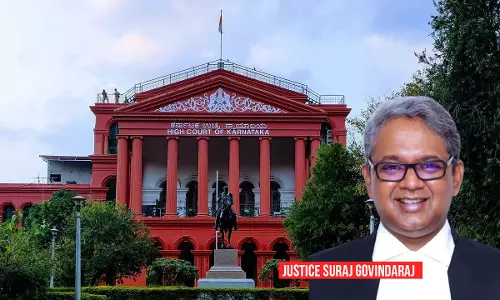
The Karnataka High Court has observed that the Lingayat religious community and Ganiga–which is a distinct occupational caste–are not mutually exclusive, wherein a person may profess Lingayat community faith yet belong to Ganiga caste within the broader community fold. Justice Suraj Govindaraj was considering whether in law, "Lingayat" (religious community) and "Ganiga" (oil pressers)...
This is a premium content
Available exclusively to
Our subscribers
Subscribe Premium 
INR 1099+GST
Your support helps us to bring you more content at
an affordable subscription scheme !!!
All payment options available
The Karnataka High Court has observed that the Lingayat religious community and Ganiga–which is a distinct occupational caste–are not mutually exclusive, wherein a person may profess Lingayat community faith yet belong to Ganiga caste within the broader community fold.
Justice Suraj Govindaraj was considering whether in law, "Lingayat" (religious community) and "Ganiga" (oil pressers) are mutually exclusive identities, or whether Ganiga may subsist as a distinct caste group within the broader Lingayat fold.
After examining the precedents the court held:
"Lingayat and Ganiga are not mutually exclusive identities; Ganiga is a distinct occupational caste which may subsist within the broader Lingayat/Veerashaiva fold; A person may simultaneously be Lingayat by religious affiliation and Ganiga by caste classification; The description “Hindu Lingayat” in school records does not, by itself, negate Ganiga identity. However, this recognition must be applied with care.
The fact that Ganigas may exist within the Lingayat fold does not mean that every Lingayat can claim Ganiga identity. The coexistence of identities is a matter of legal possibility; the establishment of such identity in a given case is a matter of proof. The authorities are therefore required to conduct a careful and evidence-based enquiry in each case where a claimant described in ancestral records as “Lingayat” asserts Ganiga identity. The enquiry must examine documentary consistency, familial records, statutory certificates, and historical context. Mere assertion is insufficient; credible and verifiable evidence is required".
Referring to sociological and historical structure of the Lingayat/Veerashaiva community in Karnataka the court said that it a broad religious denomination which, historically, has encompassed within it several occupational and caste groups.
"The Havanur Commission Report, extracted and relied upon by the Hon'ble Supreme Court in M.V. Chandrakanth v. Sangappa, records that the Veerashaiva/Lingayat community evolved by incorporating distinct caste-blocks, many of which retained their occupational and social identity even while participating in a common denominational framework. The Commission specifically identified Ganigas (oil pressers), Kumbaras (potters), Kshowrikas (barbers), Agasas (washermen), and other such - groups as caste-units that historically existed within or alongside the Veerashaiva fold while maintaining separate identity. The decision of this Court in Prabhushankar K.V. v. Selection Committee for Medical Colleges is a seminal authority on this issue. It was categorically held therein that the mere description of a person as “Lingayat” does not preclude him from belonging to a distinct backward sub-caste such as Ganiga. This Court recognised that denominational identity and caste identity may operate simultaneously. A person may profess the Lingayat faith and yet belong to a specific occupational caste within that fold," the court noted.
The court further referred to Supreme Court's order in M.V. Chandrakanth v. Sangappa which recognised that the absence of a sub-caste description in earlier records does not conclusively negate such identity. If the father was in fact Ganiga, the non-mention of that sub-caste in school records prepared before reservation policy became legally relevant would not compel a conclusion that the family is non-Ganiga.
The court noted that the Supreme Court had also examined the Notification dated 03.03.2002 classifying “Ganiga” under Category IIA; the Order dated 27.01.2009 temporarily including Lingayat/Veerashaiva-Ganiga under Category III-B; and Notification dated 28.02.2009 restoring the earlier classification.
The court said that the Supreme Court observed that the legislative and executive intent underlying these notifications was not to exclude LingayatGanigas from the benefits available to Ganigas, but to ensure proper classification. The brief reclassification and immediate restoration demonstrate recognition that Lingayat-Ganigas form part of the Ganiga community for reservation purposes. The Supreme Court observed that denominational identity (Lingayat) does not erase occupational caste identity (Ganiga). The broader religious descriptor does not extinguish the specific caste classification.
The high court thereafter said that Government Notifications analysed in M.V. Chandrakanth further reinforce that Lingayat Ganigas are not to be denied the benefits available to Ganigas under Category II-A. The restoration of classification under the Notification dated 28.02.2009 reflects the State's recognition that Lingayat-Ganigas fall within the Ganiga grouping for reservation purposes.
Background
The petitioner was serving as a Police Constable since his appointment in 1998. He belongs to the Vishwakarma community, which falls under Category 2A of the Other Backward Classes. It is alleged that respondent No.3, in fact, belongs to the Lingayat caste, which does not fall under Category 2A. In 2009, pursuant to a Government Notification inviting applications for recruitment to the post of Police Sub-Inspector (PSI), both the petitioner and respondent No.3 applied for the said post.
According to the petitioner, respondent No.3 secured selection during the recruitment process of 2010–11 by falsely representing that he belonged to the Lingayat Ganiga community, which is classified under Category 2A. The petitioner submitted a complaint before the Commissioner, Backward Classes Welfare Department. Pursuant thereto, the District Caste and Income Verification Committee, which conducted an inquiry and, by order dated 16.06.2010, rejected the request for issuance of a caste certificate under Category 2A in favour of respondent No.3.
Respondent No.3 preferred an appeal and by order dated 13.07.2010, the appellate authority allowed the appeal and remanded the matter to Committee for fresh consideration after affording an opportunity to respondent No.3 to produce all relevant documents.
Upon remand, the Committee observed that there was a correction/insertion in the school records of respondent No.3 indicating his caste as “Lingayat Ganiga.” Proceeding on the presumption that such correction was made pursuant to a valid order, the Committee directed issuance of a caste certificate under Category 2A in favour of respondent No.3.
The order also records that the President of the Akhila Bharath Ganigara Sangha had recommended issuance of the caste certificate. This was challenged by the petitioner but his appeal was dismissed. Against this the petitioner moved the high court.
In the present case the court held that the documentary material on record sufficiently established that respondent No.3 belongs to the Ganiga community under Category II-A and the broader descriptor “Lingayat” in certain ancestral records does not negate that conclusion.
With respect to the orders passed by the authorities granting the caste certificate the respondent 3 the court said that the same does not violate the principles of natural justice, are not perverse and are supported by material evidence.
It however clarified that findings recorded in the judgment are based on the documentary material placed before the statutory authorities and examined by the Court.
The plea was dismissed.
Case title: T N JAGADEESH v/s CHAIRMAN / DEPUTY COMMISSIONER THE DISTRICT CASTE AND INCOME VERIFICATION COMMITTEE & Ors.
WRIT PETITION NO. 24836 OF 2016
Click Here To Read/Download Order
Citation: 2026 LiveLaw (Kar) 63

Malavika Prasad
Malavika Prasad is a Desk Editor with LiveLaw

