



- Home
- /
- High Courts
- /
- Karnataka High Court
- /
- 'Uniformed Services Require Greater...
'Uniformed Services Require Greater Moral Behaviour': Karnataka High Court Upholds Withholding Of Cop's Increment Despite Acquittal
Amruta Gangajaliwale
9 Nov 2026 1:00 PM IST
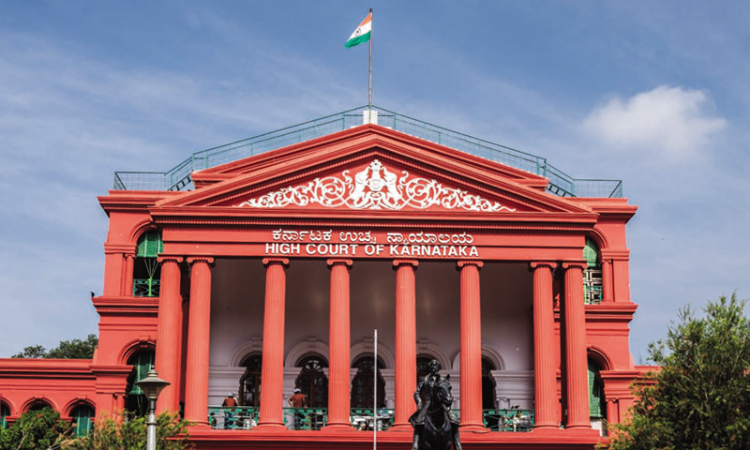
The Karnataka High Court has observed that uniformed services require a “greater degree of moral behaviour” and a cop cannot be expected to engage in acts of indiscipline. In doing so the court refused to set aside the order withholding a constable's annual increment, despite his acquittal in the criminal cases registered against him.A Division Bench of Justice Ashok S. Kinagi and...
This is a premium content
Available exclusively to
Our subscribers
Subscribe Premium 
INR 1099+GST
Your support helps us to bring you more content at
an affordable subscription scheme !!!
All payment options available
The Karnataka High Court has observed that uniformed services require a “greater degree of moral behaviour” and a cop cannot be expected to engage in acts of indiscipline.
In doing so the court refused to set aside the order withholding a constable's annual increment, despite his acquittal in the criminal cases registered against him.
A Division Bench of Justice Ashok S. Kinagi and Justice Subramanya Rangarao further relied on an Apex Court ruling that a High Court shall not reappreciate the evidence, correct an error of fact, or examine the proportionality of punishment unless it shocks its conscience of the Court while exercising judicial review of disciplinary proceedings.
The matter arose out of two criminal cases in which the petitioner, R. K. Biradar, a Civil Police Constable, was arrayed as an accused. The offences charged against him included attempt to murder (Section 307 IPC), murder (Section 302 IPC), rioting, assault, and violations under Section 25(1A) of the Indian Arms Act, 1959.
A departmental enquiry was initiated against him on February 21, 2018, for unbecoming conduct as a member of the police service. Following the enquiry report, the Superintendent of Police issued a second show-cause notice and subsequently dismissed the petitioner from service on August 7, 2019.
The petitioner appealed to the Inspector General of Police, who took a lenient view and modified the penalty from dismissal to the withholding of one annual increment. Challenging this order, the petitioner approached the Karnataka State Administrative Tribunal (KSAT), Kalaburagi Bench. The Tribunal dismissed his application, prompting him to file this writ petition before the High Court.
The petitioner argued that there was no justification for withholding an increment as he had been acquitted from both criminal cases.
Expounding on the strict standards expected of law enforcement personnel, the Bench observed,
“If police constables engage in criminal activities, it runs counter to the maintenance of law and order; Police Constables cannot be expected to engage in such conduct which amounts to indiscipline. Uniformed services require a greater degree of moral behaviour. Police Personnel are the primary contact of the criminal justice system and must strictly observe moral and ethical standards.”
Preponderance of probabilities vs proof beyond reasonable doubt
Distinguishing between the two standards of proof— preponderance of probability and beyond reasonable doubt— the High Court noted that the former applies to disciplinary proceedings, while the latter is the standard employed in criminal cases.
The Bench said, “The Petitioner herein is serving as a Civil Police Constable, and he is arrayed as accused in the aforementioned crime numbers; though it is stated that the Petitioner has been subsequently acquitted in those cases registered against him, the same is not an acquittal on merits, and it is only extending the benefit of doubt in favour of the accused therein. The consideration in a departmental proceeding is based on the preponderance of probabilities, and the case on hand does not fall under the category of 'no evidence'.”
Interference with departmental proceedings
Examining the scope of judicial interference in disciplinary proceedings, the High Court placed reliance on the Supreme Court ruling in Union of India vs. P Gunasekaran (2015), wherein it was held, “Under Articles 226/227 of the Constitution of India, the High Court shall not: (i) reappreciate the evidence; (ii) interfere with the conclusions in the enquiry, in case the same has been conducted in accordance with law; (iii) go into the adequacy of the evidence; iv) go into the reliability of the evidence; (v) interfere, if there be some legal evidence on which findings can be based. (vi) correct the error of fact however grave it may appear to be; (vii) go into the proportionality of punishment unless it shocks its conscience.”
The High Court noted that the Tribunal has dealt with the petitioner's case in detail and recoded its conclusion, thus it would not interfere with the appellate authority's order of withholding an increment.
Furthermore, the Bench found that the Tribunal was justified in refusing to interfere with the disciplinary action in the case.
“The Authorities, having conducted an enquiry and finding that the Petitioner has been arrayed as accused in the aforementioned crime numbers, which would amount to misconduct and also unbecoming of a Police Constable, have passed the order of dismissal. Subsequently, Respondent No.2 modified the order in an appeal filed by the Petitioner herein, reducing it to withholding one annual increment. The authorities have already taken a lenient view and reduced the punishment from dismissal to withholding one annual increment. In view of the same, the Tribunal is fully justified in refusing to interfere with the punishment order imposed by Respondent No.2, the Appellate Authority,” the Court said.
Accordingly, the High Court dismissed the writ petition.
Tags


