



- Home
- /
- High Courts
- /
- Karnataka High Court
- /
- “Public Office Not Consolation...
“Public Office Not Consolation Prize For Defeated Politician”: Karnataka High Court Quashes Committee Headed By Congress Leader Who Lost Election
Amruta Gangajaliwale
4 Nov 2026 3:51 PM IST
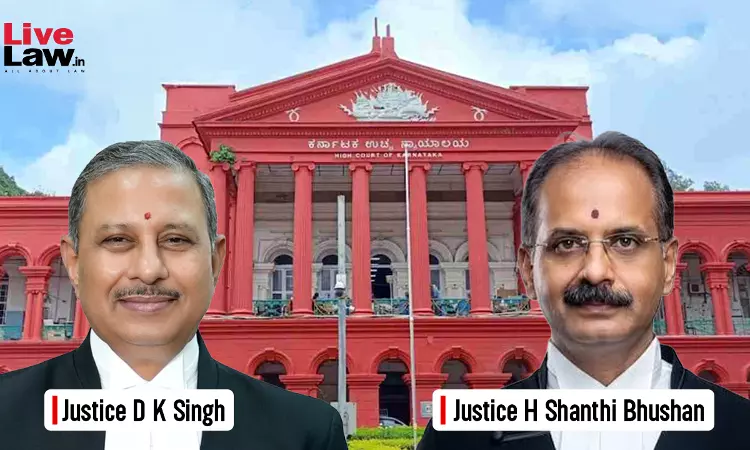
Desire to rehabilitate a leader who lost political ground can't justify creating an additional position, Court said.
The Karnataka High Court on Monday asked the state government to not treat a public office as a “consolation prize for a defeated politician” or a “reward for political loyalty.” The Court made these stern remarks while setting aside the notifications through which K. Gopal Poojary— an Indian National Congress candidate who lost the 2023 state assembly elections from...
This is a premium content
Available exclusively to
Our subscribers
Subscribe Premium 
INR 1099+GST
Your support helps us to bring you more content at
an affordable subscription scheme !!!
All payment options available
The Karnataka High Court on Monday asked the state government to not treat a public office as a “consolation prize for a defeated politician” or a “reward for political loyalty.”
The Court made these stern remarks while setting aside the notifications through which K. Gopal Poojary— an Indian National Congress candidate who lost the 2023 state assembly elections from Byndoor constituency— was appointed as the chairman of the additional land regularisation committee.
“A personal request, political influence or the desire to rehabilitate a leader who has lost political ground cannot, by itself, furnish a justification for creating an additional position or arrangement. The circumstances suggest an attempt to secure a position of authority through an indirect route and to regain power through a back-door route, rather than to address any genuine public necessity… The desire of an individual to cling on to power cannot be permitted to dictate the course of public administration,” the Bench of Justice D.K. Singh and H. Shanthi Bhushan said.
“The State Government must, therefore, remain above considerations of personal political advancement and ensure that its decisions are guided by public interest and genuine administrative necessity, rather than by an attempt to accommodate an individual's desire to regain lost authority,” the Bench advised.
The present appeal before the Division Bench was filed by Gururaj Gantihole, an MLA from the Byndoor constituency and chairman of the regularisation committee for land grants as per Section 94-A(1) of the Karnataka Land Revenue Act.
He challenged the Single Judge order which had dismissed his petition against two notifications. The first notification, dated December 4, 2023, constituted an additional land regularisation committee and appointed Poojary as its chairman. The second notification, dated December 26, 2023, allocated nearly twice as many pending applications (23,983 applications) to the Additional Committee compared to the appellant's committee (12,313 applications). The appellant had also challenged the constitutional validity of Rule 108-EE of the Karnataka Land Revenue Rules, 1966 in his petition.
Under the Act, an additional land regularisation committee can be formed if the government is of the opinion that constitution of an additional panel is necessary. Rule 108-E provides that an MLA, representing the major part of the taluk, shall be the chairman of the principal committee, while the chairman of the additional committee shall be a person nominated by the state government. Appointment of the rest of the members for both committees is similar.
Application of mind should precede government's opinion formation
The Court examined whether the state government (led by Congress party) had applied its mind and relied on relevant material before forming the opinion that an additional committee was necessary.
Referring to the Apex Court ruling in Barium Chemicals Ltd. vs. Company Law Board (1966) and Bhikhubhai Vithalbhai Patel vs. State of Gujarat (2008), the Bench said that though the formation of opinion is subjective, the record must disclose circumstances capable of supporting that opinion. It added that the material relied upon by the State should have a rational connection with its subsequent opinion.
“Section 94- A(2-A) requires the State Government to consider relevant material and apply its mind before forming an opinion that an Additional Committee is necessary. Though the opinion is subjective, it cannot rest on conjecture, imaginary grounds or wishful thinking. The material considered must also bear a rational nexus to the opinion formed. The Court is not concerned with weighing the adequacy or sufficiency of that material; it must, however, be satisfied that the material is relevant and is not remote, speculative, vague or extraneous to the statutory purpose,” the Court said.
The authorities placed reliance on a subsequent affidavit dated July 29, 2026, which referred to 4,581 applications out of a total of 36,975 applications pending in Byndoor and Vandse Hoblis. The Single Judge order found that these figures necessitated formation of an additional committee.
Rejecting the affidavit as a basis for the State's opinion on constituting an additional panel, the Court said, “Apart from that affidavit, no convincing material was produced to show that, when the Notification dated 04.12.2023 was issued, the State Government had considered relevant material and formed the requisite opinion. The affidavit can disclose the position of the applications as on the date it was filed; it cannot establish what material was considered nearly three years earlier.”
It added, “The State Government's consideration of relevant material and its formation of the requisite opinion must be evident from the notification or from the record available when it was issued. The decision cannot subsequently be supported by explanations or material introduced after the event.”
The Court further noted the letter written by Poojary, addressing the Minister for Revenue, requesting constitution of an Additional Committee on the ground that around 33,000 application were pending in Byndoor constituency. In the same letter, he recommended himself for appointment as the committee's chairman.
“Viewed in its entirety, the sequence suggests that, after failing to secure election as MLA from Byndoor Constituency, respondent No.4 sought to obtain a position of authority through the constitution of an Additional Committee by making a request to the then Minister for Revenue. The Minister's endorsement was followed by a notification that adopted the proposed composition. What could not be secured through the election appears to have been pursued through an indirect route. The Additional Committee was intended to serve the statutory purpose of considering applications for grant of land. Its constitution cannot be founded on a defeated politician's personal desire to acquire power or office. Such a desire is not relevant material for forming an opinion under Section 94-A(2-A) of the Act. Statutory power must be exercised to advance the purpose for which it was conferred, and not to accommodate personal or extraneous interests,” the Bench observed.
The High Court partly allowed the appeal in part and quashed the two notifications constituting and demarcating the jurisdiction of the additional committee.
Two committees, same functions but different composition
The High Court said that the principal committee and the additional committee, both intended to perform social function by considering land grant applications, have materially different compositions. While the former is chaired by an elected representative—believed to be in a better position to represent people of that constituency— the latter is chaired by any person appointed by the government. With no qualifications set out, Rule 108-EE gives wide and unrestricted discretion to the State, the Bench noted.
“Since both Committees discharge the same statutory functions, the composition of the Additional Committee ought reasonably to be placed on a comparable footing with that of the principal Committee. The person appointed under Rule 108-EE(1)(a) should therefore possess experience and competence commensurate with that expected of an MLA, whose membership is mandatory under Rule 108- E(1)(a),” the Court said.
Accordingly, the Bench directed the government to frame guidelines for appointment of the additional committee chairperson.
Tags


