



- Home
- /
- High Courts
- /
- Kerala High Court
- /
- 24-Hour Detention Period Begins...
24-Hour Detention Period Begins When Accused Is Effectively Detained, Not Time Of Formal Arrest Recorded By Police: Kerala High Court
Anamika MJ
13 Aug 2025 10:36 AM IST
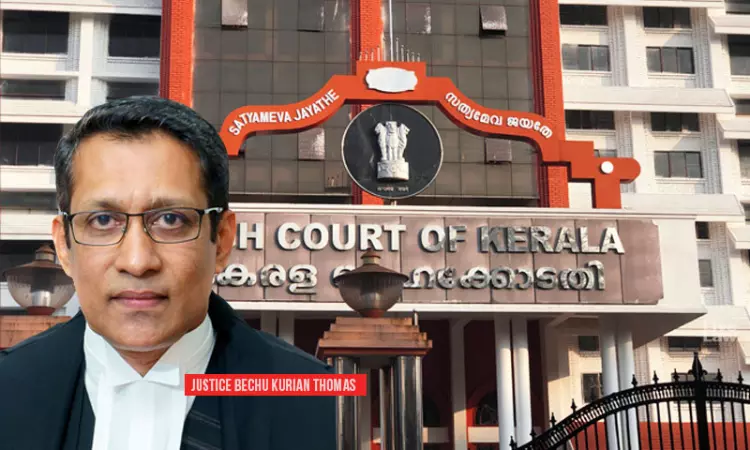
Kerala High Court has held that the 24-hour deadline for producing an accused before a magistrate under Article 22(2) of the Constitution begins from the moment a person's liberty is effectively curtailed, rather than from the time police formally records the arrest.Justice Bechu Kurian Thomas observed: “The period of twenty-four hours to produce an accused before the Magistrate commences...
This is a premium content
Available exclusively to
Our subscribers
Subscribe Premium 
INR 1099+GST
Your support helps us to bring you more content at
an affordable subscription scheme !!!
All payment options available
Kerala High Court has held that the 24-hour deadline for producing an accused before a magistrate under Article 22(2) of the Constitution begins from the moment a person's liberty is effectively curtailed, rather than from the time police formally records the arrest.
Justice Bechu Kurian Thomas observed:
“The period of twenty-four hours to produce an accused before the Magistrate commences not when the actual time of arrest is recorded by the police, but runs from the time when the accused was effectively detained or his liberty was curtailed”
The judgment was delivered in a bail application, where the petitioner challenged his detention by the Narcotics Control Bureau (NCB) on the ground that he was held beyond the permissible 24-hour limit without judicial sanction.
Petitioner was taken into custody at 3 p.m. on January 25, 2025, pursuant to the alleged detection of possession of contraband, but his arrest memo was prepared nearly 23 hours later, at 2 p.m. on January 26. He was brought before the magistrate at 8 p.m. the same day — over 29 hours from initial custody.
The Amici Curiae submitted that the twenty four hour clock for production of a person before the Magistrate begins from the moment of effective curtailment of liberty and not from the formal recording of arrest. Hence, the delay in formally recording the arrest, despite the accused being in custody, constitutes an unrecorded period of custody.
“Law has to apply equally for all. No man is above the law and none are below it either. Even the most notorious criminal is entitled to be treated with fairness and justice. Fundamental rights have been regarded as the pride of our Constitution and Article 21 as its soul,” the Court observed at the outset.
It relied on Supreme Court precedents including D.K. Basu v. State of West Bengal [ (1997) 1 SCC 416] and Joginder Kumar v. State of U.P. [ (1994) 4 SCC 260], which caution against custodial abuse and stress that deprivation of liberty cannot be masked by delayed recording of arrest.
It further noted that the unrecorded periods can be a source of human rights violation. “The technique of not recording the arrest under one pretext or the other is often resorted to under the guise of investigation. Brutalities of police generally occur during these periods of uncontrolled authority. Unless there is a check, such unrecorded periods of custody can be the source of human rights violation,” it remarked.
The court held that deprivation of liberty, whether by physical restraint or submission to police authority, constitutes “arrest” according to section 43 of BNSS
“The failure, refusal or omission to record an arrest or continuation of an interrogation for prolonged periods without recording arrest, shall not preclude those periods of curtailed liberty as constituting arrest,” the court observed and granted bail to the Petitioner-accused.
Case Title: Biswajith Mandal v Inspector, Narcotic Control Bureau
Citation: 2025 LiveLaw (Ker) 498
Case No: Bail Appl. 8581 of 2025
Counsel for Petitioner - N B Fathima Sulfath
Counsel for Respondent - R Vinu Raj (Spl. PP), K K Subeesh
Amici Curiae - Nikhina Thomas, Neha Babu
Click Here To Read/Download Judgment

Anamika MJ
Anamika MJ is a Correspondent with LiveLaw, covering Kerala High Court

