



- Home
- /
- High Courts
- /
- Kerala High Court
- /
- 'We Are Defined Not By The Office...
'We Are Defined Not By The Office We Hold, But By Choices We Make': Chief Justice Nitin Jamdar Bids Farewell To Kerala High Court
Anamika MJ
10 Jan 2026 9:00 AM IST
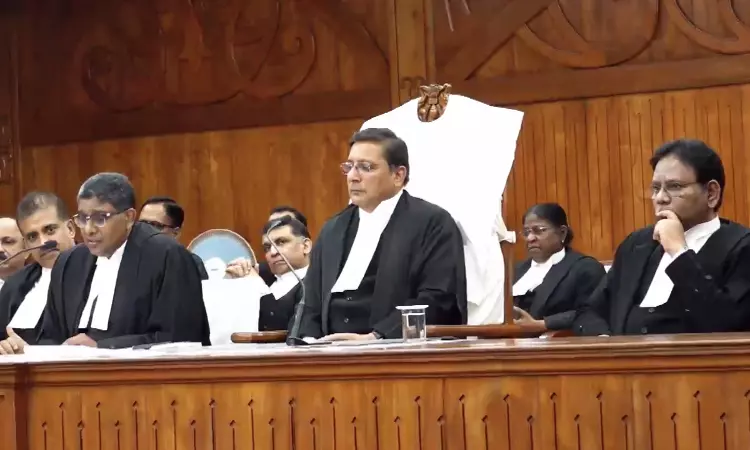
The Kerala High Court on Friday (09 January) bid farewell to its 39th Chief Justice, Justice Nitin Jamdar, who demitted office on superannuation.A full court reference was held in the presence of judges, senior advocates, members of the Bar and court staff. Chief Justice Nitin Jamdar expressed deep gratitude to the Bench, Bar and registry, describing the Kerala High Court not merely as...
This is a premium content
Available exclusively to
Our subscribers
Subscribe Premium 
INR 1099+GST
Your support helps us to bring you more content at
an affordable subscription scheme !!!
All payment options available
The Kerala High Court on Friday (09 January) bid farewell to its 39th Chief Justice, Justice Nitin Jamdar, who demitted office on superannuation.
A full court reference was held in the presence of judges, senior advocates, members of the Bar and court staff.
Chief Justice Nitin Jamdar expressed deep gratitude to the Bench, Bar and registry, describing the Kerala High Court not merely as a workplace but as a home. Emphasising that the judiciary functions as a system sustained by the quality of interactions among its stakeholders, he spoke of judicial service as a deeply ethical and inward journey.
“The judicial system is founded not only the physical or external manifestations but its internal factors. At its soul is the trust the people repose which must always be preserved, without which everything will be an empty shell,” Justice Jamdar said.
He further added that judicial service is founded on the inner values and the true satisfaction lies in the ability to live and work in accordance with one's deepest values and to step away with one's self respect intact.
“We are ultimately defined not by the office we hold or the name we acquire but by the choices we make,” he said.
He further added that fidelity to one's values sustains the spirit and gives meaning to judicial service.
“True satisfaction lies in the ability to live and work in accordance with one's deepest values and to step away with one's self respect intact. In a society that often places status above all else, quiet integrity and honesty may appear unfashionable but it is this fidelity to one's values that sustains the spirit and gives meaning to judicial service. To dispense justice with sincerity, independence and clear conscience is a deeply spiritual journey which takes you closer to the god,” he said, while thanking the members of the bar and the bench for their support during his tenure.
Justice Nitin Jamdar obtained degrees in Commerce and Law from Sydenham College and Government Law College in Mumbai. Began practice in 1989, specialising in administrative and constitutional law. Represented various public bodies, including Zilla Parishads, Municipal Corporations, and Universities, and served as Standing Counsel for the High Court administration and the Union of India. On 23 January 2012, elevated as the Judge of the Bombay High Court, where he presided over various jurisdictions. Was actively involved in the computerization movement. He was elevated as Chief Justice of Kerala High Court on 26.09.2024.
During the reference, Dr. Justice Jayasankaran Nambiar reflected on Justice Jamdar's leadership from the perspective of the Bench. He described the former Chief Justice as calm, composed and solution-oriented, noting that “nothing ever shook him.”
“On the administrative side, his strength lays in his calm and composed approach in problem solving, nothing ever shook him and he always listened patiently to those who approached him with their worries before making a satisfactory solution for each situation.” Justice Nambiar said.
Justice Nambiar recalled Justice Jamdar's deep engagement with issues affecting access to justice in remote regions, particularly Lakshadweep, where his landmark suo motu judgment led to the constitution of a permanent judicial infrastructure committee, strengthening of digital connectivity, legal services and mediation mechanisms for the islanders.
Justice Nambiar also drew attention to the implementation of a structured, technology-enabled jail appeal system in the Kerala High Court under Justice Jamdar's leadership, ensuring timely appellate remedies for incarcerated persons and strengthening judicial oversight.
Adding a lighter personal touch, Justice Nambiar shared anecdotes reflecting Justice Jamdar's subtle sense of humour and his keen interest in birdwatching and photography, describing him as a multi-faceted personality whose observational skills extended seamlessly from nature to the courtroom.
Addressing the gathering, Advocate General Goplakrishna Kurup underscored the foundational role of an independent judiciary, observing that “without a judiciary that can and will administer the law fairly and fearlessly between parties, no guarantee conferred by law can have any real meaning.” He described Justice Jamdar as a judge who exemplified fairness by listening to every voice, not merely the loudest, and who consistently resisted both prejudice and indifference.
Recalling Justice Jamdar's tenure as Chief Justice since September 26, 2024, the Advocate General noted that though brief, it was marked by justice that was “fair, firm and fearless”, leaving behind an indelible administrative and institutional imprint. He particularly highlighted the Chief Justice's courtroom demeanour calm, attentive and precise.
“Court room silence can often be as persuasive as the loudest argument for a wise judge who speaks softly with fierce precision. My lords demeanor at the Bench may be described as one of the kind authority. You listen carefully to the submissions of the counsels and engage with them calmly. Delving deep into the intricacies of the lists to be adjudicated,” Advocate General said.
Justice Jamdar's administrative initiatives to reduce pendency, including designating Wednesdays as regular hearing days and introducing systematic monthly listings of fully pleaded cases, were noted as having significantly improved disposals.
The Advocate General also referred to Justice Jamdar's emphasis on roster discipline and his jurisprudence clarifying the distinction between maintainability and entertainability of writ petitions under Article 226.
“My lords, judgments reflect a remarkable versatility in traversing branches of laws with clarity. They stand as a testament to your unwavering commitment to fairness, equity and social justice, a legacy that continues to guide both the bench and bar, long after today,” he said.
Advocate General also highlighted the Justice Jamdar's advocacy for a digitized judiciary and paperless courtrooms which would in turn result in reducing the delay and lowering the cost of litigation and also for ensuring the integrity and long term preservation of judicial records.
He further added that Justice Jamdar's visionary has led to the inauguration of the first fully paperless district Judiciary at Kalpetta.
The President of the Kerala High Court Advocates' Association (KHAA), Adv. Peeyus A Kottam, paid tribute on behalf of the Bar, describing Justice Jamdar as a judge who never sought applause but remained unwaveringly faithful to constitutional principles. The KHAA President highlighted Justice Jamdar's role in ushering in landmark technological reforms, most notably the inauguration of India's first fully paperless district judiciary at Kalpetta, which has since become a national benchmark.
Referring to Justice Jamdar's progressive judgments, the KHAA President cited rulings on surrogacy rights and environmental protection as illustrations of a judicial approach that balanced constitutional freedoms with ethical and ecological concerns. He also noted Justice Jamdar's international engagement in environmental law and legal technology forums, reflecting the global resonance of his judicial vision.
Anamika MJ
Anamika MJ is a Correspondent with LiveLaw, covering Kerala High Court

