



- Home
- /
- High Courts
- /
- Kerala High Court
- /
- 'Even Though We Have Excellent Lady...
'Even Though We Have Excellent Lady Lawyers, Representation On Bench Is Minuscule': Justice VG Arun Bids Farewell To Kerala High Court
Anamika MJ
24 Jan 2026 11:03 AM IST
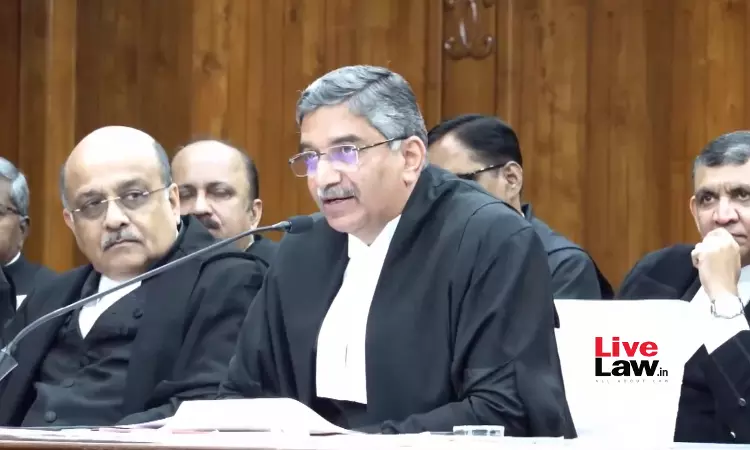
Justice V G Arun of the Kerala High Court on Friday (23 January) said that he is perturbed by the fact that even though there are excellent lady lawyers, their representation in the bench is miniscule and added that he hoped that it would change in the near future.The remarks were made during the farewell address, during the Full Court Reference held at the Kerala High Court as he was...
This is a premium content
Available exclusively to
Our subscribers
Subscribe Premium 
INR 1099+GST
Your support helps us to bring you more content at
an affordable subscription scheme !!!
All payment options available
Justice V G Arun of the Kerala High Court on Friday (23 January) said that he is perturbed by the fact that even though there are excellent lady lawyers, their representation in the bench is miniscule and added that he hoped that it would change in the near future.
The remarks were made during the farewell address, during the Full Court Reference held at the Kerala High Court as he was demitting office upon attaining the age of superannuation.
"I would say, I am a bit perturbed by the fact that even though we have excellent lady lawyers, their representation in the bench is miniscule and I hope this will change in the near future. My interaction with young judicial officers as the portfolio Judge of Wayanad, Thalassery, and Alleppey Judicial Districts gives me immense hope in the future of the Kerala Judiciary, which has always been a cut above the rest of the Country," Justice Arun said.
In his farewell address, Justice Arun expressed deep gratitude to his family, colleagues on the Bench, members of the Bar, court staff, and the registry. He acknowledged the collective nature of his achievements and paid special tribute to the late Advocate Anil Sivaraman, whom he described as a close confidant.
He further added that his guiding light has always been the trinity of liberty, equality, and fraternity.
“As a judge, my guiding light has always been, the principles of liberty, equality and fraternity, the core of our great democracy. As Dr. Ambedkar, often stressed, these three principles formed the Union of Trinity, traversing one would defeat the purpose of democracy. I step down from this venerable institution, confident that my brothers and sisters in the Bench and friends at the Bar will continue the unstinting efforts to uphold this principles and render Justice equitably.” Justice Arun said.
Describing retirement as “a semicolon rather than a full stop,” he said he looked forward to reading judgments without writing them, revisiting neglected books, and discovering a life beyond courtrooms.
Justice Arun is the son of late TKG Nair, a renowned writer, journalist, and public intellectual, and Smt. Sulochana V. Nair. His familial lineage reflected a deep association with the legal profession. His mother was the sister of Justice V. Sivaraman Nair, former judge of the Kerala High Court. Justice Anu Sivaraman of Karnataka High Court, Senior Advocate V Rajendran, and the late Advocate Anil Sivaraman were among his cousins.
Justice Arun obtained a degree in Economics from Baselius College, Kottayam and later pursued law at the Kerala Law Academy, Thiruvananthapuram.
Enrolled as an advocate on 8 January 1989, Justice Arun began his practice at Kozhikode under Advocate V. Sreekumar Menon, before shifting to the Kerala High Court in December 1990. There, he trained under Senior Advocate T. R. Raman Pillai.
He served as Editor of the Kerala Series of Indian Law Reports from 2005 until his elevation to the Bench and was closely associated with the Kerala Law Journal.
Presiding over the Full Court Reference, Justice A. K. Jayasankaran Nambiar paid tribute to Justice Arun as a dear friend and brother judge, praising his intellectual rigour, elegant judgment writing, and administrative contributions, including his role with the Kerala Judicial Academy.
Justice Nambiar added that the judgments of Justice Arun reflected a rare balance between doctrinal precision and practical wisdom inspiring confidence in the rule of law among the bar and the public alike.
Recalling Alexander Pope, Justice Nambiar observed that Justice Arun's judgments reflected an ease born of mastery “true ease in writing comes from art, not chance.” He also offered lighter reminiscences, hinting at the wit and humour long restrained by judicial office, now free to re-emerge in retirement.
“The years on the Bench required restraint, though wit came naturally and silence where laughter might have otherwise found voice. With retirement, that gentle self imposed shackle is finally lifted, allowing the lighter side of his personality, his easy humour, affable warmth, quiet mischief and joyful companionship to re-emerge in full measure.” Justice Nambiar said.
Advocate General, Gopalakrishna Kurup, addressed the Reference by quoting Socrates on the four essential qualities of a fine judge “to hear courteously, answer wisely, consider soberly and decide impartially” and noted that Justice Arun's career stood as an embodiment of these ideals.
“I have witnessed you as a lawyer measured in submissions, unfailingly courteous to the Court, marked by a calm and composed demeanor, yet persuasive and thoroughly effective. Even when faced with interruptions at the behest of the opposite side or queries from the court, you never permitted yourself to be perturbed, responding instead with poise, precision and quiet confidence.” The Advocate General said.
It was further stated that as a Judge, Justice Arun, emerged as a resolute adherent to principles of judicial independence and impartiality.
“As a judge, my lord, has been a resolute adherent of principles of judicial independence and has ensured that both your decisions and decision making process were marked by absolute impartiality, and treated all who appeared before the Court in pursuit of justice with complete equality and has consistently ensured the judicial duties took precedence over all other activities.” The Advocate general added.
The Advocate general also threw light on significant judgments delivered by Justice Arun which reflected a deep commitment to constitutional values, human dignity, personal liberty and freedom of thought. Among his notable rulings were decisions affirming the right of individuals to be recognised as non-religious in official records, permitting change of religious affiliation in school documents, safeguarding freedom of expression of prisoners, restraining intrusive police surveillance at night, and upholding women's reproductive autonomy as an inseparable facet of Article 21.
He also delivered significant rulings addressing the rights of accused persons in medical negligence cases, the prohibitive cost of life-saving breast cancer drugs, compensation for vaccine-related fatalities, and the rights of older couples seeking parenthood under assisted reproductive technology laws.
Peeyus A Kottam, President of the Kerala High Court Advocates' Association (KHCAA) described Justice Arun as a bar-friendly judge whose court was marked by discipline without severity and authority without intimidation.
“His lordship, presided over the Court with Calm, composure never did anger, tension or impatience cloud his countenance. That reassuring smile, transformed the Court room into a space of confidence and comfort, reminding us, justice can be firm without being harsh, and authoritative without being. Members of the Bar, in particular, found his lordship a source of encouragement and confidence. Junior advocates were given the freedom to participate fearlessly, to speak without hesitation and to grow without anxiety.” he said.
After the conclusion of Justice Arun's reply speech, an applause filled the courtroom at Justice Nambiar's invitation.

Anamika MJ
Anamika MJ is a Correspondent with LiveLaw, covering Kerala High Court

