



- Home
- /
- High Courts
- /
- Kerala High Court
- /
- Using Minimum Corporal Punishment...
Using Minimum Corporal Punishment For Discipline Not Offence: Kerala High Court Quashes Criminal Case Against Teacher For Caning Student
K. Salma Jennath
10 Feb 2026 8:43 PM IST
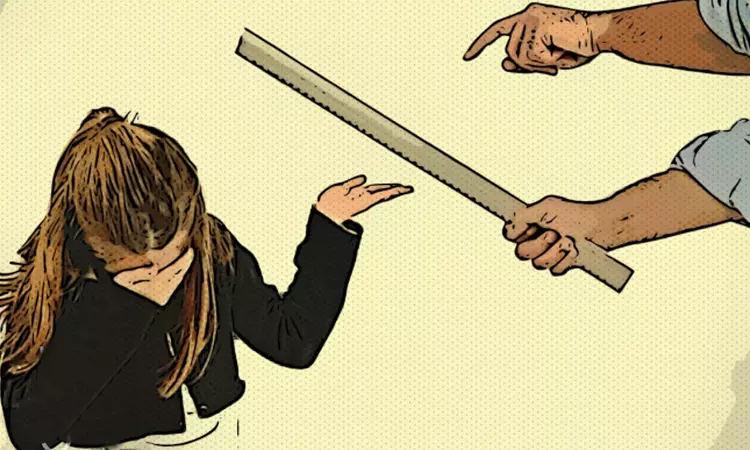
The Kerala High Court has reiterated that using minimum corporal punishment to discipline student in school is not an offence under the Juvenile Justice Act or the Bharatiya Nyaya Sanhita.Justice C. Pratheep Kumar quashed the criminal case initiated against a teacher for caning a student in the school.The prosecution case is that the accused teacher voluntarily caused hurt to a student by...
This is a premium content
Available exclusively to
Our subscribers
Subscribe Premium 
INR 1099+GST
Your support helps us to bring you more content at
an affordable subscription scheme !!!
All payment options available
The Kerala High Court has reiterated that using minimum corporal punishment to discipline student in school is not an offence under the Juvenile Justice Act or the Bharatiya Nyaya Sanhita.
Justice C. Pratheep Kumar quashed the criminal case initiated against a teacher for caning a student in the school.
The prosecution case is that the accused teacher voluntarily caused hurt to a student by beating him with a cane on his buttocks. A crime was registered alleging commission of offences under Section 118(1) of BNS [Voluntarily causing hurt or grievous hurt by dangerous weapons or means] and Section 75 of the JJ Act.
The teacher came before the High Court to enforce its extraordinary jurisdiction to quash the criminal case.
The Court noted that the registration of the FIR and the issuance of the Accident Register cum Wound Certificate from the Health Centre were done 3 days after the incident. Further, it also took notice of the fact that there were external injuries seen by the doctor who treated the child.
The petitioner argued that the offence under Section 118 BNS would not be attracted since cane was not a dangerous weapon. This contention was accepted by the Court. It remarked:
"Since the weapon allegedly used by the petitioner is only a cane, the same does not amount to a dangerous weapon as defined under Section 118(1) of the BNS. Therefore, the allegations against the petitioner does not constitute the offence under Section 118(1) of BNS."
The Court examined various precedents laid down on the subject as to what extent a teach could lawfully inflict corporal punishment on a student.
The Court placed reliance on Jomi v. State of Kerala wherein it was held that when corporal punishment is inflicted with no malafide intention by a teacher and only for the well-being of the student, the offence under Section 75 of the JJ Act would not be attracted.
"When a student does not behave properly or act according to the rules of a school, and if the teacher gives him a corporal punishment for improving his character and conduct, the court has to ascertain whether the said act of the teacher was bona fide or not. If it is found that he had acted with a good intention, only to improve or correct the student, he is within his limits. From the evidence available on record, it appears that the petitioner has only used minimum corporal punishment for enforcing discipline in the school and there is no evidence to show that he had any guilty intention to cause any hurt to the defacto complainant or to treat the defacto complainant with cruelty."
Thus, the Court allowed the plea and quashed all further proceedings against the teacher.
Case No: Crl.M.C. No. 7868/2025
Case Title: Sibin S.V. v. State of Kerala and Anr.
Citation: 2026 LiveLaw (Ker) 87
Counsel for the petitioner: M.R. Sarin, P. Santhoshkumar (Karumkulam), Parvathi Krishna, Aji S., Midhun Soman
Counsel for the respondent: Breez M.S.

K. Salma Jennath
Salma Jennath is a Principal Correspondent with LiveLaw, covering Kerala High Court

