



- Home
- /
- High Courts
- /
- Kerala High Court
- /
- Christian Women Can File For...
Christian Women Can File For Divorce At Their Place Of Residence: Kerala High Court
K. Salma Jennath
19 Aug 2026 4:37 PM IST
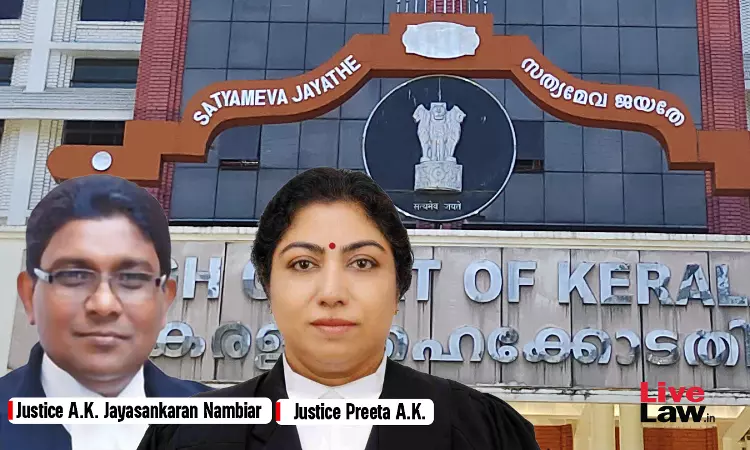
In a significant ruling, the Kerala High Court has held that as per Section 3 of the Divorce Act, Christian women can file for divorce in their places of residence. [2026 LiveLaw (Ker) 456]The Division Bench of Dr. Justice A.K. Jayasankaran Nambiar and Justice Preeta A.K. was considering an appeal filed by a wife after the Single Bench rejected her plea seeking a declaration that Section 3(3)...
This is a premium content
Available exclusively to
Our subscribers
Subscribe Premium 
INR 1099+GST
Your support helps us to bring you more content at
an affordable subscription scheme !!!
All payment options available
In a significant ruling, the Kerala High Court has held that as per Section 3 of the Divorce Act, Christian women can file for divorce in their places of residence. [2026 LiveLaw (Ker) 456]
The Division Bench of Dr. Justice A.K. Jayasankaran Nambiar and Justice Preeta A.K. was considering an appeal filed by a wife after the Single Bench rejected her plea seeking a declaration that Section 3(3) of the Divorce Act ought to be read in a manner so that jurisdictional courts for filing petitions under the Act would also include the court within whose territorial limits the wife resides.
Section 3(3) defines District Court and as per the provision, petitions under the Act can only be filed in the District Courts in whose jurisdiction: (i) marriage was solemnized; (ii) where the husband and wife resides; or (iii) the husband and wife last resided together.
Allowing the appeal, the Bench held:
"we allow this Writ Appeal, by declaring that Section 3(3) of the Act, and in particular, the second limb to the definition of “District Court” that clarifies that “the District Court (Family Court) within whose jurisdiction the husband and wife reside”, shall be seen as enabling a wife, when she is the petitioner, to present a petition under the Act before a District Court (Family Court) having jurisdiction over the place where she resides at the time of presenting the petition, notwithstanding that the said place may be different from the place where her marriage was solemnized or where she and her husband last resided together or where her husband presently resides."
The Court noted that other statutes, such as the Hindu Marriage Act, allows women to seek divorce at their place of residence. Therefore, adopting an interpretation restricting the right of Christian women was discriminatory, the Court observed.
"When the pari materia provisions in other matrimonial statutes have been suitably amended to enable the wife, where she is the petitioner, to file a petition before the jurisdictional District Court where she is residing on the date of presentation of the petition, an interpretation of the second limb of the definition in Section 3(3) of the Act in a restrictive manner that prevents a christian woman from so approaching the jurisdictional District Court where she is residing on the date of presentation of the petition, would be discriminatory to christian women and has to be avoided," the Court said.
The appellant had filed an application for dissolving her marriage before the Family Court, Kalpetta (Wayanad) but it was rejected on the ground that there was no jurisdiction to entertain the same. She had submitted that her matrimonial home is at Kasargod but she was subjected to severe domestic violence and was thrown out. She then returned to her parents' house in Wayanad.
Her marriage was conducted at Kasargod and she along with her three children, resided together at the matrimonial home there. Since Section 3(3) says only courts in Kasargod would have jurisdiction to entertain petitions, she is faced with severe difficulties.
The single bench, while rejecting her petition, had recommended that Parliament amend the law to enable Christian wives to file divorce petitions at their place of residence.
Case No: W.A.No.1407/2026 in W.P.(C) No. 8801/2025
Case Title: X v. Union of India and Ors.
Citation: 2026 LiveLaw (Ker) 456
Counsel for the appellant: Jayna Kothari (Sr.), Thulasi K. Raj, Chinnu Maria Antony, Manjima, Tarun Philip, Sarath K.P.
Counsel for the respondents: M. Jayakrishnan – Central government counsel, T.P. Sajid - Senior Government Pleader

K. Salma Jennath
Salma Jennath is a Principal Correspondent with LiveLaw, covering Kerala High Court

