



- Home
- /
- High Courts
- /
- Kerala High Court
- /
- Temple Land Bought With Public...
Temple Land Bought With Public Funds Can't Be Held By Advisory Committee In Its Own Name, Land Must Vest In Deity: Kerala High Court
K. Salma Jennath
8 April 2026 2:47 PM IST
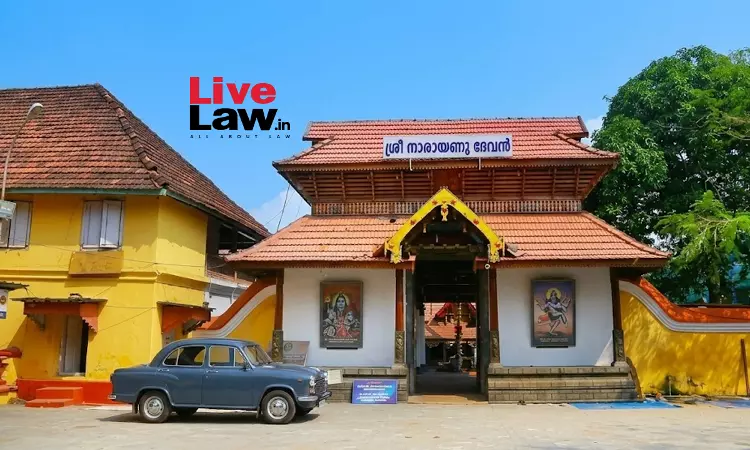
Court also flagged apparent role of Devaswom Board and Kochi Corporation in Ernakulam Shiva Temple irregularities.
The Kerala High Court recently held that temple property purchased using public funds collected from devotees cannot be held in the name of Advisory Committee and must absolutely vest in the deity.The Division Bench of Justice Raja Vijayaraghavan V. and Justice K.V. Jayakumar found that the property of the Ernakulam Shiva Temple purchased under the scheme “Ernakulathappanu Oradi Mannu”...
This is a premium content
Available exclusively to
Our subscribers
Subscribe Premium 
INR 1099+GST
Your support helps us to bring you more content at
an affordable subscription scheme !!!
All payment options available
The Kerala High Court recently held that temple property purchased using public funds collected from devotees cannot be held in the name of Advisory Committee and must absolutely vest in the deity.
The Division Bench of Justice Raja Vijayaraghavan V. and Justice K.V. Jayakumar found that the property of the Ernakulam Shiva Temple purchased under the scheme “Ernakulathappanu Oradi Mannu” (One Foot Land for Lord Shiva) was usurped by the Ernakulam Kshetra Kshema Samithi, which had previously acted as the Temple Advisory Committee.
The Court highlighted the fact that property was purchased from the funds collected from devotees and therefore, there was no justification in conferring part ownership on a private entity:
“The entire purchase consideration had been collected from devotees, rich and poor alike, through donations mobilised by coupons, with the Samithi playing a leading role in the collection of funds…Where land is acquired entirely with funds donated for the deity, there can be no justification whatsoever for conferring co-ownership rights on a private entity….”
The usurpation of the property purchased from the Corporation of Kochi came to light while the Court was perusing the records relating to two pleas, one preferred by the Samithi challenging its removal as Advisory Committee. The other was a suo motu petition (DBP No. 41 of 2022) initiated to examine the sharing of income generated from the conduct of trade fairs at the Grounds between the Board and Samithi.
The Court remarked that the property was usurped due to the concerted actions of the Samithi, the Cochin Devaswom Board and the Corporation of Kochi:
“serious irregularities and instances of usurpation of properties, which were acquired using public funds for the benefit of the temple, have come to the attention of this Court. These irregularities appear to have occurred at the instance of persons who were at the helm of affairs of the Cochin Devaswom Board, the Samithi, and the Kochi Corporation… Since during the consideration of these matters, the above shocking aspect has come to our notice, this Court is obliged to protect religious and charitable properties from encroachment, misuse, or wrongful claims as held by the Apex Court.”
The Court also passed various directions for the protection of the property.
Facts
The Samithi was acting as a temple advisory committee pursuant to the conferment of such a status upon the organisation by the Board.
The decision to mobilise funds through the afore scheme was jointly taken by the Board and the Samithi to purchase the property, located at the eastern portion of the Krishnanvilasam Palace compound, from the Corporation for a concessional rate of around ₹3.75 crores.
Thereafter, the Samithi approached the High Court through CMP No. 3062 of 2000 for permission to use the western side of the Palace compound for consolidating funds. Permission was granted to the Samithi to use the area on a temporary basis and it was directed that all amounts realised must be placed before the Court.
The Board subsequently gave a licence to the Samithi to conduct trade fair for a period of 11 months for a fee of Rs. 6.5 lakhs and directed that Rs. 5 lakhs from the same was to be adjusted as the Devaswom share of contribution.
In 2009, the Board issued an order disclosing that the Samithi had handed over Rs. 3.75 crores to it and thereafter, steps were taken to proceed with the purchase of the property from the Corporation. In 2010, the Court in a suo motu petition (DBP No. 28 of 2010) directed for expediting the proceedings for closure.
In 2012, a meeting was convened by the Chief Secretary of the Corporation for resolving the land transfer transaction between the Corporation and the temple. The Chief Secretary had advised that the Corporation has to facilitate the registration of the sale deed in favour of the temple.
Perusing the Minutes of the meeting, the Court on 05.12.2012, directed that the sale deed be executed in favour of the temple within a month. This was reiterated in February 2013 as well along with an observation that fresh sanction from the government was not needed for the transfer.
This order and similar subsequent orders remained not complied with until April 10, 2013 when the Corporation and Samithi submitted that the sale deed was executed. Thereafter, DBP 28/2010 was disposed of recording the submission but not examining the sale deed.
Irregularities
It was only while considering the present proceedings did the Court note that the property was purchased partly in the name of the Samithi in clear contravention of the orders passed in DBP 28/2010.
It was further noted that the Sale Deed refers to a government order, which had wrongly stated that the afore direction was to transfer the property that the property in the name of the Samithi even though in the meeting it was clearly stated the transfer was to be made in favour of the temple.
“Having examined the Sale Deed…, we are shocked to note that the Secretary of the Samithi has been shown as one of the purchasers.. What is even more serious is that, in blatant violation of the directions issued by this Court, the deed came to be executed by conferring one-half share in the property upon the Samithi. This crucial fact was not brought to the notice of this Court either by the Devaswom Board, the Kochi Corporation, or the Samithi. The omission is not minor; it strikes at the very root of compliance with this Court's directions…The tenor of the orders issued by this Court is entirely inconsistent with the manner in which the Government Order understood, described, or acted upon them. We do not think that this is an innocent mistake”
The Court had sought an explanation following which, the Deputy Director of the Audit department and the Samithi filed affidavits. Perusing the same, the Court remarked that the Samithi tried to justify the purchase in its name:
“The stand taken by the Samithi, in a careful reading, is essentially an attempt to justify the purchase of the property in its name by invoking considerations of public sentiment, administrative necessity, and alleged protection of the deity's interests. It is contended that the involvement of the Samithi from the very inception was on account of the demands and expectations of the devotees, who apprehended that, if the property were vested solely with the Devaswom Board, it would become part of its general assets and might be commercially exploited or utilised for purposes not exclusively connected with the temple. Proceeding on this premise, the Samithi seeks to portray its role as that of a caretaker acting alongside the Board, so as to ensure that the property and its income are used only for the benefit of the deity. Reliance is also placed on governmental sanction and certain observations of this Court emphasising that the purchase was intended for the deity, and not merely for the Board. However, the attempt is obvious and the same is to substitute popular perception and purportedly benevolent intent in place of binding legal requirements.”
The Court also noticed that the Audit department had noted serious allegations against the Board and the Samithi since no accounts were submitted with respect to the income and expenditure of the purchase of the property.
During the course of the proceedings, the Court had directed the Samithi to produce the audited records from which it was entrusted with the functions of the Temple Advisory Committee. Though the audited accounts from 2016 to 2023 was produced, the accounts relating to the purchase of the property was not and the Samithi contended that Board officials forcefully took away the same.
But the Court felt that this was untrue based on the surrounding circumstances and observed:
“The materials on record indicate that substantial amounts of money were collected from devotees and the general public under the scheme “One Foot Land for Lord Shiva” for the purpose of acquiring the property, and that the utilisation of such funds has not been transparently or properly accounted for. We are, therefore, of the firm view that the allegation of theft of records is wholly untenable and has been raised only with the intent to obscure the manner in which public funds were collected, utilised, and appropriated by the Samithi… This omission is not a mere procedural lapse, but goes to the very root of the matter. We must, therefore, strongly deprecate the conduct of the Samithi. Having collected substantial amounts from the public in the name of the deity, and that too with the concurrence and permission of this Court, the Samithi stood in the position of a trustee and was under a bounden obligation to maintain transparency and render a full and proper account of such funds.”
The Court examined the provisions of the Travancore-Cochin Hindu Religious Institutions Act, 1950 (TCHRI Act), which lay down the roles and duties of the Cochin Devaswom Board as well as the manner in which Devaswom properties are to be alienated.
It noted that the role of the Cochin Devaswom Board is that of a trustee, which has stringent fiduciary obligations and must act with utmost good faith, diligence and prudence for the interest of the trust.
Directions
The Court passed a slew of directions to protect the property of Lord Shiva, including a declaration that the property, half of which is in the possession of the Samithi, vests absolutely in the deity of the temple and therefore, the same can be administered and managed by the Devaswom Board in the capacity of a trustee.
The revenue authorities concerned were directed to effect mutation of the property in the name of the Board or the deity and make necessary entries in the records.
The Board was also directed to initiate proceedings to account for the funds collected by the Samithi in the name of Lord Shiva and to produce all relevant records.
It was further added by the Court that complaints must be lodged and proceedings must be initiated if any misappropriation of funds or breach of trust is found. The same was ordered to be completed within a period of 4 months of the judgment.
Ernakulam Kshethra Kshema Samithi cannot act as Temple Advisory Committee
The Samithi preferred one of the pleas after disputes arose between it and the Devaswom Board regarding sharing of income derived from leasing out Devaswom property, handling of accounts by the Samithi and its very functioning. This led to the Board passing orders for selecting a new Temple Advisory before the Samithi's tenure end and for putting an end to the income-sharing, prompting the Samithi to approach the High Court.
This order was initially stayed by the Court, and in the meanwhile the bye-law governing Temple Advisory Committee was amended in 2025 in accordance with the Court's directions. As per the modified bye-laws, the earlier provision empowering the Board to confer status of Temple Advisory Committee to organisations was done away with.
Thereafter, the stay ordered was vacated by the Court noting that the Samithi's tenure ended in 2023, the new bye-laws no longer provide for conferment of the status on organisations, and the disputes between the Board and the Samithi. It then directed the Board to act strictly in accordance with its bye-laws and to ensure proper administration of the temple.
“only adult Hindu devotees who are interested in the upliftment of the temple and are willing to offer dedicated service are entitled to be members of the Temple Advisory Committee. Only if the Devaswom Board is satisfied that such a devotee meets these criteria, the person may be included as a member of the Temple Advisory Committee. Eligible persons are expected to reside within the vicinity of the temple, to be regular visitors, and to work actively for the advancement of the temple and to comply with all stipulations in the byelaws. The Samithi, under no circumstances, can aspire to be conferred with the status of the Temple Advisory Committee,” the Court remarked that the Samithi cannot be given the status of Temple Advisory Committee.
Thus, it disposed of the petitions.
Case No: DBP No.41/2022 & WP(C) No.15798/2023
Case Title: Suo Motu v. State of Kerala and Ors. & Ernakulam Kshethra Kshema Samithi v. Cochin Devaswom Board and Ors.
Citation: 2026 LiveLaw (Ker) 186
Counsel for the Ernakulam Kshethra Kshema Samithi: K.Saneesh Kumar Shri.B.G.Harindranath (Sr.)
Counsel for the respondents: K.P.Sudheer - Cochin Devaswom Board, Rashmi K.M. – Government Pleader, A. Parvathi Menon, D. Kishore, Meera Gopinath, R. Muraleekrishnan (Malakkara), Anant Kishore
Tags

K. Salma Jennath
Salma Jennath is a Principal Correspondent with LiveLaw, covering Kerala High Court

