



- Home
- /
- High Courts
- /
- Kerala High Court
- /
- 'Intellectual Disability Results In...
'Intellectual Disability Results In Lifelong Impairment': Kerala HC Assesses Functional Disability Of Child Injured In Road Accident At 100%
K. Salma Jennath
4 April 2026 3:57 PM IST
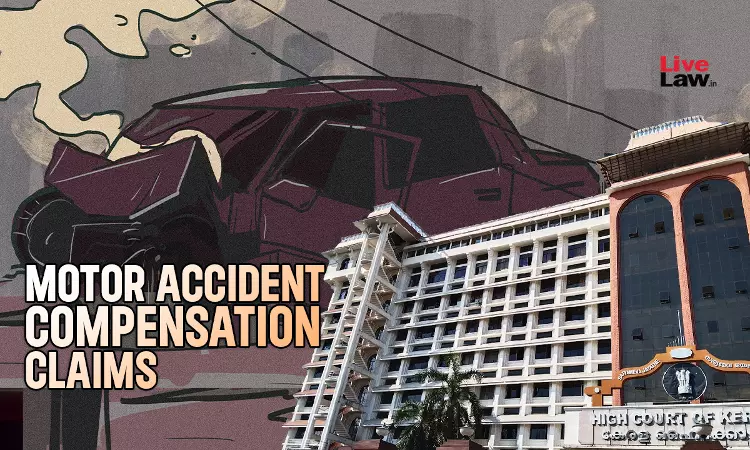
The Kerala High Court recently considered an appeal seeking enhancement of compensation awarded by a Motor Accidents Claims Tribunal to a child, who suffered intellectual disability, following an accident.Justice Sobha Annamma Eapen interacted with the injured person and opined that her functional disability should be assessed as 100% since intellectual disability results in...
This is a premium content
Available exclusively to
Our subscribers
Subscribe Premium 
INR 1099+GST
Your support helps us to bring you more content at
an affordable subscription scheme !!!
All payment options available
The Kerala High Court recently considered an appeal seeking enhancement of compensation awarded by a Motor Accidents Claims Tribunal to a child, who suffered intellectual disability, following an accident.
Justice Sobha Annamma Eapen interacted with the injured person and opined that her functional disability should be assessed as 100% since intellectual disability results in life-long impairment.
“Intellectual disability results in lifelong impairment and functional incapacity. The Psychiatrist of the Medical Board, after examining the injured, found that 'she had regression in the developmental milestones resulting in features suggestive of intellectual disability'. After assessment by several tests, the Clinical Psychologist of the Medical Board reported that 'the assessment reveals a mental age of 6 years and 11 months and SQ of 47, indicating moderate intellectual disability'…Upon interacting with her in person and considering the report of the Medical Board as well as the documents produced by the appellants, I deem it appropriate to reassess and fix her functional disability at 100%,” the Court remarked.
The injured, when she was 3.5 years old, sustained injuries while travelling in a car that was hit by a pick-up van driven in a rash and negligent manner. The injured and her mother, who was her guardian and next friend approached the Tribunal claiming compensation. The Tribunal found that the accident took place because of the pickup driver's negligence and awarded a sum of ₹4,37,869/- as compensation.
Unhappy with the compensation awarded, the claimants came before the High Court seeking enhancement. The appellants' counsels contended that the injured was a very active girl, who sustained intellectual disability as a result of the accident. It was pointed out that though the Medical Board had assessed her permanent disability at 50% her functional disability was 100% due to the intellectual impairment, which caused her to be totally dependent on others.
The appellants argued that the injured had suffered loss of enjoyment and amenities of life, she is suffering from ongoing pain, hardship and is in need of life-long support due to limited intellectual capacity. Though she was at a special school, she had to brought back to her parental home since the school only accommodated students up to the age of 25 years.
The insurer also appeared and contended that the Tribunal rightly considered the disability and its nature and extend, and the award granted was adequate. It was also submitted that the injured does not require a bystander throughout her life since she can carry out day-to-day activities independently.
After hearing the parties, the Court wished to interact with the injured in person and she was brought before the Court by her parents. After meeting the injured, the Court was of the opinion that her intellectual developments were not in par with her current age of 25 years.
The Court then referred her to a Medical Board of another hospital and after a detailed examination, the Board assessed her with 75% moderate intellectual disability and 20% locomotor/functional disability. The total permanent disability was assessed at 80% and her mental age was assessed as 6 years and 11 months.
The Court after perusing the report remarked:
“as per the report of the Medical Board, the intellectual functioning/mental age of the injured is that of a 6-year-old child. It is also evident that she is able to carry out her day-to-day activities only under supervision. Being intellectually disabled, no amount of money can renew her mental faculties that have been battered or shattered due to the accident.”
The Court then felt it appropriate to fix her functional disability at 100%. The Court referred to the Apex Court decisions in Hitesh Nagjibhai Patel v. Bababhai Nagjibhai Rabari and Baby Sakshi Greola v. Manzoor Ahmad Simon and another, wherein it was held that the notional income of a minor is to be calculated based on the minimum wages payable to a skilled labourer in the respective State.
However, since the accident occurred in 2004, the Court remarked that there was no minimum wages fixed in the State at the time and therefore, felt that notional income can be fixed at Rs. 3000. It thus awarded an additional amount of Rs. 3,56,000 under the head of permanent disability.
Under the head of bystander expenses, a compensation of Rs. 5,40,000 was awarded taking Rs. 3000 per month for a total of 15 years. An amount of Rs. 5 lakhs was granted under the head of pain and suffering.
Considering the loss of amenities, a compensation of Rs. 5 lakhs was awarded. Under the head 'loss of marriage prospects', a further amount of Rs. 5 lakhs was granted. Thus, a total of Rs. 23,96,000 was additionally awarded and the enhanced compensation was to be paid with 7% interest.
The insurer was directed to deposit the amount with interest before the Tribunal within 2 months and the Tribunal is to release 40% of the amount while keeping 60% of the same in a long-term fixed deposit in a nationalised bank in the names of the appellants. The interest accruing on the same is to be paid to the appellants quarterly if required.
The Court added that the injured's mother is allowed to withdraw 40% of the enhanced compensation. If any need arises in the future to withdraw the amount deposited in fixed deposit, she can file an application before the Tribunal, which is to consider the same and permit withdrawal.
Thus, the Court disposed of the appeal.
Case No: MACA No.1680/2015
Case Title: XXX v. The United India Insurance Co. Ltd. and Anr.
Citation: 2026 LiveLaw (Ker) 185
Counsel for the appellants: K. Shaj, Sajju S., Bharat Vijay
Counsel for the respondents: P. Muraleedharan, Shameer P.M.
Tags
K. Salma Jennath
Salma Jennath is a Principal Correspondent with LiveLaw, covering Kerala High Court

