



- Home
- /
- High Courts
- /
- Kerala High Court
- /
- Major Siblings Can Claim...
Major Siblings Can Claim Compensation For 'Loss Of Dependency' If Proved By Evidence: Kerala High Court Upholds Award To Unmarried Sister
K. Salma Jennath
10 Jun 2026 9:40 AM IST
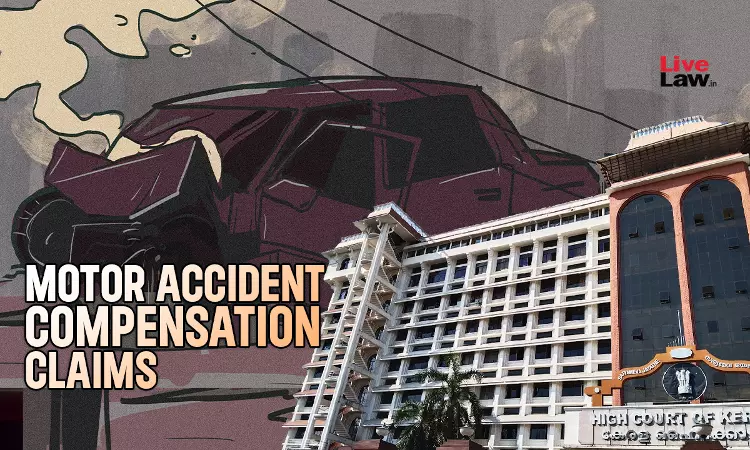
The Kerala High Court recently held that a sibling is entitled to compensation under the head of loss of dependency if dependency is established by adducing evidence before the Tribunal in motor accidents claims.Justice Shoba Annamma Eapen upheld the compensation awarded by the Motor Accidents Claims Tribunal to an unmarried and unemployed sister of the deceased, who had deposed and gave...
This is a premium content
Available exclusively to
Our subscribers
Subscribe Premium 
INR 1099+GST
Your support helps us to bring you more content at
an affordable subscription scheme !!!
All payment options available
The Kerala High Court recently held that a sibling is entitled to compensation under the head of loss of dependency if dependency is established by adducing evidence before the Tribunal in motor accidents claims.
Justice Shoba Annamma Eapen upheld the compensation awarded by the Motor Accidents Claims Tribunal to an unmarried and unemployed sister of the deceased, who had deposed and gave evidence regarding her dependency.
The Court, however, set aside the award granted to the other siblings of the deceased, who were all majors and living separately with their respective families.
“In order to prove dependency, evidence was adduced by…the second claimant as well as one of the sisters of the deceased. She had deposed that she is also a spinster and was dependent on the deceased for her day-to-day living expenses… during evidence, the second claimant had stated that her life was completely dependent on the deceased. In the cross-examination, she stated that everyone was dependent on the deceased…Unless proper evidence is adduced to establish that the other claimants were dependent on the deceased, they cannot be treated as dependents and, consequently, are not entitled to compensation under the head of loss of dependency,” the Court observed.
The deceased was hit by a scooter while she was crossing the road through a zebra line on a National Highway. After her death, her siblings preferred a claim before the Tribunal for compensation of Rs. 5 lakhs.
The driver and the owner of the offending vehicle was ex parte before the Tribunal. The insurer admitted the policy but disputed regarding quantum of compensation. The second claimant deposed before the Tribunal as PW1.
The tribunal fixed the notional income of the deceased as Rs. 7,000 and awarded a sum of Rs. 6,89,400 under different heads. Challenging the same, the insurer came before the High Court.
The main challenge was to the notional monthly income fixed by the Tribunal as well as the compensation awarded to siblings of the deceased under 'loss of dependency'. It was argued that the claimants were all majors and residing separately from the deceased and hence, they were not dependents.
The insurer pointed out that the monthly pension of the deceased was only Rs. 6,285 and therefore, notional income ought not to have been fixed as Rs. 7,000. Further, it was contended that since the deceased was a spinster, one-half of her income ought to have been deducted towards personal and living expenses but the Tribunal has only deducted one-third of the income.
The claimants argued before the High Court that though they were all major siblings, since the deceased was unmarried, they were all dependent on her. They also contended that they were entitled to compensation towards loss of estate, if not loss of dependency.
The Court noted that in the Treasury Passbook produced to prove the income of the deceased, the income was Rs. 6,285. It rejected the claimants' argument for refixation of notional income at Rs. 9,500 based on Ramachandrappa v. Manager, Royal Sundaram Alliance Insurance Company Ltd. [(2011) 13 SCC 236] as the deceased was a pensioner.
Since there was no case for the claimants that the deceased had any other income and since no appeal has been filed challenging fixation of income, the Court felt it appropriate to refix the income to Rs. 6,285 from Rs. 7000.
With respect to the challenge on compensation awarded towards loss of dependency, the Court remarked that only the second claimant had adduced sufficient evidence to prove her dependency on the deceased.
The Court added 10% future prospects and took the notional income as Rs. 6913.5 for calculating loss of dependency. It also deduced one-half of the income towards personal and living expenses, instead of one-third. The multiplier was taken as '9'.
It then came to a conclusion that the second claimant is entitled to get only a compensation of Rs. 3,73,329/- with a reduction of Rs. 1,81,071 under the head of loss of dependency. Since no other grounds were raised by the insurer regarding the quantum of compensation, the Court decided not to interfere with the same.
Total compensation was changed to Rs. 5,08,329 after deducting the reduction towards loss of dependency. It was clarified that only the second claimant would be entitled to the same. It also set aside the penal interest awarded at the rate of 12%.
The Court, thus, partly allowed the appeal.
Case No: MACA No. 349 of 2020
Case Title: The New India Assurance Company Limited v. Devaki and Ors.
Citation: 2026 LiveLaw (Ker) 320
Counsel for the appellant: Mathews Jacob (Sr.), P. Jacob Mathew, Preethy R. Nair
Counsel for the respondents: Arun Bose, M.V. Thamban, R. Reji, Thara Thamban, B. Bipin
Tags

K. Salma Jennath
Salma Jennath is a Principal Correspondent with LiveLaw, covering Kerala High Court

