Kerala High Court's Example Prompted Supreme Court To Strive For More Women Representation : CJI Surya Kant
K. Salma Jennath
1 Nov 2026 9:43 PM IST
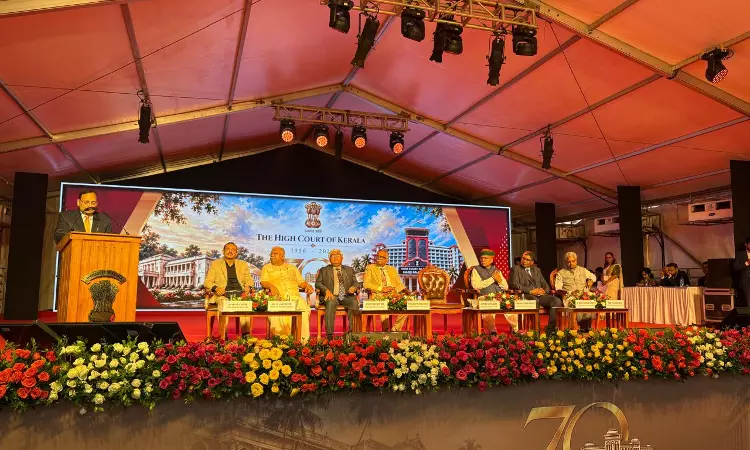
Chief Justice of India Surya Kant on Sunday (November 1) inaugurated the Platinum Jubilee Celebration of the Kerala High Court, marking 70 years since its inception on November 1, 1956.
"This High Court has been a place where constitutional promises have found practical meaning, where difficult questions of law have received thoughtful answers, and where successive generations have reposed their faith in the ideals of justice, fairness and dignity. It is this legacy of public trust and constitutional commitment that makes today's occasion truly worthy of celebration.. I am, therefore, specially pleased that this historic occasion has finally brought me to this beautiful State," Justice Kant began his inaugural address.
The Chief Justice also quoted examples of pioneering women judges like Justice Anna Chandy and Justice Fathima Beevi, who both began at the Kerala High Court. He added that this example set by the Kerala High Court had inspired the collegium as well as the Apex Court to ensure more representation of women in the Bench as well as Bar bodies:
"It seems to me that after I took over as Chief Justice of India, the collegium must have been influenced by this pragmatic and progressive approach of the Kerala High Court as we have been able to bring two distinguished women judges to Supreme Court in the recent time. May be, somewhere behind the back of my mind, I must have been influenced with the visionary approach of this High Court where on judicial side, I was able to, not only pass an order, but persuade the majority of the State Bar Councils, the Bar Council of India and the District and High Court Bar Associations to ensure 30% representation for the women members of the bar. All these historical steps find their strength and legacy somewhere and for that I will give full credit to the Kerala High Court because it was this High Court that at a time when the higher judiciary remained largely dominated by men or when the Bar Associations or the Bar Council were on the lighter side named as 'Men Club', I think the example set by this High Court has prompted and persuaded the Apex institution of this country to provide a formidable, fair and effective representation to the women members of the bar, whether it was a question of bench or the question of effective representation in Bar Council and Bar Associations."


Justice Kant also emphasised upon the High Courts' power to uphold constitutional and legal rights of the people, with a touch that can only provided by institutions closer to them. He pointed to a 'new dimension of litigation' where litigants approach the Supreme Court for urgent listings before the High Courts. He added that timely intervention and interim orders are often more important than final verdicts, and High Courts must strive to recognise the same.
"The Supreme Court, on its side, has consistently respected the institutional autonomy of the High Courts, including their authority to regulate their own rosters. That position is rooted in respect for the constitutional status of the High Courts. Yet, the frequency of such requests made before the Supreme Court invites us to consider whether there is a room to improve the responsiveness of our processes. We must ask ourselves: Can urgent matters be identified more effectively? Can listing procedures be made more transparent and predictable? Can technology assist in prioritising cases where delay may cause irreversible prejudice? And can we ensure that a litigant's access to timely justice does not depend upon their ability to travel to the national capital? Friends, these are not questions of institutional criticism, but of collective responsibility. Judicial independence and judicial efficiency are not competing virtues. On the contrary, timely and effective functioning reinforces public confidence in the independence of our courts," the Chief Justice added.
Supreme Court judge Justice Sarasa Venkatanarayana Bhatti attended the event as a Guest of House and delivered a special address.
The judge began his speech by talking about the vital roles played by the judges, senior and junior lawyers as well as the court staff over the years in the effective functioning of a court:
"An institution is not something that can be tangibly touched but its effect is felt by everyone under the institution's umbrella. This effect does not happen in a day, in a month or even in a year. It is built by the lawyers that prepare every morning, the juniors carrying the seniors' books without complaint, the judge reading the paperbooks in the night before. The court staff who catch on to things without missing a beat and so much more. This glory that it is 70 years in the making belongs to all of you."
He also made an analogy of the contributions made by the judges and lawyers of the Kerala High Court with a good tea:
"There is a familiar advertisement for three roses tea, which speaks of tea leaves rich in 'ruchi' [taste], 'varnam' [colour] and 'vaasana' [aroma]. Kerala's hills know tea very well and I can think of no better description of what the Bench and the Bar of this Court have given us. Ruchi is substance, the quality of the argument and the reasoning in the judgment. Varnam is character, the visible dignity with which this court Conducts itself. The vaasana is the reputation, which lingers long after the hearing is over and the courtroom has emptied."
The judge included a message for junior and senior lawyers. To the junior lawyers, he advised learning the court craft by observing a courtroom and senior advocates, instead of relying solely on technology. He urged the senior lawyers to keep their doors open for juniors and impart lessons. He concluded his speech by encouraging all to strive to reach higher standards instead of settling for earlier achievements.
"Today, the Information is a click away. Young lawyers are tempted to believe that learning the and knowing the law are the same things. They are not correct. Technology is an excellent servant but a poor teacher. If the chain from the senior to the junior is weakened, we risk losing the very thing that made this bar what it is. So I ask the young to sit in courtrooms, to seek out seniors and to learn the law in order leave it. I ask seniors to keep their chamber doors open and teach the juniors. When we gather for the next jubilee, whatever name the history gives it, may we be able to say that this Court did not rest on its yesteryears' achievements or laurels. May it strive for new standards of professional success measured by the fairness, quality and accessibility of the justice it delivers," Justice Bhatti remarked.
Union Law Minister Arjun Ram Meghwal, Chief Justice of Kerala High Court Soumen Sen, Kerala High Court judge Dr. Justice A.K. Jayasankaran Nambiar, Advocate General K. Jaju Babu and Additional Solicitor General of India P. Sreekumar also spoke during the inaugural ceremony. Kerala High Court Advocates' Association (KHCAA) President Peeyus A. Kottam delivered the vote of thanks.
The event was attended by Chief Justices and judges of various High Courts, former judges, judicial officers, staff of the High Court and members of the bar.
The celebratory events included inauguration of the KHCAA Benevolent Scheme 2026; honouring of Advocate P.B. Menon, who was recently given the designation of Senior Advocate; launch of documentary "The High Court of Kerala - 70 Years of Justice, 200 Years of a Journey"; release of Platinum Jubilee Souvenir; and unveiling of the Platinum Jubilee Commemorative Stamp.