



- Home
- /
- High Courts
- /
- Kerala High Court
- /
- Private Banks Not Amenable To Writ...
Private Banks Not Amenable To Writ Jurisdiction: Kerala High Court Sets Aside ₹50K Cost Imposed On South Indian Bank
K. Salma Jennath
15 Dec 2025 4:50 PM IST
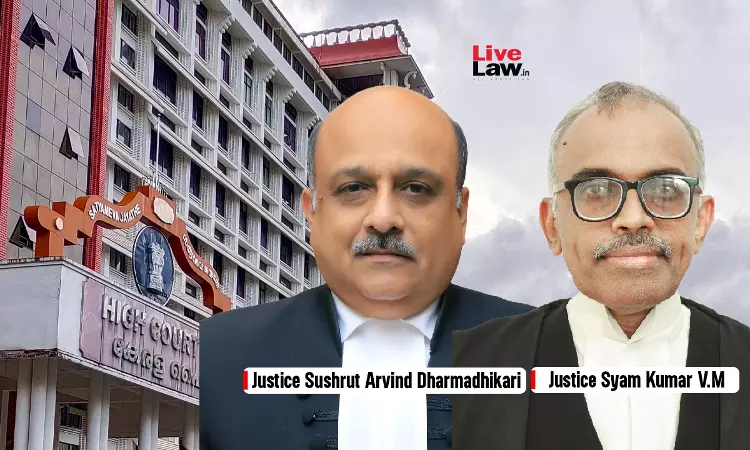
The Kerala High Court recently set aside a Single Bench's order that imposed a cost of ₹50,000 on South Indian Bank, a private commercial bank, which had not returned the original title deeds of its customers 9 years after the closure of their joint loan account.The Division Bench comprising Justice Arvind Sushrut Dharmadhikari and Justice Syam Kumar V.M. held that the writ petition was...
This is a premium content
Available exclusively to
Our subscribers
Subscribe Premium 
INR 1099+GST
Your support helps us to bring you more content at
an affordable subscription scheme !!!
All payment options available
The Kerala High Court recently set aside a Single Bench's order that imposed a cost of ₹50,000 on South Indian Bank, a private commercial bank, which had not returned the original title deeds of its customers 9 years after the closure of their joint loan account.
The Division Bench comprising Justice Arvind Sushrut Dharmadhikari and Justice Syam Kumar V.M. held that the writ petition was not maintainable since the private bank was not amenable to jurisdiction under Article 226 of the Constitution.
The Court was considering a writ appeal preferred by South Indian Bank challenging the Single Bench's order in a writ petition by the customers of the bank and their legal heirs seeking return of original title documents after their loan account was closed.
The Single Bench passed a declaration that the bank had no authority to retain the deeds but declined to pass a direction to release them since the documents were not available. The plea for compensation was also declined but giving liberty for them to approach an appropriate forum.
A cost of Rs. 50,000 was also imposed against the bank, half of which was to be paid to the petitioners/party respondents and the other half was directed to be paid to Kerala State Legal Services Authority (KeLSA).
The bank contended before the Division Bench that the writ petition was not maintainable and that the Single Judge ought not to have entertained the same on merits. The petitioners, however, argued that since private banks also discharge public functions and non-return of the documents after 9 years since loan account closure amounted to a violation of their fundamental rights.
Considering the arguments and relying on Federal Bank Ltd. v. Sagar Thomas and others [(2003) 10 SCC 733] and Mathew Ignitious C. v. Catholic Syrian Bank Limited [(2019 (5) KHC 835], the Division Bench allowed the appeal and set aside the Single Judge's judgment.
It held: “Admittedly, in the present case, the appellant bank is a private commercial bank, therefore, the same is not amenable to writ jurisdiction under Article 226 of the Constitution of India. The learned Single Judge has committed an error in entertaining the Writ Petition and issuing certain directions. In the case of Mathew Ignitious (supra), it has been already held that the private scheduled bank registered under the Companies Act do not fall within the purview of “State” or other authorities under Article 12 of the Constitution of India. As such, the judgment of the learned Single Judge is hereby set aside. The Writ Petition stands dismissed as not maintainable.”
The Court further clarified that the petitioners, i.e., loan account holder and the legal heirs, were at liberty to work out the remedies in accordance with law.
Case No: WA NO. 1498 OF 2025
Case Title: The Authorised Officer, South Indian Bank and Anr. v. Sheela Francis Parakkal and Ors.
Citation: 2025 LiveLaw (Ker) 826
Counsel for the appellants: Sunil Shanker, Vidya Gangadharan, Thomas Glaison
Counsel for the respondents: Praveen K. Joy, P. Paulochan Antony, Sreejith K., G. Viswanathan, N. Abhilash, E.S. Saneej, Albin Varghese, Fathima Shalu S., Abisha E.R., Megha G., Lakshmi K.S., Abhijith V. Prasad, Althaf Ameer, Archana Vinod, M.P. Unnikrishnan

K. Salma Jennath
Salma Jennath is a Principal Correspondent with LiveLaw, covering Kerala High Court

