



- Home
- /
- High Courts
- /
- Kerala High Court
- /
- Kerala High Court Refuses To Close...
Kerala High Court Refuses To Close Suraj Lama Case Despite Identification Of Body, Orders SIT To Probe Sequence Of Events
Anamika MJ
11 Feb 2026 2:55 PM IST
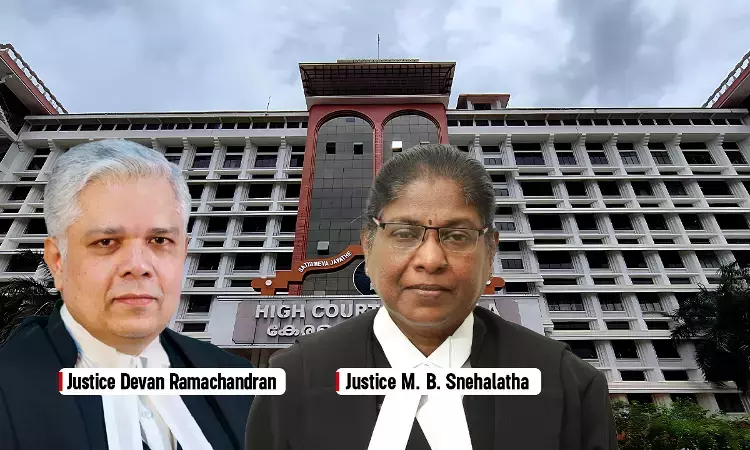
The Kerala High Court on Wednesday (11 February) declined to close the habeas corpus petition filed to trace Suraj Lama, an Indian citizen who was deported from Kuwait but went missing after arriving at Kochi, even after identification of his dead body recovered from Kochi's Kalamaserry area.The division bench comprising Justice Devan Ramachandran and Justice M B Snehalatha has directed...
This is a premium content
Available exclusively to
Our subscribers
Subscribe Premium 
INR 1099+GST
Your support helps us to bring you more content at
an affordable subscription scheme !!!
All payment options available
The Kerala High Court on Wednesday (11 February) declined to close the habeas corpus petition filed to trace Suraj Lama, an Indian citizen who was deported from Kuwait but went missing after arriving at Kochi, even after identification of his dead body recovered from Kochi's Kalamaserry area.
The division bench comprising Justice Devan Ramachandran and Justice M B Snehalatha has directed the Special Investigation Team (SIT) to continue its investigation, to document the sequence of events from the time of Lama's arrival to India until he was found dead.
Suraj Lama was deported from Kuwait and sent to Kochi pursuant to official orders. However, despite his visibly vulnerable condition, described as involving possible cognitive and other impairments, he was cleared by all authorities, including immigration and airport security, and allowed to leave the airport without assistance.
Even though after a complaint for a missing person was filed, the police took Lama into protective custody and sent him to the Kalamaserry Medical College Hospital. But he was discharged and sent away on the ground that he did not suffer from any apparent medical issues.
The Court had previously expressed concern over the administrative handling of deportees, asking if any protocol was in place. Subsequently, a body was found from Kalamassery, which was confirmed to belong to Lama by a Forensic report.
Pursuant to this, the Court has directed the Nedumbasery SHO or the investigating officer to produce the case file of Suraj Lama Missing Case along with the Post mortem report.
Today, the Government Pleader submitted that an interim post-mortem report dated December 1, 2025, had been obtained by the police which recorded that the “Cause of death cannot be ascertained due to the advanced decomposition stages.”
With the cause of death remaining undetermined, the Court noted that the case is still wide open.
The Court noted that although the original plea filed by Lama's son sought issuance of a writ of habeas corpus to produce the alleged detenue, it said that the matter could not be closed merely because the body had been identified.
The Court acknowledged that the SIT had prima facie done a good job in identifying the body. However, it added that this development had thrown more questions than ever before.
Advocate Parvathy Menon, appearing for the petitioner, referred to the Court's earlier orders to argue that negligence appeared at multiple levels. According to submissions recorded by the Court, lapses may have occurred when the alleged detenue arrived in India and was cleared through immigration; when he was reportedly left unattended in the city despite a missing person complaint lodged by his wife; and also at the Medical College where he was sent by police but allegedly left without adequate attention, even assuming he was found medically normal.
The Court observed that halting the proceedings solely because the body had been identified would do more harm than good.
It emphasized that the entire sequence of events, from the alleged detenue's arrival in India, clearance by immigration and CIAL, subsequent action by police and medical college authorities, and ultimately the discovery of his body, must be thoroughly examined, investigated, and properly documented.
Such an inquiry, the Bench observed, would be “the least solace that can happen to the family.”
The SIT, originally constituted when the Court was under the impression that the alleged detenue was alive, has now been directed to continue its investigation. The probe is to be led by the Commissioner of Police or an officer of equivalent rank.
“We clarify that we are ordering this for the purpose of this case, which means to say that the entire sequence of events, from the time the alleged detenue came to India until he was found dead, will have to be properly looked into...” Court added
The Bench also took note of the petitioner's specific allegation that the death may not have been accidental and that possibility of murder cannot be ruled out.
“Going by the sequence, no one can throw this out as of now, particularly when the post mortem report is also inconclusive,” the Court observed.
“We are not investigating the murder, we are investigating the sequence until the body was found. The rest of it is for you to take a call on…” Court added.
The matter is posted after three weeks.
Case Title: Santon Lama v State of Kerala
Case No: WP(Crl.) 1421/ 2025
Counsel for Petitioner: Parvathi Menon

Anamika MJ
Anamika MJ is a Correspondent with LiveLaw, covering Kerala High Court

