



- Home
- /
- High Courts
- /
- Kerala High Court
- /
- Kerala High Court Restrains State...
Kerala High Court Restrains State Waqf Board From Taking Major Decisions Due To Absence Of Non-Muslim Members
K. Salma Jennath
15 July 2026 4:15 PM IST
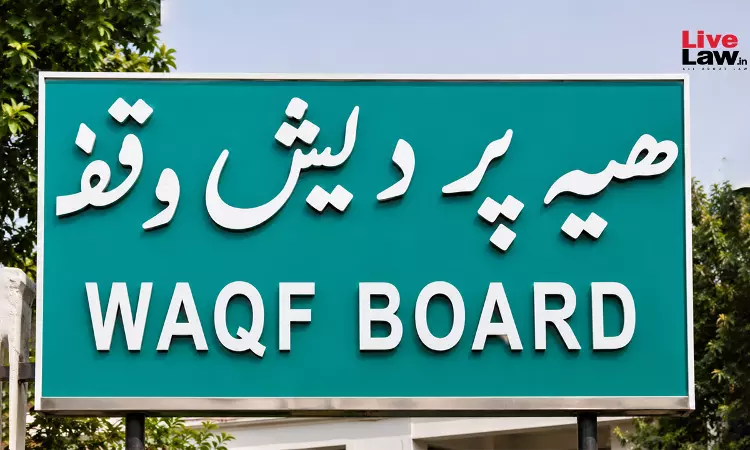
The Kerala High Court on Wednesday (July 15) passed an order restraining the State Waqf Board from taking any major decisions until the controversy regarding its present constitution is resolved.The Division Bench of Chief Justice Soumen Sen and Justice Syam Kumar V.M. today prima facie found that the Board is not constituted in accordance with Section 14 of the Unified Waqf...
This is a premium content
Available exclusively to
Our subscribers
Subscribe Premium 
INR 1099+GST
Your support helps us to bring you more content at
an affordable subscription scheme !!!
All payment options available
The Kerala High Court on Wednesday (July 15) passed an order restraining the State Waqf Board from taking any major decisions until the controversy regarding its present constitution is resolved.
The Division Bench of Chief Justice Soumen Sen and Justice Syam Kumar V.M. today prima facie found that the Board is not constituted in accordance with Section 14 of the Unified Waqf Management, Empowerment, Efficiency, and Development Act 1995 due to the absence of 2 non-Muslim members and one Shia member.
The Court then passed an interim order:
"In view of the fact that admittedly, two non-Muslim members have not been included in the Waqf Board and also, as urged by some of the writ petitioners that one Shia member should also be included, we hold that the constitution of the Board prima facie appears to be not in conformity with Section14 of the said Act. Hence, the present Board shall not take any major decisions or incur any capital expenditure or any policy decision without the express leave of this Court."
The development comes in four public interest litigations challenging the constitution of the State Waqf Board. The Court today heard detailed arguments by the Advocate General Jaju Babu, Additional Solicitor General of India P. Sreekumar, Senior Advocate T. Krishnanunni representing the present Board, Advocates S. Sanal Kumar (Sr.), Lakshmi Sreedhar, Shinto Mathew and Adil M.H. appearing for the writ petitioners.
The Court also directed the State government to ensure that the government representative, who would be an ex-officio member of the Board, would also be in accordance with the provisions of the Act. It added that the Board shall function, for the time being, under the Joint Secretary to the State Government department dealing with Waqf matters.
Today, the AG told the Court that an affidavit has been filed on behalf of the State. He admitted that there are certain infirmities with respect to the Board's present constitution.
Hearing the same, Justice Sen sought clarification: "So the stand of the State is, that to reconstitute the Board in accordance with the mandate of S. 14? That is after taking into consideration the representation?...Impliedly, you accept that the Board has not been properly constituted?"
AG replied: "Subject to your Lordships' approval regarding the allegation of illegality in the existing Board...Impliedly, yes...Infirmity is accepted by us."
Senior Advocate Krishnanunni, who was representing the Board, sought time to go through the same and defend the constitution. He conceded that two non-Muslims have not been nominated but submitted on instructions that it was in view of pendency of cases on related issues before the Supreme Court.
However, the ASGI and the writ petitioners pointed out that there are no cases pending before the Supreme Court.
"So two non-Muslims have not been nominated?...Shia members come later. First, if two non-Muslims are not nominated, then prima facie, that only will not allow you to function. For the time being, may be an administrator, if it is there, who shall function till this issue is resolved. No major decision could be taken," the Court orally remarked.
The Court, thus, deemed it fit to restrain the present Board from taking major decisions. The cases are posted after a week for further consideration.
Background
All the PILs have challenged the non-inclusion of non-Muslim persons to the Board, which is mandated as per the newly amended Waqf Act.
One of the PILs, moved by the Christian charitable organisation named Assembly of Christian Trust Services (ACTS), has also challenged the upload of the details of the disputed Munambam land on UMEED Portal (Unified Waqf Management, Empowerment, Efficiency, and Development Portal), which is set up for the purpose of filing of details of waqf, saying that it affects Hindu and Christian communities living there.
In the PIL moved by ACTS, there is a challenge to the very composition of the Board for non-inclusion of Shia, Bohra and Aghakhani communities as mandated by law. The composition is also challenged on various other grounds.
The organisation has thus sough for a direction to the State government to issue a fresh notification nominating new members to the Board in accordance with law within a timeframe fixed by the Court. The ACTS has also challenged the filing of the disputed Munambam land by the Board on Centre's UMEED Portal on the ground that the Waqf Act empowers only the muttawali to do so.
In the PIL, moved by BJP leader Shone George, the prayer is for a direction to the State government to nominate the two non-Muslim members immediately and to declare that the Waqf Board is presently functioning in violation of Section 14(1) of the Waqf Act as amended in 2025. The Court had earlier sought the State's response and had directed it to file an affidavit.
In yet another PIL, the same grounds taken in the afore cases were also taken. Additionally, the inclusion of CPI(M) politician and former MLA Kunhammed Kutty Master in the Board is highlighted.
Case No: WP(PIL) 135/2026 and connected case
Case Title: Assembly of Christian Trust Services (ACTS) v. State of Kerala and Ors. and connected cases
Counsel for the petitioners: Shinto Mathew Abraham, Anil Sebastian Pulickel, Mathew Nevin Thomas, Kurian Antony Mathew, Karthik Rajagopal, Leah Rachel Ninan, Noel Ninan Ninan, Aparnna S., Adeen Nazar, Arun Joseph Mathew, Rohan Mathew, Santhosh Mathew (Sr.), Veena Raveendran, Karthika Maria, Adil M.H., Joseph Joy, S. Sanal Kumar (Sr.), K.B. Rahim, Lakshmi Sreedhar, P.B. Krishnan (Sr.)
Counsel for the respondents: P.M.Saneer - Spl.G.P. To Addl. A.G., K. Jaju Babu - Advocate General, P. Sreekumar - ASGI, T. Krishnanunni (Sr.), Jamsheed Hafiz, Harikrishnan P.B.
Tags
K. Salma Jennath
Salma Jennath is a Principal Correspondent with LiveLaw, covering Kerala High Court

