



- Home
- /
- High Courts
- /
- Kerala High Court
- /
- Kerala High Court Directs...
Kerala High Court Directs Sabarimala Devaswom Board To Ensure Prasadam Materials Conform To Temple Customs
Anamika MJ
1 Oct 2026 3:16 PM IST
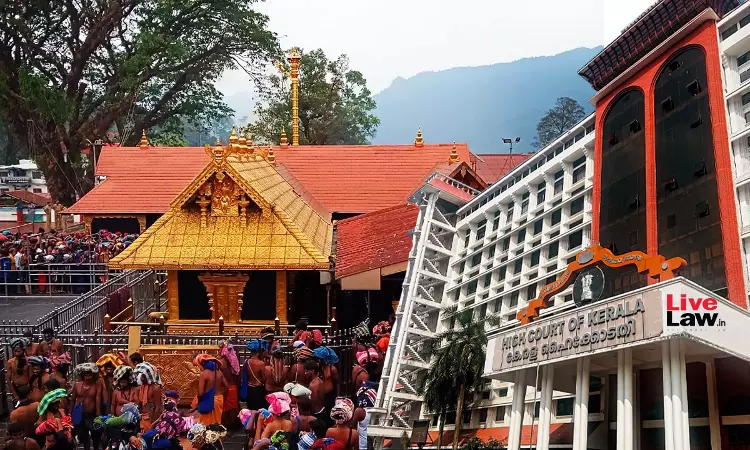
The Kerala High Court has recently directed the Travancore Devaswom Board (TDB) to exercise due care while procuring materials for the preparation of Nivedyam and Prasadam at Sabarimala and to ensure that the materials are in conformity with the prescribed quality standards as well as religious customs and requirement applicable to the Temple. [2026 LiveLaw (Ker) 541]A Division Bench...
This is a premium content
Available exclusively to
Our subscribers
Subscribe Premium 
INR 1099+GST
Your support helps us to bring you more content at
an affordable subscription scheme !!!
All payment options available
The Kerala High Court has recently directed the Travancore Devaswom Board (TDB) to exercise due care while procuring materials for the preparation of Nivedyam and Prasadam at Sabarimala and to ensure that the materials are in conformity with the prescribed quality standards as well as religious customs and requirement applicable to the Temple. [2026 LiveLaw (Ker) 541]
A Division Bench comprising Justice Raja Vijayaraghavan V and Justice K.V. Jayakumar made the observation while disposing of a writ petition by a devotee of Lord Ayyappa, who had challenged the procurement of Halal-certified jaggery for preparing offerings, including Aravana and Unniyappam.
The petitioner contended that the use of jaggery so procured was inconsistent with the religious customs and rituals followed at the temple. The petitioner had also raised concerns over the quality of the jaggery and alleged that spoiled or substandard material had been supplied. He sought directions to ensure that only Satwik and pure materials of high quality were used for Nivedyam and Prasadam.
The Devaswom Board, however, informed the court that the jaggery had been procured through an e-tender process. According to its statement, some packets supplied by Vardhan Agro Processing Limited during 2019 carried the label “Halal JUH/HRC/437/2018”. The supplier explained that it exported jaggery to Arab countries, where Halal certification was required, and that the certification had been obtained for that purpose.
The Special Commissioner, Sabarimala, also reported that the manufacturer had stated that the Halal declaration was placed on the packaging because of export requirements for certain Middle Eastern countries. A Food Safety Officer reported that the Halal declaration on the packaging did not contravene the provisions of the Food Safety Standards Act, 2006.
The High Court examined the food-safety analysis reports submitted before it and it noted that the certificates showed that the jaggery supplied by Vardhan Agro Processing Limited had been tested for parameters including moisture content and total sugar and was found satisfactory in respect of the parameters tested.
The Court noted that the grievance of the petitioner was specifically against the Halal certification marking on the jaggery. The court observed that the jaggery manufacturer exported its products to certain Middle Eastern countries and that the Halal marking was placed on the packaging for that purpose.
“Ideally, the Travancore Devaswom Board ought to have exercised greater care to ensure that the quantity of jaggery supplied by the manufacturer did not bear symbols, markings or declarations that could give rise to an apprehension of conflict with the religious customs and practices followed at the Temple.” Court noted.
The Court, however, noted that the quality testing did not reveal any substance or element that would make the jaggery unsuitable for preparing Prasadam.
The Court thus disposed of the writ petition directing the Travancore Devaswom Board to exercise due care and caution in future. It further directed the Board to incorporate appropriate conditions in its e-tender documents to ensure that materials procured for Nivedyam and Prasadam comply with prescribed quality standards as well as the religious customs and requirements applicable to the temple.
Counsel for Petitioner: M.K. Sumod, Vidya M.K, Sudhir Nambiar P.V, Rema T.P, Thushara. K, Meera S. Gopan
Counsel for Respondent: G. Biju (SC - TDB), K.R. Sunil (Spl. GP) S.A. Anand, O.D. Sivadas
Tags

Anamika MJ
Anamika MJ is a Correspondent with LiveLaw, covering Kerala High Court

