Kerala High Court Refuses To Stay Order Reconstituting State Waqf Board
K. Salma Jennath
18 Oct 2026 8:06 AM IST
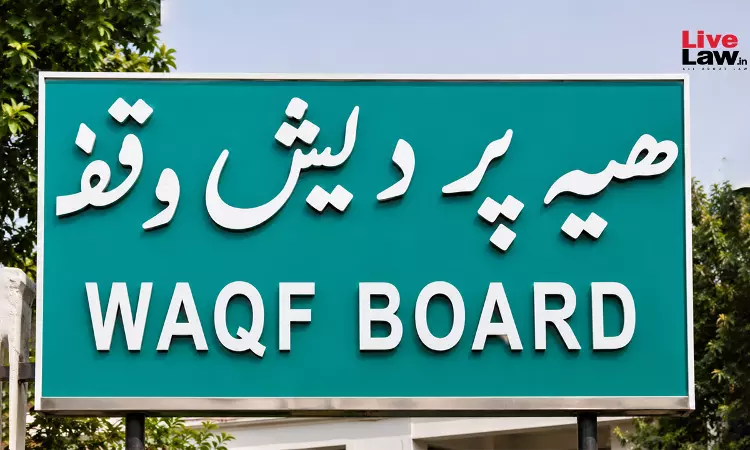
The Kerala High Court on Saturday (October 17) refused to stay the State Government's order dated October 16 reconstituting the State Waqf Board and appointing 9 new members.
Justice S. Manu, however, made it clear that the reconstitution of the Board as per Exhibit P9 would be subject to the outcome of the two writ petitions challenging the order.
"I am of the view that no case is made out to pass a stringent interim order staying the operation of Ext.P9. Hence the request to stay the operation of Ext P9 is rejected. Nevertheless, as formidable contentions which would require elaborate reflection are raised in these writ petitions, I direct that reconstitution of the Board by Ext.P9 shall be subject to the outcome of these writ petitions," the Court said.
The Court was considering two pleas preferred by K.S. Hazma and C.K. Usman Haji, who respectively were the Chairperson and member of the Board prior to the reconstitution. The order under challenge was the one that superseded two earlier government orders that appointed the chairperson and members of the Board.
The Court issued notice to the newly appointed Chairperson and members. It then referred these two pleas before the Division Bench hearing public interest litigations raising similar issues.


Contentions raised by the petitioners
The petitioners' arguments were that the present decision to reconstitute the Board was contrary to the submissions made before the Division Bench, which was that the government's intention was to only fill up vacancies. Moreover, the timing of the present order is also relevant since the government was aware of the fact that the Court would not be sitting till October 22, it was contended.
It was also pointed out that the newly amended Waqf Act do not have provisions granting power to the State Government to reconstitute the Board. Referring to Section 99(1), it was contended that supersession of the Board can only be done if the specific conditions are satisfied and after giving reasonable time to the Board to show cause why it shall not be superseded. It was further pointed out that Section 20 lays down specified situations when the power to remove the chairperson and members can be exercised. Moreover, the mandate under Section 14(1)(b)(i) and 14(1)(f) of the Act was not followed by the present order.
State's arguments
The Additional Advocate General appearing for the State, on the other hand, argued that the government order that was superseded was in violation of the Act since no determination as per Section 14(6) of the Act was undertaken. He pointed out that there was no vacancy as the previous order to have a member of the Bohra community since 9 Muslim members were already nominated and only the decision to appoint non-Muslim members was pending. The requirement of Bohra and Shia members has been addressed in the present order, he added.
He pointed out that an interim application was moved in one of the PILs for a direction to the government to not reconstitute the Board and while that came up on October 14 for consideration before the Division Bench, there was no order passed. Moreover, the Bench had recorded the submission of the Advocate General regarding the government's decision to reconstitute the Board and had granted time to produce the order, he added.
The AAG relied on State of Maharashtra v. Shaikh Mahemud and Anr. to point out that the power to appoint members would also include power to remove them. The decision was made prior to the amended Waqf Act but the principle holds, it was argued.
With respect to the question on non-nomination of a member of Parliament and a member of Bar Council, it was submitted that since there are two more vacancies, nomination to those vacancies has been deferred awaiting outcome of the case pending before the Supreme Court regarding the requirement of two non-Muslim members.
Court's findings
The Court considered whether the government had acted contrary to its earlier submissions made before the Division Bench and the orders passed in the PILs. It was noted that the Division Bench had not restrained the State government from taking action to make the Board's constitution to satisfy the requirements under Section 14. It referred to orders passed on August 19 and October 14.
"It appears that the Division Bench of this Court, apart from not forbidding the State Government from taking steps to ensure that constitution of the Board is in accordance with law, took note of willingness expressed by the State to reconstitute the Board...Prima facie, I do not find merit in the submissions made on behalf of the petitioners that reconstitution of the Board is not in accordance with the submissions made before the Division Bench and orders passed in the PILs," the Court observed.
With respect to the arguments that there is no power to reconstitute the Board, the Court opined that the principle laid down by the Apex Court in State of Maharashtra v. Shaikh Mahemud, specifically regarding nominations by the State Government, is relevant in the context of amended Act as well. It added that it cannot be said that the Government has no authority to cancel the appointments made.
On this reasoning, the Court refused to grant interim relief.
Counsel for the petitioners: P. Chandrasekhar, Manu V., Anand Sankar, Farhana Kabeer, Sreejith A., Sunil Nair Palakkat, Rishi Varma T.R., Rithik S.Anand, M.A.Mohammed Siraj, Alfiya Shamsudheen, Teena M. Ashok
Counsel for the respondents: - Additional Advocate General, Jamsheed Hafiz - Standing Counsel - Waqf Board