



- Home
- /
- High Courts
- /
- Kerala High Court
- /
- State Can't Escape Liability For...
State Can't Escape Liability For Harm Caused By Wild Animals Merely Because It Does Not Own Or Control Them: Kerala High Court
Anamika MJ
23 Oct 2026 11:30 AM IST
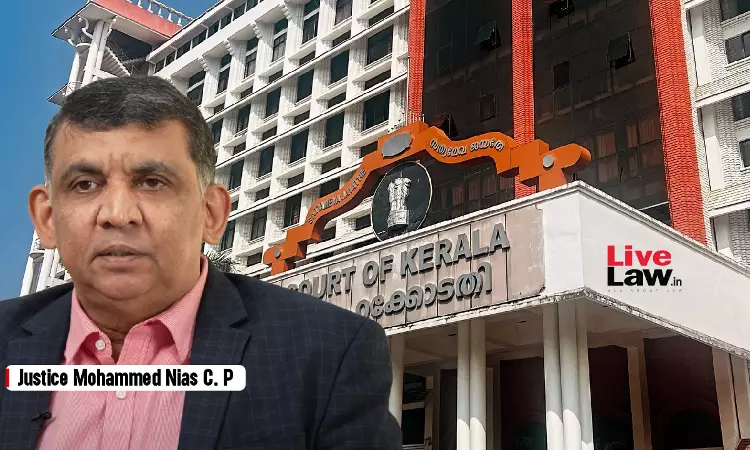
The Kerala High Court has held that the State's lack of ownership or physical custody over wild animals does not, by itself exclude the State from the liability for harm caused by them. [2026 LiveLaw (Ker) 594]Justice Mohammed Nias C.P., made the observation while dismissing a Regular Second Appeal filed by the State against the concurrent findings of the Munsiff's Court, Kalpetta, and the...
This is a premium content
Available exclusively to
Our subscribers
Subscribe Premium 
INR 1099+GST
Your support helps us to bring you more content at
an affordable subscription scheme !!!
All payment options available
The Kerala High Court has held that the State's lack of ownership or physical custody over wild animals does not, by itself exclude the State from the liability for harm caused by them. [2026 LiveLaw (Ker) 594]
Justice Mohammed Nias C.P., made the observation while dismissing a Regular Second Appeal filed by the State against the concurrent findings of the Munsiff's Court, Kalpetta, and the Sub Court, Sulthanbathery.
The plaintiff, an agriculturist residing at Thariode in Wayanad district, was attacked by three wild elephants in 2017, when he stepped out of his house to milk his cow. The attack caused serious injuries, including multiple fractures, and required hospitalisation and surgery.
According to the plaintiff, he incurred substantial medical expenses and suffered permanent disability that impaired his ability to undertake physically demanding work. He also alleged that his left leg had become shorter than his right following the incident.
The plaintiff maintained that the authorities had failed to install adequate protective infrastructure, including electric fencing and trenches, at the interface between forest land and private property.
The Forest Range Officer had initially paid ₹75,000 as emergency relief. However, the plaintiff approached the civil court seeking ₹8 lakh in damages, contending that the amount paid was inadequate and that the authorities had failed to reimburse his remaining expenses.
The State and forest officials argued that ₹75,000 was the maximum compensation payable under the Kerala Rules for Payment of Compensation to Victims of Attack by Wild Animals, 1980, read with the relevant Government Order dated March 22, 2013. They further contended that wild animals roaming freely in forests were neither owned nor controlled by the State and that the authorities had taken reasonable measures to prevent such attacks.
The trial Court held that the compensation scheme did not bar victims from seeking damages in a civil court if the prescribed compensation was inadequate.
The Munsiff's Court, Kalpetta, partly decreed the suit and awarded ₹5,37,030, with interest at 8% per annum from the date of the suit until realisation.
The award comprised ₹1.20 lakh for loss of earnings, ₹2,000 for clothing and transportation, ₹3,750 for bystander expenses, ₹3,000 for extra nourishment, ₹1,24,280 towards medical expenses, ₹50,000 for pain and suffering, and ₹2.34 lakh for permanent disability.
The State's appeal was dismissed by the Sub Court, Sulthanbathery. Hence the present appeal before the High Court.
The State argued that the doctrine of strict liability could not be applied to wild animals freely roaming in forests, as the authorities neither owned nor possessed the animals. It also contended that the principles laid down in State of Kerala v. V.V. George, [2017 (3) KHC 882], could not be applied to the facts of the present case, as it applied only where the State owned, possessed or had custody of the animal.
In V.V. George, the Court held that the compensation rules did not expressly or impliedly bar a civil action and that the State and its officers could be liable under the doctrine of strict liability.
It was argued that the animals roaming freely in forests are not in the State's custody or control, and the State cannot be held liable for their entry into non-forest areas. They further contended that it is unjust and practically impossible to require the State to prevent every such attack by fencing the entire forest or controlling all wild animals. It was further submitted that such incidents are akin to accidents, force majeure or acts of God.
Reliance was placed on the decision in Centre for Environment Law, World Wide Fund India v. Union of India, [(2013) 8 SCC 234], to contend that wild animals in forests could not be treated as the property of the State or any individual.
The Court observed that the decision in Centre for Environment Law addressed the legal status of wildlife and the State's conservation obligations and it did not declare the State immune from liability for damage caused by wild animals.
“The absence of ownership or physical custody of wild animals does not, by itself, exclude the application of the doctrine of strict liability. The question of liability must be determined with reference to the nature of the activity, the legal obligations of the State and the principles governing the compensation claim.” Court held.
The Court observed that though the State does not own wild animals as private property, it has a statutory and public duty concerning the protection and management of wildlife.
Referring to Article 48A of the Constitution and the Wild Life (Protection) Act, 1972, the Court held that the State must take reasonable measures to prevent human-wildlife conflict and safeguard human habitations and agricultural properties.
“The State is therefore responsible for balancing wildlife protection with its constitutional obligation to protect citizens' fundamental rights, including the right to life under Article 21.” Court noted.
The Court clarified that the State's obligation was one of reasonable care and did not require it to fence the entirety of forest land.
“It (the State) must take reasonable measures to prevent human-wildlife conflict and protect human habitations and agricultural properties. Citizens may claim compensation for harm caused by wild animals, whether or not their claims are expressly covered by a Government order, scheme or provision.” Court added.
However, appropriate protective measures, including fencing near human habitations, were necessary. The Court also observed that the State could not shift the burden of protecting property from wild-animal attacks onto citizens when the law itself restricts the measures they may take against wildlife.
In the present case, the defendants asserted that solar fencing, trenches and a wall had been provided and that watchers had been appointed. However, they failed to produce documentary or other supporting evidence to substantiate these claims.
Since the attack occurred at the plaintiff's residence and the authorities had failed to establish that adequate preventive measures were in place, the High Court found no reason to interfere with the lower courts' conclusion on negligence.
Relying on the decision in Wildlife Warden and Ors. v Thadathil Saramma and Ors. [2026 (6) KHC 53] the Court had held that the Kerala Rules for Payment of Compensation to Victims of Attack by Wild Animals, 1980, prescribed the quantum and procedure for expeditious ex gratia relief but did not constitute the sole and exclusive remedy available to victims.
The Court reiterated that the right to claim just and adequate compensation for injury or loss of life caused by wild animals could be traced to Article 21 of the Constitution and the common law principle of strict liability, independently of an executive compensation scheme.
The prescribed amount, it held, could not fetter the jurisdiction of civil courts to determine compensation commensurate with the actual loss, pain and suffering sustained by a claimant.
The Court thus held that a victim could approach a civil court for damages where the compensation available under the statutory rules was considered inadequate.
With the observations, the Court dismissed the Regular Second Appeal.
Counsel for Appelland: Kannan M (GP)
Counsel for Respondent: Mithun P, Merin Thomas, Sumeen S
Tags

Anamika MJ
Anamika MJ is a Correspondent with LiveLaw, covering Kerala High Court

