



- Home
- /
- High Courts
- /
- Kerala High Court
- /
- Stringent Bail Restrictions Under...
Stringent Bail Restrictions Under UAPA & NDPS Act Don't Apply To Accused Who Has Turned Approver: Kerala High Court
Anamika MJ
26 Nov 2026 1:57 PM IST
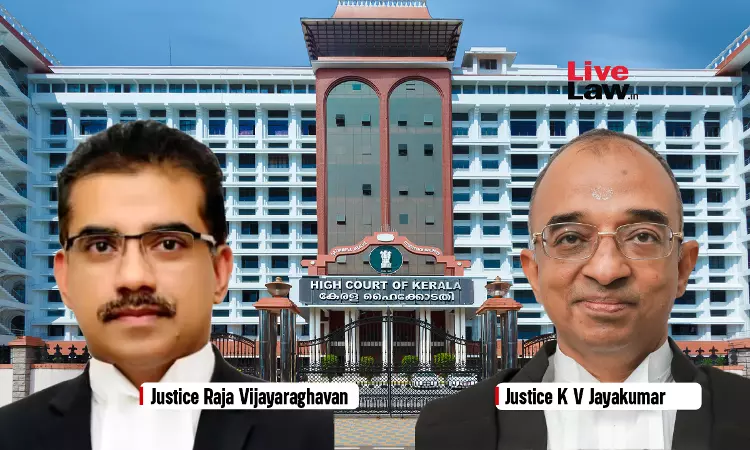
The Kerala High Court has held that stringent bail restrictions under Unlawful Activities (Prevention) Act, 1967 (UAPA) and Narcotic Drugs and Psychotropic Substances Act, 1985 (NDPS Act) do not apply to accused who has accepted a tender of pardon and become an approver. [2026 LiveLaw (Ker) 651]A Division Bench comprising Justice Raja Vijayaraghavan V and Justice K.V. Jayakumar delivered...
This is a premium content
Available exclusively to
Our subscribers
Subscribe Premium 
INR 1099+GST
Your support helps us to bring you more content at
an affordable subscription scheme !!!
All payment options available
The Kerala High Court has held that stringent bail restrictions under Unlawful Activities (Prevention) Act, 1967 (UAPA) and Narcotic Drugs and Psychotropic Substances Act, 1985 (NDPS Act) do not apply to accused who has accepted a tender of pardon and become an approver. [2026 LiveLaw (Ker) 651]
A Division Bench comprising Justice Raja Vijayaraghavan V and Justice K.V. Jayakumar delivered the judgment in a criminal appeal preferred under Section 21 of the National Investigation Agency Act, 2008.
The appellant was arrested on December 19, 2022, in connection with an alleged transnational conspiracy involving narcotics trafficking, arms smuggling and activities allegedly intended to finance and facilitate the revival of the banned organisation Liberation Tigers of Tamil Eelam (LTTE).
The prosecution alleged that the conspiracy involved international criminal syndicates operating across Pakistan, Sri Lanka and India. The alleged seizures included more than 300 kilograms of heroin, AK-56 assault rifles and 1,000 rounds of live ammunition.
The appellant was alleged to have facilitated the movement of drug consignments, handled proceeds of unlawful transactions through hawala channels and converted proceeds of crime into cryptocurrency.
During the investigation, the appellant volunteered to make a full disclosure concerning the offence and the involvement of other accused persons. Pursuant to his statement under Section 164 CrPC, the Special Court for Trial of NIA Cases, Chennai, tendered pardon to him by an order dated December 19, 2023. He accepted the tender of pardon and became an approver.
Despite this, he continued to remain in judicial custody for nearly four years. His application for bail was rejected by the Special Court, which principally relied upon Section 306(4)(b) CrPC, the restrictions under Section 43D(7) UAPA and the apprehension that, being a foreign national, he might abscond if released.
Aggrieved by this, the appellant approached the High Court.
The High Court considered the applicability of Section 43D(7) UAPA and Section 37 NDPS Act to a person who has accepted pardon and become an approver.
The Court noted that Section 43D(7) UAPA prohibits the grant of bail to a person accused of an offence under the Act, if that person is not an Indian citizen and has entered the country unauthorized or illegally, except in very exceptional circumstances and for reasons recorded in writing.
The Special Court had relied upon this provision, having regard to the appellant's Sri Lankan nationality and the allegation that he had been residing in India on the strength of fraudulently obtained identity documents.
The High Court, however, drew a distinction between an accused person and an approver.
It observed that the statutory embargo under Section 43D(7) is directed against a person accused of an offence under the UAPA. Once pardon is tendered and accepted, the person concerned ceases to occupy the position of an accused and assumes the status of a prosecution witness.
The Court held that the same principle applies to Section 37 of the NDPS Act, which imposes stringent conditions for the grant of bail to persons accused of specified offences under that legislation.
“An approver, whose pardon remains in force, occupies a distinct legal position. He is no longer before the Court as an accused seeking the concession of bail, but as a prosecution witness whose evidence is required for the adjudication of the charges against the remaining accused. The statutory restrictions governing the release of an accused cannot, therefore, be mechanically extended to an approver merely because the offences in question are grave or attract stringent provisions relating to bail.” the court observed.
Reliance was placed on the State of Maharashtra v. Abu Salem Abdul Kayyum Ansari [(2010) 10 SCC 179], to reiterate that the object of tendering pardon to an accomplice is to secure evidence against other persons involved in serious offences.
The Court also referred to A.J. Peiris v. State of Madras [AIR 1954 SC 616], wherein the Supreme Court recognised that, upon the tender of pardon, the person concerned ceases to be an accused and becomes a witness.
The Bench clarified that the protection flowing from pardon is conditional. If the approver willfully conceals essential facts or gives false evidence, the consequences contemplated under Section 308 CrPC may follow, including proceedings against him in accordance with law.
“Unless and until the protection flowing from the pardon is withdrawn in accordance with Section 308 Cr.P.C., he cannot be treated as an accused merely for the purpose of attracting the statutory embargoes governing the grant of bail under the UAPA or the NDPS Act.” the Court added.
The Court therefore held that neither Section 43D(7) UAPA nor Section 37 NDPS Act was attracted to the appellant in his capacity as an approver.
The Court also considered whether the statutory requirement under Section 306(4)(b) CrPC, mandating the continued detention of an approver until the termination of the trial, extends to a person who has been granted pardon under Section 307 CrPC by a Court of Session.
The Court examined Sections 306 and 307 CrPC. Section 306 empowers specified Magistrates to tender pardon to an accomplice on the condition that the person makes a full and true disclosure of the circumstances within his knowledge concerning the offence and the involvement of other persons.
Section 306(4)(b) specifically provides that a person accepting pardon under Section 306(1) shall, unless already on bail, be detained in custody until the termination of the trial.
Section 307, on the other hand, empowers the Court of Session or the Court to which a case has been committed to tender pardon at any time after commitment but before judgment is pronounced.
The Court emphasised that Section 307 does not contain any provision corresponding to Section 306(4)(b), which mandates the continued detention of an approver until the conclusion of the trial.
Reliance was placed on the decision in A. Devendran v. State of Tamil Nadu [1997 (11) SCC 720], in which the Supreme Court has held that the words “same conditions” occurring in Section 307 CrPC refers to the conditions mentioned in Section 306 (1) CrPC, namely the requirement of making a full and true disclosure.
“More importantly, Section 307 does not contain a provision corresponding to Section 306(4)(b), requiring the person accepting pardon to remain in custody until the termination of the trial.” the Court noted.
The Court also relied on its earlier decisions in Shammi Firoz v. National Investigation Agency [2010 (4) KHC 319] and Saidevan Thampi v. State of Kerala [2013 KHC 694], which had considered the distinction between the two provisions.
The Court also examined the statutory framework governing NIA Special Courts. Under Section 2(h) of the NIA Act, a Special Court is a Court of Session designated under Sections 11 or 22. Section 16(1) empowers such a Special Court to take cognizance of offences directly, without the necessity of committal proceedings.
The Court held that an NIA Special Court, being a Court of Session with the statutory power to take cognizance directly, can tender pardon by invoking Section 307 CrPC.
The Court thus observed that the pardon in the present case had been tendered by the Special Court by invoking Section 307 .
"The said restriction is expressly attached to a tender of pardon made under Section 306(1). It cannot be extended to a case where pardon has been tendered by the Special Court by invoking Section 307 of the Code." the court held.
The Court accordingly concluded that Section 306(4)(b) had no application to the appellant and that the Special Court was not justified in rejecting bail on the ground that the provision mandated his continued detention.
- Prolonged Incarceration In Determining The Entitlement To Bail
The Court thereafter examined whether the appellant's prolonged incarceration justified his release, particularly considering the seriousness of the allegations.
The Court referred to the principles laid down by the Supreme Court in Union of India v. K.A. Najeeb [(2021) 3 SCC 713].
The Supreme Court in K.A. Najeeb had held that statutory restrictions on bail under special enactments do not completely exclude the constitutional courts' power to grant bail where prolonged incarceration results in the infringement of fundamental rights under Part III of the Constitution.
Referring to decisions in Sheikh Javed Iqbal @ Ashfaq Ansari v. State of Uttar Pradesh [(2024) 8 SCC 293], Javed Gulam Nabi Shaikh v. State of Maharashtra [(2024) 9 SCC 813], Rabi Prakash v. State of Odisha[2023 SCC OnLine SC 1109] and Athar Parwez v. Union of India[(2024) 20 SC 57], where the Court emphasised that when a speedy trial is denied to an accused who has suffered prolonged incarceration, the rigorous restriction on the grant of bail with penal statutes would not be a bar for the constitutional court to grant bail.
The Court noted that in the present case, the appellant has remained in judicial custody for almost four years despite having been granted pardon and agreeing to assist the prosecution as an approver.
Taking into account the period of incarceration already undergone by the appellant and the fact that some of the co-accused have been enlarged on bail in connected cases, the Court held that that the appellant was entitled to be released, subject to appropriate conditions to ensure his availability for the proceedings, protect the integrity of the prosecution and safeguards the interest of justice.
- Ensure Effective Implementation of the Witness Protection Scheme
Referring to Section 398 of the Bharatiya Nagarik Suraksha Sanhita, 2023, the Court observed that every State Government is under an obligation to prepare and notify a Witness Protection Scheme to ensure the safety and security of witnesses.
The Bench took note of the proposed Kerala Witness Protection Scheme, 2026, which had been submitted to the State Government for issuance and was under consideration.
Having regard to the appellant's role as an approver and his decision to testify against the other accused, the Court held that the case warranted consideration for protection under the applicable Witness Protection Scheme.
“The appellant's safety and security must receive due consideration so that he is able to discharge his obligation as a witness without fear, intimidation or apprehension of retaliation.” the Court said.
The Secretary to Government, Home Department, was accordingly directed to take immediate steps to bring the appellant within the protective framework of the applicable scheme. The competent authorities were directed to assess the nature and extent of any threat and determine the protective measures required.
“We would like to emphasise that the criminal justice system can function effectively only when persons who come forward to assist the administration of justice, often at considerable personal risk, are assured that their safety will not be compromised on account of their willingness to testify.” the Court said.
The Court underscored that witness protection is not merely an issue of individual security but an essential prerequisite for the fair and effective administration of criminal justice.
“A system which expects witnesses to come forward and assist in the prosecution of offenders must also ensure that they are not left vulnerable to threats, intimidation or retaliation.” the Court added.
The High Court thus allowed the appeal and directed the release of the appellant subject to several conditions.
These include execution of a bond for Rs.1 lakh with two solvent sureties of the like amount, surrender of his passport, disclosure of residential and contact particulars, and a restriction on leaving Ernakulam District without prior permission of the Special Court.
The appellant was also prohibited from contacting the other accused or attempting to influence, intimidate or interfere with prosecution witnesses.
The Court further prohibited him from participating in media interactions or making public or social media communications concerning the case in a manner capable of prejudicing the investigation or trial.
The Bench clarified that the grant of bail would not confer upon the appellant any right to remain in India. The Foreigners Regional Registration Office and other competent authorities would remain at liberty to initiate or continue proceedings concerning his immigration status in accordance with law.
The NIA was also given liberty to approach the Special Court for cancellation of bail in the event of violation of the conditions.
Counsel for Appellant: Nireesh Mathew
Counsel for Respondent: P. Sreekumar (ASGI), Amal Parthasarathy (CGC)
Tags

Anamika MJ
Anamika MJ is a Correspondent with LiveLaw, covering Kerala High Court

