



- Home
- /
- High Courts
- /
- Kerala High Court
- /
- Kerala High Court Bars Construction...
Kerala High Court Bars Construction Of Commercial Kiosks On Kochi's Queen's Walkway, Cites Pedestrians' Right To Unobstructed Access
K. Salma Jennath
22 Jun 2026 5:39 PM IST
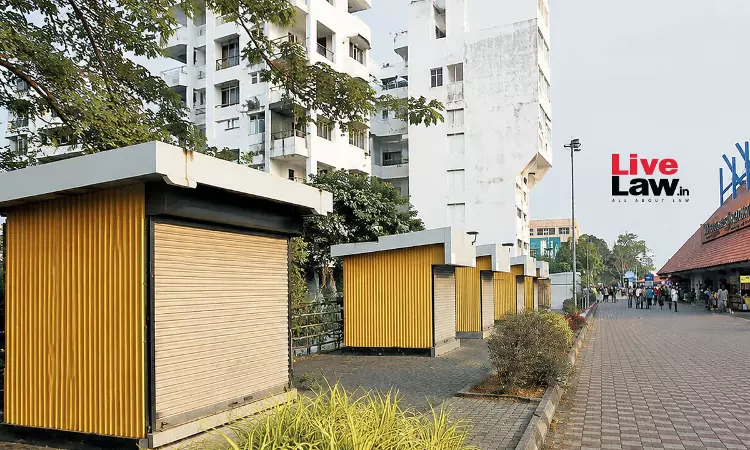
The Kerala High Court on Monday (June 22) allowed the plea filed by the Tritvam Apartment Owners Association against the proposed construction of 20 commercial kiosks in the Queen's Walkway. [2026 LiveLaw (Ker) 339]Justice Bechu Kurian Thomas pronounced that the Goshree Islands Development Authority (GIDA) do not have any right to construct, install or operate commercial kiosks on the...
This is a premium content
Available exclusively to
Our subscribers
Subscribe Premium 
INR 1099+GST
Your support helps us to bring you more content at
an affordable subscription scheme !!!
All payment options available
The Kerala High Court on Monday (June 22) allowed the plea filed by the Tritvam Apartment Owners Association against the proposed construction of 20 commercial kiosks in the Queen's Walkway. [2026 LiveLaw (Ker) 339]
Justice Bechu Kurian Thomas pronounced that the Goshree Islands Development Authority (GIDA) do not have any right to construct, install or operate commercial kiosks on the Queen's walkway as it would affect the legal rights of the pedestrians:
"Goshree Chakyath road falls into the prohibited zone under the Street Vending Act and those footpaths cannot be used for setting up commercial kiosks. Further, construction of commercial kiosks on the Queen's walkway would prejudice unobstructed access and thereby, affect the legal right of the pedestrians. Hence, GIDA has no right to construct kiosks on the Queen's Walkway in Cochin. If any kiosks is to be constructed, it can be done on areas, designated or demarcated for that purpose. In the result, a writ of mandamus is issued to the respondents not to construct, install or operate any kiosks on the Queen's walkway in Kochi," the Court said while pronouncing its order in open court.
The two issues considered by the Court were:
"(i) Whether GIDA has right/authority over the Goshree Chakyath road and the Queen's walkway adjacent to it; and (ii) Whether footpaths can be utilized for setting up commercial kiosks and whether GIDA has the right to construct kiosks on the Queen's walkway in Cochin."
The Court held that a reading of Sections 207 and 234 of the Kerala Municipalities Act, would make it evident that all roads including the footpaths has to be regarded as the public road and it is vested with the Municipality.
"Thus even though the title to the area over which the Goshree Chakyath road has been constructed belongs to GIDA, by virtue of the patta issued, still, after the formation of the public road, the said road and its walkway vests with the local authority. Said statutory vesting of the road on the municipality is defeated by the act of any party, including an order of the government. Thus, it has to be held that not withstanding the patta issued to GIDA over the entire 25 hectares of reclaimed land, still, after the formation of the Goshree Chakyath road, the said road vests absolutely with the Cochin Corporation," the Court reasoned.
To answer the second issue, reliance was placed on S. Rajasekharan v. Union of India, wherein the Supreme Court had observed that the right to have footpaths and footways, which are in good condition, is an essential part of Article 21 of the Constitution of India and if there is no provision made for proper footpaths or footways, pedestrians would be forced to walk on the roads, which will cause danger and which may lead to accidents.
A reference was also placed on the Indian Roads Congress's Guidelines for Pedestrian Safety, which recognised pedestrian walking as an important mode of transport, one that consumes no fuel and adds to fitness of walkers.
"A reading of the guidelines of the Indian Road Congress will reveal that the convenience of the pedestrians should be the paramount consideration to ensure full utilisation of the facilities…It is also identified that pedestrian facilities are a critical element in producing a pedestrian-friendly environment with a number of engineering solutions to improve the quality of the pedestrian, all of which should be taken into account so that it will cater to the groups like children, families with young children, elderly persons, persons with disabilities, and people carrying heavy luggage," the Court opined.
The Court further relied upon the recent Apex Court decision in Maniyar Iliyaz Shaik Riyaz v. P. Ayyappan, wherein right to walk was declared as a fundamental right with a correlative duty on the local authorities to provide demarcated and well-maintained footpaths for walkers. The top Court had also held that a violation of the right to walk on demarcated footpaths will entitle the citizens to invoke constitutional and legal remedies.
The Court also highlighted that the Cochin Corporation has a duty to demarcate and maintain all footpaths, including the Queen's walkway:
"From the above principles, it becomes apparent that the space provided for the pedestrians cannot be infringed upon. As observed upon in Maniyar Iliyaz case, as a duty-bearer, the Corporation is bound to ensure that the pedestrian infrastructure, not only in Queen's walkway, but even every footpath is maintained properly. The corporation also has a duty to demarcate and construct necessary pedestrian infrastructure through the city. Once a kiosk is set up, or even hawker is permitted on a footpath or a walkway, it will infringe upon the pedestrian space resulting in compelling the pedestrian or the cyclists to shift from the demarcated area thereby paving the way for accidents. Of course, the construction of kiosks will cater or complement economic viability. However, such an issue should have been considered at the time of designing the walkway by providing specific areas or decks beyond the walkway to cater to such needs."
The Court further reasoned that the proposed kiosks is an afterthought and since no specific area has been provided for the same, it cannot be constructed by reducing the width of the walkway. It was also found that the present area falls outside the street vending zone, and therefore, neither GIDA nor the Corporation can construct any kiosks:
"In the instant case, GIDA did not contemplate, at the initial stage or while designing the walkway, to construct any kiosks. Have they designed it so, they would have certainly kept apart a portion of the adjacent land for construction of such a kiosk. No area is available on the walkway specifically kept aside as a space for setting up kiosks. Even at the time of sale of the adjacent lands, GIDA did not…to provide such a space to cater to the needs of construction of kiosks on those roads. It is only an afterthought that they have now permitted the construction of kiosks by reducing the width of the walkway. Though, normally, a walkway or footpath can be used only for the purpose of pedestrians, an exception is created under Street Vendors Act. Based on the said provisions, Cochin Corporation has formulated byelaws for street vending in the year 2022…Therefore, it is evident that the Goshree Chakyath road...is not within the vending zone, entitling GIDA or even the Corporation of Kochi to set up any kiosks or vending shops. Exclusion from the schedule amounts to a declaration that such areas have no vending zone."
The Court issued a writ of mandamus to GIDA, Cochin Corporation and CSML restraining construction of commercial kiosks in Queen's Walkway. The plea filed by the Tritvam Apartment Owners Association was thus allowed.
Background
The Court had earlier heard detailed arguments on behalf of Senior Advocate George Poonthottam on behalf of GIDA and Advocates S. Muhammed Haneeff and Asif Ali for the petitioners as well as the standing counsels for the Cochin Corporation and Cochin Smart City Mission Ltd. (CSML). It had then reserved its verdict.
The petition was filed stating that the construction of the kiosks would change the residential character of the area, overburden civic infrastructure and also create traffic congestion, health and safety risks.
GIDA had contended that the property where the kiosks are proposed to be set up belonged to GIDA and not to the petitioner. It was further pointed that constructions would not be on the footpath but on the duct space adjacent to the walkway.
GIDA also raised a point that the writ petition was in the nature of a public interest litigation. It was also pointed out that GIDA has entered into contract with a third party for the construction, which was to commence from April 1. It was highlighted that there would be damages in case of delay and that the petitioners are taking advantage of the Single Bench's interim order to further delay the proceedings with the application for Advocate Commissioner.
The Court had earlier orally remarked that the people in Ernakulam are being harmed with the conversion of areas kept aside for public benefit into commercial spaces. It had also questioned GIDA regarding its authority to construct the proposed 20 commercial kiosks.
The Court had also passed an interim order restraining the construction/installation of commercial kiosks and the same was challenged before the Division Bench in appeal. The Division Bench had dismissed the same, observing that it would not be proper for it to consider the appeal at that stage.
Case No: WP(C) 6851/2026
Case Title: Tritvam Apartment Owners Association (TAOA) and Anr. v. The District Collector and Ors.
Citation: 2026 LiveLaw (Ker) 339
Counsel for the petitioners: S. Muhammed Haneeff, M.H. Asif Ali, Ashik Ali M.H., Aswathi K.C., and Vismaya Jayaraj
Counsel for the respondents: George Poonthottam (Sr.) - GIDA, Varghese K. Paul - GIDA, Diastus Komath, K. Janardhana Shenoy, M.U.Vijayalakshmi
Tags

K. Salma Jennath
Salma Jennath is a Principal Correspondent with LiveLaw, covering Kerala High Court

