



- Home
- /
- High Courts
- /
- Kerala High Court
- /
- Confession Made To Police Can't Be...
Confession Made To Police Can't Be Used Against Co-Accused Without Independent Evidence: Kerala High Court Acquits Man In Theft Case
Anamika MJ
29 Jan 2026 11:15 AM IST
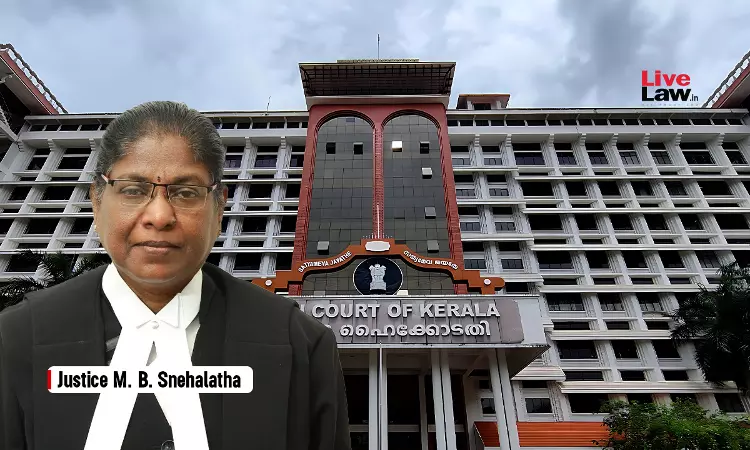
The Kerala High Court has reiterated that a confession made to the police by one accused cannot be used to convict a co-accused in the absence of an independent incriminating evidence.Justice M B Snehalatha was delivering a judgment in a criminal revision petition filed by the second accused in a theft case. The petitioner challenged the conviction and sentence for the offence punishable...
This is a premium content
Available exclusively to
Our subscribers
Subscribe Premium 
INR 1099+GST
Your support helps us to bring you more content at
an affordable subscription scheme !!!
All payment options available
The Kerala High Court has reiterated that a confession made to the police by one accused cannot be used to convict a co-accused in the absence of an independent incriminating evidence.
Justice M B Snehalatha was delivering a judgment in a criminal revision petition filed by the second accused in a theft case. The petitioner challenged the conviction and sentence for the offence punishable under Section 379 (theft) of IPC.
The prosecution case was that the police party who were on patrolling duty, intercepted a motorcycle ridden by the accused number one and 2. According to the prosecution, the second accused was a pillion rider and on seeing the police, he took to heels and the policemen tried to catch him but could not succeed.
The rider of the vehicle could not furnish records relating to the vehicle and later it was found that the motorcycle was stolen from the residence of one Babu. The Police, after the completion of the investigation, submitted a final report in which an offence punishable under Section 379 was charged against the second accused along with the first accused.
The trial Court convicted both the accused guilty under Section 379 read with 34 of IPC.
The second accused, who is the revision petitioner submitted that the prosecution failed to adduce any evidence to connect him with the crime and the trial Court and the appellate court convicted him based only on the confession statement given by the first accused to the Police, which is inadmissible in evidence.
The Court analysed the Sections 24 to 30 of the Indian Evidence Act, 1872, along with their corresponding provisions under the Bharatiya Sakshya Adhiniyam, 2023, to examine whether the confession statement given by the first accused to the police that he, along with the second accused, committed the theft of the motorcycle.
The Court observed that Section 25 of the Evidence Act imposes an absolute bar on proving confessions made to police officers, even if it is made voluntarily.
The Court further observed that Section 30 of the Evidence Act states that a confession can be taken into consideration against co-accused only if it is legally admissible and duly proved.
“The basis on which this provision is founded is that if a person makes confession implicating himself, that any suggest that the maker of the confession is speaking the truth. Normally, if a statement made by an accused person is found to be voluntary and it amounts to a confession in the sense that it implicates the maker, it is not likely that the maker would implicate himself untruly, and so, Section 30 provides that such a confession may be taken into consideration even against a co-accused who is being tried along with the maker of the confession” Court added.
The Court further examined the definition of Evidence under Section 3 of the Act and noted that confession under Section 30 is not evidence under Section 3 of the Indian Evidence Act.
The Court relied on Bhuboni Sahu v. King [AIR 1949 PC 257], Haricharan Kurmi v. State of Bihar [1964 KHC 540] and other precedents to note that confessions under Section 30 of the Evidence Act can be used against co-accused when there is other material evidence against the accused.
The Court noted that, when the confessional statement is excluded or inadmissible by virtue of Section 25 or 26 of the Evidence Act, such confessional statements cannot be made admissible against another co-accused by stretching it with the help of Section 30 of the Act.
For context, Section 25 of the Evidence Act places a complete ban on the making of such confession by that person, whether he is in custody or not. Section 26 of the Evidence Act lays down that a confession made by a person while he is in the custody of a police officer shall not be proved against him unless it is made in the immediate presence of a Magistrate.
“It is a well settled principle that confession statement contemplated under Section 30 of the Evidence Act must be both relevant and admissible in terms of the Evidence Act” the Court said.
The Court noted that Section 30 of the Evidence Act permits the Court to take into consideration the confession of a co-accused only if such confession is proved.
“The expression “confession proved” in Section 30 of the Evidence Act necessarily means a confession that is legally admissible. Since Section 25 of the Evidence Act imposes an absolute bar on confession made to a police officer, such a confession cannot be proved at all. Consequently, it cannot be looked into even for the limited purpose contemplated under Section 30 of the Evidence Act.” Court observed.
The Court thus noted that the section 30 of the Evidence Act does not override the ban under Section 25 of the Evidence Act.
The Court observed that, in the present case, except for the statement by the PWs 3 and 4 (police officers) that while in custody, the first accused made a confession statement to the police that he was with the second accused while stealing the motorcycle. There was no evidence connecting the second accused/ revision petitioner to the crime in question.
The Court thus observed that the prosecution failed to establish the involvement of the revision petitioner and allowed the revision Petition. The conviction and sentence of the second accused were set aside, and he was acquitted.
Case No: Crl. R P 448/ 2018
Case Title: Shyjal C v State of Kerala
Citation: 2026 LiveLaw (Ker) 53
Amicus Curiae: R Harikrishnan
Counsel for Respondent: Maya M N
Tags

Anamika MJ
Anamika MJ is a Correspondent with LiveLaw, covering Kerala High Court

