



- Home
- /
- High Courts
- /
- Kerala High Court
- /
- SC/ST Claimant's Inability To Prove...
SC/ST Claimant's Inability To Prove Caste Not Enough To Deny Constitutional Benefits Unless State Shows Contrary Evidence: Kerala High Court
Anamika MJ
7 Sept 2026 1:00 PM IST
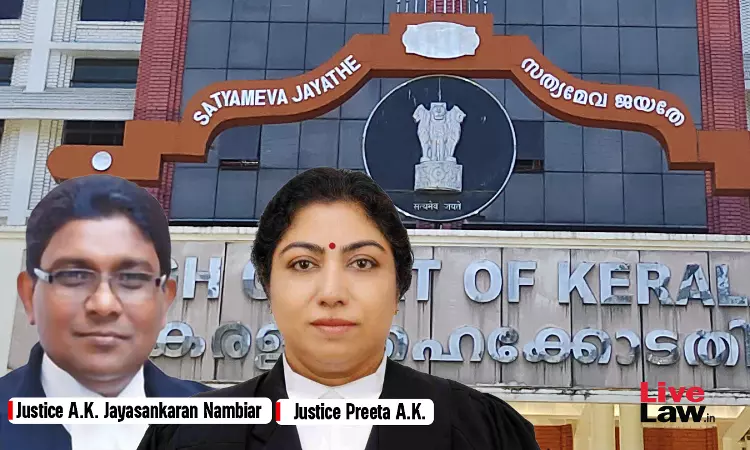
The Kerala High Court has held that authorities scrutinising caste claims under the Kerala (Scheduled Castes and Scheduled Tribes) Regulation of Issue of Community Certificates Act, 1996 cannot insist that members of Scheduled Castes and Scheduled Tribes discharge the same burden of proof ordinarily expected of citizens when establishing their community identity. [2026 LiveLaw (Ker)...
This is a premium content
Available exclusively to
Our subscribers
Subscribe Premium 
INR 1099+GST
Your support helps us to bring you more content at
an affordable subscription scheme !!!
All payment options available
The Kerala High Court has held that authorities scrutinising caste claims under the Kerala (Scheduled Castes and Scheduled Tribes) Regulation of Issue of Community Certificates Act, 1996 cannot insist that members of Scheduled Castes and Scheduled Tribes discharge the same burden of proof ordinarily expected of citizens when establishing their community identity. [2026 LiveLaw (Ker) 486]
The Division Bench of Dr. Justice A.K. Jayasankaran Nambiar and Justice Preeta A.K. held that the denial of constitutionally guaranteed benefits to members of SC/ST communities must be confined to cases of patent fraud established by independent material available with the State.
The Court was considering an appeal by a retired Postal Assistant, challenging a Single Bench judgment which had upheld proceedings declaring that he did not belong to the Scheduled Tribe community of Malai Pandaram.
The petitioner had obtained appointment as a Postman in 1980 and promotion as Postal Assistant in 1989 under the Scheduled Tribe reservation quota, on the strength of a community certificate issued by the Tahsildar identifying him as a member of the Malai Pandaram community.
A vigilance inquiry subsequently concluded that the petitioner belonged instead to the Pandaram (Veera Saiva) community, classified as an Other Backward Community. The Scrutiny Committee relied upon an anthropological investigation and directed consequential action, including cancellation of his community certificate. The Government subsequently ordered his termination from service and directed prosecution for allegedly making a false caste claim.
The appellant had alleged discrepancies in the material relied upon by the authorities and contended that the vigilance report substantially relied on an alleged admission by his maternal uncle, who himself was stated to belong to the OBC category. The petitioner pointed out that other relatives had obtained benefits on the basis of their Scheduled Tribe identity and sought access to the original documents relied upon against him. Those documents, however, had not been shown to him before the adverse order was passed.
The Division Bench noted that the objection and explanation submitted by the petitioner had not been considered while passing the impugned proceedings.
The Court rejected the State's argument that non-consideration of the objections would not amount to a violation of natural justice because the material already available was sufficient to establish the finding against him.
The Court further noted that the approach adopted by the Scrutiny Committee was erroneous even from the perspective of the 1996 Act.
The Court observed that, in proceedings alleging fraudulent misrepresentation of caste status for securing affirmative-action benefits, authorities cannot be oblivious to the disadvantages faced by SC/ST members in obtaining the very identity documents required to establish their entitlement to constitutional protections.
“Instances are numerous where members of the Scheduled Caste/Schedules Tribe community are denied such benefits for want of identity documents to prove their identity as members of the said community. The struggle faced by them in obtaining identity documents such as Aadhaar cards and caste/community certificates from the authorities concerned is something that this Court can take judicial notice of, going merely by the number of cases that reach this Court claiming such reliefs.” Court noted.
The Court held that the authorities must adopt a lenient approach while assessing their claims and look at the overall circumstances, including instances of extension of social security benefits to other family members, including extended family members.
The Court held that authorities cannot simultaneously acknowledge that affirmative State action is necessary to bring SC/ST communities on an equal footing with other citizens and yet require members of those communities to satisfy the same evidentiary burden as ordinary citizens when proving their identity.
The Court further held that the denial of constitutionally guaranteed privileges to SC/ST members should occur only in exceptional cases of patent fraud, and such fraud must be established through material independently available with the State.
This would include, where relevant, proof of fraud allegedly committed by the authorities who issued the caste certificate on which the individual secured service benefits.
The Court held that a claimant's inability to produce sufficient evidence establishing their community identity cannot, by itself, justify deprivation of constitutional benefits in the absence of positive evidence from the State to the contrary.
TheCourt thus set aside the Scrutiny Committee's proceedings as well as the consequential Government order.
The Committee was directed to reconsider the matter afresh after examining the petitioner's earlier objection and any further material he wished to produce. It was also directed to allow him to inspect the originals of the documents relied upon against him.
The fresh proceedings are to be completed within six months from receipt of the judgment. The Committee was specifically directed to bear in mind the High Court's observations concerning the burden of proof applicable to the appellant and his family members.
The Court also permitted the petitioner to continue drawing provisional pension pending the outcome of the fresh proceedings.
The writ appeal was accordingly allowed.
Case Title: V. Balan v State of Kerala and Ors.
Case No: W.A 1214/ 2016
Citation: 2026 LiveLaw (Ker) 486
Counsel for Appellant: Poly Mathai, Vimal K. Charles
Counsel for Respondent: Jaishankar V. Nair, M.R. Arunkumar (Sr. GP)
Tags

Anamika MJ
Anamika MJ is a Correspondent with LiveLaw, covering Kerala High Court

