



- Home
- /
- High Courts
- /
- Madras High Court
- /
- 'Govt Acted Fairly': Madras High...
'Govt Acted Fairly': Madras High Court Dismisses Villagers' Plea Against Eviction For Madurai Airport Expansion
Upasana Sajeev
2 March 2026 3:15 PM IST
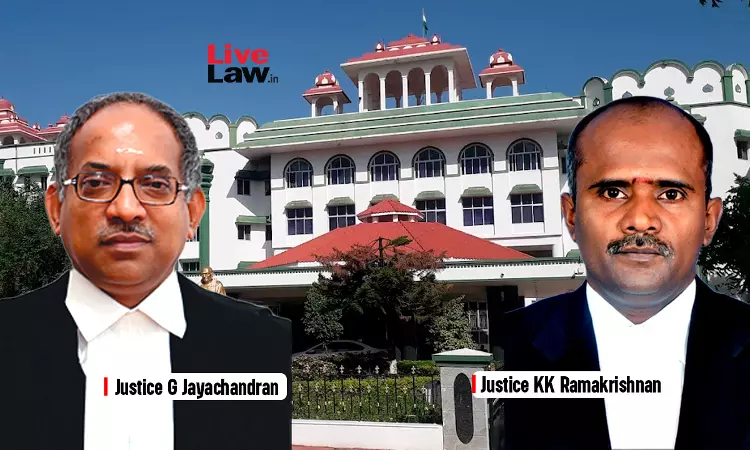
The Madras High Court has dismissed pleas by more than 300 families challenging the eviction proceedings initiated by the State government as part of upgrading the Madurai airport to an international airport. The bench of Justice G Jayachandran and Justice KK Ramakrishnan noted that the government had acted fairly and reasonably and had even granted additional compensation to the...
This is a premium content
Available exclusively to
Our subscribers
Subscribe Premium 
INR 1099+GST
Your support helps us to bring you more content at
an affordable subscription scheme !!!
All payment options available
The Madras High Court has dismissed pleas by more than 300 families challenging the eviction proceedings initiated by the State government as part of upgrading the Madurai airport to an international airport.
The bench of Justice G Jayachandran and Justice KK Ramakrishnan noted that the government had acted fairly and reasonably and had even granted additional compensation to the families, along with providing alternate housing.
“In this case, from the above discussion, it is clear that the Government has acted in a fair, reasonable, and magnanimous manner in granting additional compensation as per the Central Act, 2013, and also undertook to provide alternative house sites to the petitioners. In view of above extraordinary circumstances of the present case, this court has applied the foundational principle of Utilitarianism of “Bentham and Mill” that “greatest good for the greatest number of people”,” the court said.
The court was dealing with a batch of writ petitions filed to forbear the authorities from evicting the villagers without providing rehabilitation and resettlement assurance. Another batch of plea was filed to declare the provisions under Section 4(2) and 4(3) of the Tamil Nadu Acquisition of Land for Industrial Purposes Act 1997 as null and void and ultravires the constitution, or in alternative to harmoniously construct that provisions of Section 38 along with Schedule 2 and Schedule 3 of The Right to Fair Compensation and Transparency in Land Acquisition, Rehabilitation and Resettlement Act 2013 have to be read together with The Revival Act 38 of 2019 and Section 4 (2) and 4 (3) of The Tamil Nadu Acquisition of Land for Industrial Purposes Act, 1997 to provide the rehabilitation and resettlement before eviction.
The petitioners claimed that they belonged to the scheduled caste community and were living in the village in their own patta lands. They submitted that in 2009, the State issued notification to acquire lands for expansion of Madurai airport under Section 3(2) of the Tamil Nadu Industrial Purpose Act 1997. Compensation was granted by 2023 except for 30 families and the Special Tahsildar issued proceedings forcing the villagers to vacate their houses and lands.
The petitioners argued that they were not given reasonable compensation and the eviction proceeding was without providing proper resettlement and rehabilitation. The petitioners also argued that they belonged to the scheduled caste community and the act of the authorities, forcefully evicting them violates their fundamental rights under Article 21 and 300(A) of the Constitution. The petitioners also argued that they were entitled to a built house, 2 acres of agricultural land and other rehabilitation and resettlement package.
The State, on the other hand, submitted that it had compensation for land acquisition and even granted exgratia compensation as per Right to Fair Compensation Act 2013. Apart from the compensation, the state submitted that it had given 2 cents of house site near the acquired area and also agreed to give a built house in the property as part of special scheme using State funds.
The State submitted that the petitioners were seeking unjust agreement by not agreeing to the State's proposal. The State submitted that though the programme was initiated in 2009, it had not been completed due to the defiant attitude of the petitioners. The state also submitted that due to the petitioner's attitude, it was suffering escalation cost and was also unable to implement the project pf upgrading the airport.
The court noted that in the present case, the land acquisition was started in 2009, and thus, the provisions of the Right to Fair Compensation Act 2013 would not be applicable in the present case. Though the petitioners also claimed 2 acre of agricultural land, the court noted that there was nothing to show that they were involved in agriculture and thus, the demand could not be accepted.
“This Court finds every reason to reject the prayer of the writ petitioner to give resettlement and rehabilitation on the ground that the act of the writ petitioner to occupy the land after the receipt of the compensation and opposing the authorities to take over the possession under the guise of the caste , is nothing but abuse of process of law and also amounts to unjust enrichment and also justified the communication of the respondent to evict the petitioner by using force, which is permissible as per Section 4(3) of the State Act, 10 of 1999,” the court said.
Thus, the court was not inclined to accept the petitioner's case and directed them to vacate the premises within 2 weeks. The court added that if the orders were not complied with, it was open for the government to take possession by using force as authorised under the law. The court also asked the petitioners to submit their consent letter to the District Collector and directed the collector to allot 2 cents of land within 2 weeks.
Counsel for Petitioner: Mr. T. Lajapathi Roy, Senior Counsel For Mr. S. Lenin Prabu, Mr. A. Haja Mohideen
Counsel for Respondents: Mr. Veera Kathiravan Additional Advocate General Assisted by Mr. D. Sasikumar Additional Government Pleader, Mr. C. Godwin, Mr. P. Sundaravadivel
Case Title: P Malairajan and Others v. Government of Tamil Nadu
Citation: 2026 LiveLaw (Mad) 96
Case No: W.P.(MD).Nos.27922, 28131 and 29208 of 2024
Tags

Upasana Sajeev
Upasana Sajeev is a Principal Correspondent with LiveLaw, covering Madras High Court

