



- Home
- /
- High Courts
- /
- Madras High Court
- /
- 'CM Office Is Not So Fragile':...
'CM Office Is Not So Fragile': Madras High Court Grants Anticipatory Bail To DMK Councillor Who Abused Chief Minister Joseph Vijay
Upasana Sajeev
3 Nov 2026 9:45 AM IST
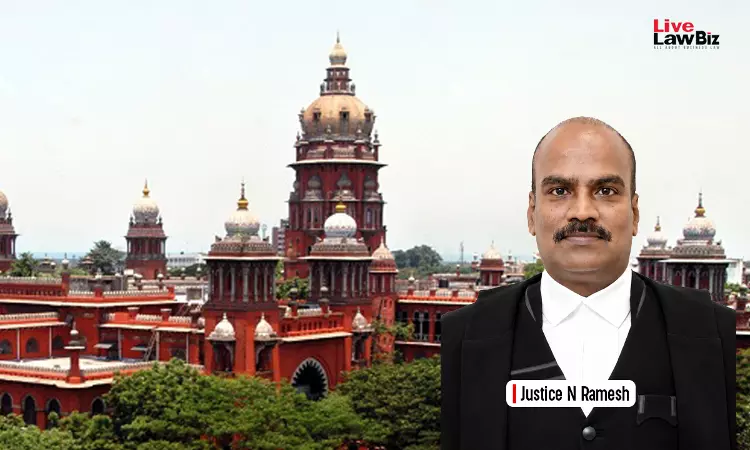
Political speech including hostile, intemperate criticism of those who hold public office, lies at the core of Article 19(1)(a), Court said.
The Madras High Court, on Monday (November 2), granted anticipatory bail to D Sudha, DMK's Councillor of Ward No 95 of the Greater Chennai Corporation in a case relating to her offensive speech against Chief Minister Joseph Vijay in a public function. [2026 LiveLaw (Mad) 524]Justice N Ramesh highlighted that political speech, however hostile it might be, was protected under Article 19(1) of...
This is a premium content
Available exclusively to
Our subscribers
Subscribe Premium 
INR 1099+GST
Your support helps us to bring you more content at
an affordable subscription scheme !!!
All payment options available
The Madras High Court, on Monday (November 2), granted anticipatory bail to D Sudha, DMK's Councillor of Ward No 95 of the Greater Chennai Corporation in a case relating to her offensive speech against Chief Minister Joseph Vijay in a public function. [2026 LiveLaw (Mad) 524]
Justice N Ramesh highlighted that political speech, however hostile it might be, was protected under Article 19(1) of the Constitution and could be limited only by reasonable restriction under Article 19(2) of the Constitution.
“Political speech, including hostile, unfair and intemperate criticism of those who hold public office, lies at the core of Article 19(1)(a), and may be restricted only on the grounds Article 19(2) enumerates, applied through the tests of incitement and of proximate, not conjectural, danger laid down in Kedar Nath Singh, S. Rangarajan and Shreya Singhal (all cited supra),” the court noted.
The court also observed that the office of the Chief Minister was not so fragile that a ward councillor's harsh speech could shake it. The court added that if the State resorts to arrest people for such words, it would be diminishing itself.
“Those who hold high office in a republic hold it on the term that they will be criticised, lampooned and, not rarely, abused. The office is not so fragile that a ward councillor's invective at a party meeting can shake it, and the State diminishes the office it claims to protect when it answers words of that kind with the machinery of arrest,” the court observed.
The court also remarked that a government that is sure of itself meets criticism with argument, mockery with performance and abuse with remedy of defamation.
“A government confident of itself meets criticism with argument, mockery with performance, and abuse— where it truly crosses the line—with the remedy the law of defamation provides. Magnanimity towards political speech is not a grace the State may extend or withhold; it is what the Constitution exacts of those who hold power over their critics. Seventy-five years into the Republic, as the Supreme Court observed in Imran Pratapgadhi (cited supra), our foundations are not so shaky that a speech can be treated as a threat to them,” the court observed.
The court observed that insult or defamation of a public functionary has to be remedied by initiating defamation proceedings and not by registering cases under the BNS. The court also noted that public order provisions under the BNS could not substitute for defamation proceedings as there are no two classes or communities, and no proximate danger of disorder.
In the present case, the prosecution had alleged that on October 7, 2026, during a function organised by the DMK party, Sudha had addressed the gathering and used derogatory and abusive language against the CM, referring to him as a “dog” and a “corpse”, along with other objectionable language.
The court noted that for 12 days after the speech was made, there was no complaint and only on October 19, a TVK party functionary had presented a complaint before the police station. Based on the complaint, a notice under Section 35(3) of the BNSS was served on her, and she had then approached the court for anticipatory bail.
Sudha also submitted an affidavit tendering an apology to the CM, with an undertaking of care and restraint in her future public utterances. She also filed an affidavit expressing respect for the court.
Sudha submitted that she was 60 year old, with no antecedents. She pointed out that the offences alleged against her carry a maximum sentence of 3 years and arrest in such cases is an exception. She also submitted that the speech, however intemperate, was against the head of a rival political party and there was no community or incitement. Sudha also submitted that all the materials in connection with the case was already with the police and no custodial purpose was pleaded.
The state, on the other hand, opposed the plea and submitted that the speech was not criticism but naked abuse of the holder of highest elected office in the State. It was also argued that the speech was calculated to set the cadres of rival parties against each other and the apprehension of repetition was not fanciful.
The court observed that before registering a case arising out of speech punishable with 3 years or more, the police must conduct a preliminary enquiry under Section 173(3) of BNSS. The court also noted that when the offence relates to words already recorded, custodial interrogation serves no investigative purpose.
The court also highlighted that in such cases, the police should have an even hand between the party in office and its opponents and not use arrest to threaten the opposition.
“An even hand between the ruling party and its opponents is not a courtesy the police extend; it is a condition of their constitutional legitimacy. The police serve the State, which endures, and not the party in government, which changes,” the court observed.
Considering all materials, the court was inclined to grant anticipatory bail on conditions and ordered accordingly.
Counsel for Petitioner: Mr. A. Damodaran for Mr. Thanasekar A
Counsel for Respondent: Mr. R. John Sathyan, State Public Prosecutor, Assisted by Mr. R. Rajasekaran Government Advocate (Crl.side)
Tags

Upasana Sajeev
Upasana Sajeev is a Principal Correspondent with LiveLaw, covering Madras High Court

