



- Home
- /
- High Courts
- /
- Madras High Court
- /
- Madras HC Directs Approval For...
Madras HC Directs Approval For Bangladeshi Mother's Kidney Donation To Minor Son, Says Authorisation Committee Considered Irrelevant Factors
Upasana Sajeev
3 Jun 2026 3:56 PM IST
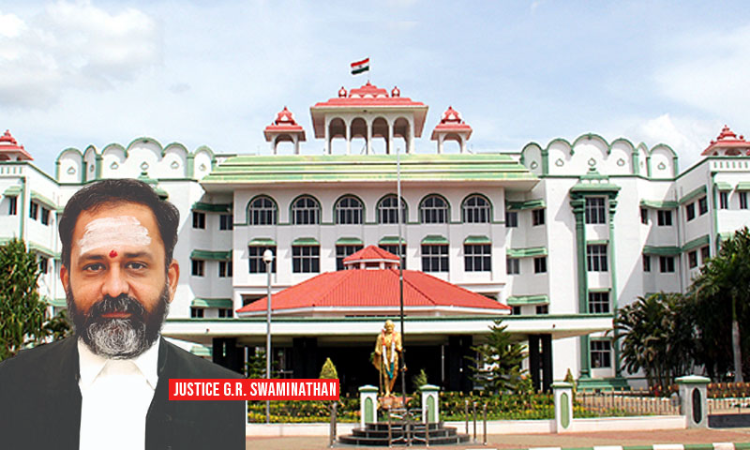
The Madras High Court recently directed the Authorisation Committee under the Directorate of Medical Education and Research to grant permission to a Bangladeshi mother to donate one of her kidneys to her minor son, who was suffering from end-stage renal chronic kidney disease. While doing so, Justice GR Swaminathan criticised the Authorisation Committee for denying permission...
This is a premium content
Available exclusively to
Our subscribers
Subscribe Premium 
INR 1099+GST
Your support helps us to bring you more content at
an affordable subscription scheme !!!
All payment options available
The Madras High Court recently directed the Authorisation Committee under the Directorate of Medical Education and Research to grant permission to a Bangladeshi mother to donate one of her kidneys to her minor son, who was suffering from end-stage renal chronic kidney disease.
While doing so, Justice GR Swaminathan criticised the Authorisation Committee for denying permission for transplantation on alleged suspicion about the spousal relationship between the minor's mother and father. The judge noted that the spousal relationship was irrelevant and the authorisation committee should have only considered whether the recipient was the son of the donor. The court thus held that the order was vitiated by irrelevant consideration.
“The approach of the Authorization Committee has to be interfered with for more than one reason. The only relevant question which the Committee should have posed to itself was whether the first petitioner (recipient) was the son of the second petitioner (donor). Whether the third petitioner was the husband of the second petitioner was irrelevant. It is well settled that if an administrative decision is vitiated by an irrelevant consideration, it is liable to be set aside. On this sole ground, the impugned order is set aside,” the court said.
The court also held that the committee should have approached the issue with more sensitivity. It held that by raising doubts on the spousal relationship of parents, the committee had stigmatised the minor. The court thus held that the order suffered from misdirection in law and utter non-application of mind.
“The committee should have been little more sensitive when holding that the relationship of the petitioners 2 & 3 has not been established. They have virtually stigmatised the first petitioner who is a minor child. The consequence that would be visited upon the first petitioner ought to have been duly taken note of,” the court said.
The court was hearing a petition filed by the minor, his mother, and father against the order of the Authorisation Committee, refusing to grant approval for kidney transplant. It was submitted that the minor was advised to undergo kidney transplant in November 2025 itself. however, due to the unstable political condition prevailing in Bangladesh, the parties were unable to obtain “e-Apostille certificate” from the Ministry of Foreign Affairs.
The e-Apostille certificate was obtained on February 15, 2026. The mother came forward to donate one of her kidneys and was found compatible. The authorisation committee conducted inquiry with the assistance of an interpreter. The application was however rejected on the ground that the spousal relationship between the parents was not proved.
The government, on the other hand, argued that there was large-scale human organ trafficking and the court should not ordinarily review the decision taken by the Expert Committee constituted for that purpose.
The court noted that the only question for consideration was whether the Authorisation Committee had adopted the right approach. The court noted that Rule 18 of the Transplantation of Human Organs and Tissues Rules 2014 has set out the procedure to be adopted. The court noted that as per the Rule, the authority has to satisfy itself regarding the genuineness of the documents produced by the applicants.
The court also highlighted that the Authorisation Committee's approach should be from a commonsense point of view. It added that if the documents produced by the applicants establishes near relationship by applying one's commonsense, an approval ought to be given. The court highlighted that the endeavour of the committee should not be to reject the application but to find out the truth.
In the present case, the court noted that the parties had submitted passports, visa, Application in Form I of the Donor / second petitioner, Notarized affidavit, HLA/DNA report in Form 5 dated 19.03.2026, Birth Registration Certificate of minor, 10th standard / SSC result of minor, national ID card issued by Bangladesh government, E-Apostille Certificate dated 15.02.2026 issued by the Chief Judicial Magistrate, Pabna and certified by the Assistant Secretary, Ministry of Foreign Affairs, Family Certificate dated 15.10.2025 issued by the Kashinathpur Union Parishad to the petitioners, Form 21 / Relationship Certificate and No-Objection Certificate issued to the petitioners 1 & 2 by the Bangladesh Deputy High Commission, Chennai and family photographs.
From the documents, the court said that it could be concluded that the parents were husband and wife and the minor was born to them through the wedlock.
Thus, the court held that the order of the Authorisation Committee had to be interfered with. The court set aside the order and directed the committee to grant permission immediately.
Counsel for Petitioner: N.Manoharan, R.Renukadevi, A.Adhishree, S.Shrish
Case Title: Minor Atonu Saha and Others v The State of Tamil Nadu and Others
Citation: 2026 LiveLaw (Mad) 234
Case No: WP No. 20140 of 2026
Tags

Upasana Sajeev
Upasana Sajeev is a Principal Correspondent with LiveLaw, covering Madras High Court

