



- Home
- /
- High Courts
- /
- Madras High Court
- /
- Madras High Court Upholds...
Madras High Court Upholds Invalidation Of Man's ST Certificate, Says Retirement Can't Protect Benefits Secured On False Claim
Upasana Sajeev
18 Sept 2026 4:36 PM IST
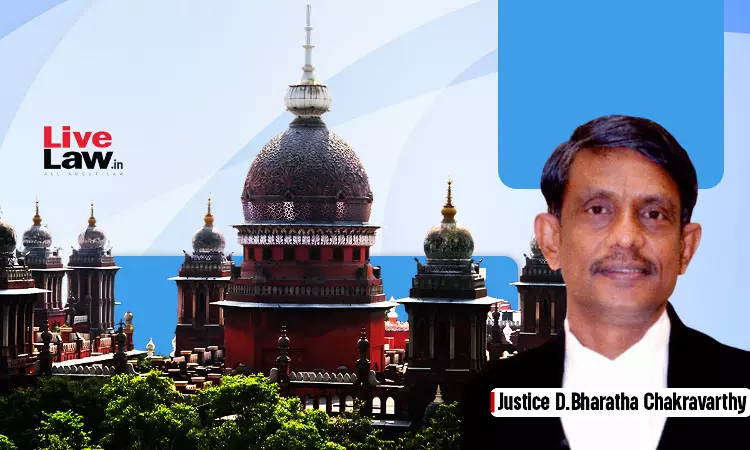
The Madras High Court has refused to interfere with the State Level Scrutiny Committee's finding that the community certificate held by a Chennai Port Trust employee was bogus, 40 years after his appointment. Though the employee had alleged that he was not given an opportunity of hearing, Justice Bharatha Chakravarthy noted that the proceedings had started immediately after...
This is a premium content
Available exclusively to
Our subscribers
Subscribe Premium 
INR 1099+GST
Your support helps us to bring you more content at
an affordable subscription scheme !!!
All payment options available
The Madras High Court has refused to interfere with the State Level Scrutiny Committee's finding that the community certificate held by a Chennai Port Trust employee was bogus, 40 years after his appointment.
Though the employee had alleged that he was not given an opportunity of hearing, Justice Bharatha Chakravarthy noted that the proceedings had started immediately after his appointment, way back in 1983, and the petitioner had been dragging on the issue by raising one or the other hyper-technical plea.
The court noted that it would be an abuse of the process of law if the matter is remanded back even after it was abundantly clear that the employee had secured the post falsely.
The court reiterated that fraud is anathema to every principle of law, and obtaining reservation benefits based on such fake documents is fraud on the Constitution. The court held that technical grounds and repeated remands could not aid such fraud.
“When it is abundantly clear that the petitioner has falsely secured the benefit and got appointment to the post and the caste has been rightly re-validated, repeatedly, if on one plea or the other, the matter is remanded back, any more remanding the matter back would make the very process of the petitioner approaching this Court under Article 226 of the Constitution of India as an abuse of process. Fraud is an anathema to every principle of law and the dictum of the Hon'ble Supreme Court of India is that obtaining of benefits of reservation amounts to constitutional fraud. Such constitutional fraud cannot be aided by technical grounds and repeated remands,” the court observed.
The court was hearing a petition filed by the employee, A Jegannathan. The petitioner claimed to belong to the Hindu Urali tribe, which was recognised as a Scheduled Tribe community in the State of Tamil Nadu. The petitioner was appointed as Mazdoor in Chennai Port Trust in 1980, and after 33 years of service, the petitioner attained superannuation in January 2013. However, since the verification of community was pending, the petitioner was granted only a provisional pension, and the full pension was withheld.
The petitioner argued that he was called for enquiry by the Vigilance Cell in January 2021. The petitioner argued that though he had submitted documents, the Vigilance Cell had submitted a report to the State Level Scrutiny Committee holding that he did not belong to the Scheduled Tribe community.
The petitioner further argued that when the Committee held an enquiry, he had raised an objection on the verification process being taken up at the gag end of the service. However, he argued that without giving sufficient time or without considering any of the documents in favour of the petitioner, the Committee passed its order holding that the petitioner did not belong to the Scheduled Tribe Community. This was challenged by the petitioner.
The petitioner argued that the verification was undertaken 40 years after the appointment, which was uncalled for. He also argued that his appointment was in the year 1992, and as per the National Commission for Scheduled Tribes, only caste certificate of those entering service after 1995 should be verified by the State Level Scrutiny Committee.
The Tamil Nadu State Level Scrutiny Committee, on the other hand, argued that immediately after the appointment, the petitioner's community certificate was sent for verification. However, when a notice was sent through registered post, it was returned as undelivered, stating that no one was living at the address. The authority argued that after perusing the school records, it was concluded that the community certificate of the petitioner was not genuine as he belonged to the Urali Gounder caste. Based on the District Collector's communication, the petitioner was discharged from service in 1990. However, the same was challenged and the court disposed of the plea, directing that the petitioner be given an opportunity of hearing.
After the State Level Scrutiny Committee was set up, the matter was referred to the committee. However, due to multiple rounds of litigation, the enquiry kept pending.
The court noted that the order of the Committee was challenged mainly on the ground that the verification could not be taken up after superannuation and that the community certificates for appointments made before 1995 should not be taken up for verification.
The court noted that as per the order of the full bench of the Madras High Court, the verification could be undertaken for employees who were appointed after 1995 and even after their superannuation. The court also noted that the petitioner had been given an opportunity of hearing but had been stalling the verification process till 2021.
“Thus, it is clear that from the very beginning, from the year 1985, the petitioner has adopted a conscious and well-calculated strategy: he will always seek adjournment on one pretext or the other and will not appear before any authority verifying his certificate and protract the matter and enjoy the benefits, depriving an unknown genuine scheduled tribe person who, despite having suffered the social stigma, is refused the constitutional benevolence shown by the Nation. Thus, the findings and conclusion reached by the State Level Scrutiny Committee cannot be interfered with,” the court said.
Thus, noting that the petitioner should not be permitted to gain other benefits, the court was not inclined to grant the relief prayed for. The court thus dismissed the plea and directed the Chennai Port Trust to act upon the order of the Committee and pass further orders.
Counsel for Petitioner: Mr. V. Vijay Shankar
Counsel for Respondent: Mrs. Inthu Karunakaran, Special Government Pleader, Mr.R.Karthikeyan
Case Title: A Jegannathan v The Chairman
Citation: 2026 LiveLaw (Mad) 452
Case No: WP Nos 12138 of 2020 and 22361 of 2021
Tags

Upasana Sajeev
Upasana Sajeev is a Principal Correspondent with LiveLaw, covering Madras High Court

